


 SINTESIS: Marxismo, liberalismo y políticas de la diferencia (Nestor Kohan). De los generales Videla y Pinochet a la guerra psicológica de Hollywood. Doctrina contrainsurgente, hegemonía y fabricación industrial del consenso. De Popper, Isaiah Berlin y Fukuyama a Friedman, von Hayek, von Mises y Alsogaray. ¿Marxismo = totalitarismo? ¿Neoliberalismo = libertad? La antiutopía “1984” de Orwell realizada: el capitalismo actual y el fin de la intimidad. ¿Es posible la disidencia? Multiculturalismo, socialdemocracia y políticas de la diferencia. Ernesto Laclau, Judith Butler y Bruno Bauer. ¿Es realmente “crítico” y “radical” el horizonte de las reformas institucionales? “Emancipaciones” posmodernas, disidencias controladas y revolución socialista. Libertad negativa: ¿ser propietario = ser libre? De Galileo Galilei y Thomas Hobbes a 1789. La concepción de la libertad en Marx. De LA CUESTION JUDIA y los ESCRITOS SOBRE IRLANDA a EL CAPITAL. Libertad como conciencia de la necesidad y libertad más allá de la necesidad material. Libertad como realización en comunidad. Trabajo y tiempo libre. La libertad en el plano individual, en el comunitario y a escala global. Proyecto Memoria del futuro: BRANCALEONE FILMS y CATEDRA CHE GUEVARA: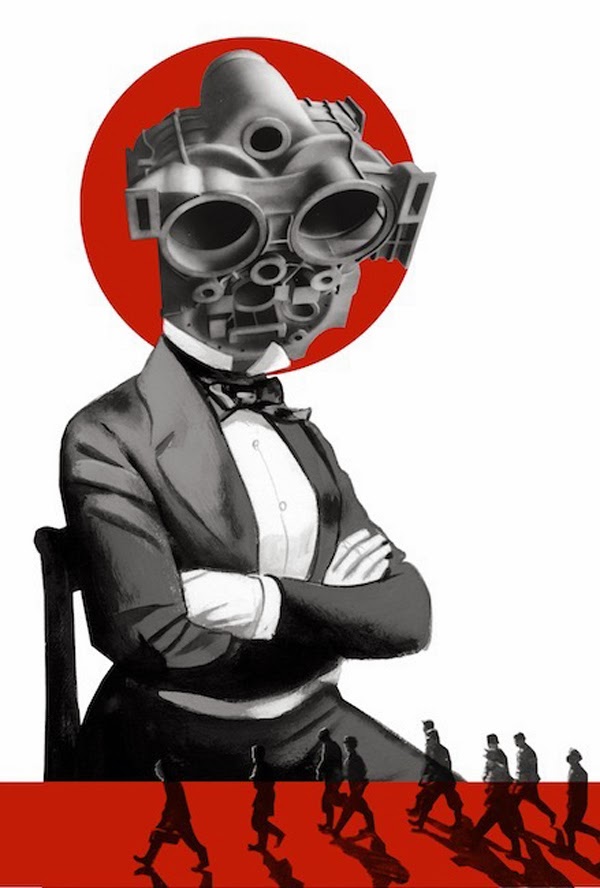
Introduction
When Sergei Eisenstein died on the 11th of February 1948, a post-mortem examination was conducted to establish the cause of death. His body was subjected to a dissection and his brain was exposed, measured and photographed. The photographs of Eisenstein’s brain were kept by his friend of thirty years, neuropsychologist Alexander Luria, who would show them to his students to illustrate the asymmetry of the brain’s hemispheres. Eisenstein’s brain featured a dramatically enlarged right hemisphere, which is responsible for visual images and spatial information processing, while his left hemisphere was of a normal size.[1] This striking image provides an apt illustration for one of the most challenging and enduring intellectual projects at the intersection of film theory, psychology and philosophy: that of trying to understand how mind, brain and cinema interact. It was also a postscript to Eisenstein and Luria’s scientific collaboration, which at various stages included the linguist Alexander Marr and cultural psychologist Lev Vygotsky. The research program they carried out, from the mid-1920s until Eisenstein’s death, aimed to combine neuroscience, social sciences, and cinema theory to address the neural basis and semiotics of screen aesthetics.
This collaboration reveals and confirms Eisenstein’s status as a theoretician with broad interdisciplinary interests, as has been increasingly acknowledged in the scholarly literature.[2] As Francesco Casetti notes: “In Eisenstein we find a constant urge to operate in the interstices of different sciences, between linguistics and anthropology, between psychology and aesthetics, between the history of art and biology.”[3] While some aspects of Eisenstein’s theoretical activity – such as his engagement with linguistics and anthropology [4] – have been explored more extensively, his extensive engagement with the emerging discipline of psychology in the first half of the 20th century remains underestimated.
Leer más…
 A propósito de las 16 tesis de economía política
 Manuel Sacristán. Translated and edited by Renzo Llorente
 “La cruda contemplación de la gran convulsión de los intereses
 A continuación presentamos la introducción del libro Para qué sirve El Capital: un balance contemporáneo de la obra principal de Karl Marx, publicado por
  La lógica de El capital y el concepto de Valor
 Neil Davidson, in an excerpt from his new book, defends Walter Benjamin from sectarian dismissals and academic obscurantism.
 En este programa temático de
  La crítica de Carlo Benetti a la derivación de la necesidad de dinero (Benetti 1990, pp. 163-69) es muy conocida en México y es ampliamente aceptada (por ejemplo Hernández) (aunque no aceptada universalmente, por ejemplo Robles).


















 marxismocritico.com