
Archivo
«Developing Realistic Philosophy: From Critical Realism to Materialist Dialectics»: Andrew Brown
 Abstract
This paper compares the (relatively little known) ‘materialist dialectics’ of E.V. Ilyenkov to the ‘critical realism’ and ‘dialectical critical realism’ of Roy Bhaskar. The latter author specifies an ontology of ‘emergence’ and ‘stratification’. He demonstrates that, not only a critique of postmodernism, but an outflanking of much contemporary Marxist work can be achieved on the basis of such an ontology. For example, the ‘new dialectics’ interpretation of Marx and Hegel (Arthur 1993) remains largely silent on the ‘emergence’ of thought from material body; yet, critical realism shows that a specification of the mind-body relation is of utmost importance. Not despite, but because of its great strength, the paper undertakes an ‘immanent’ critique of the critical realist ontology. Drawing upon Ilyenkov’s interpretation of Spinoza, the paper argues that the critical realist articulation of stratification and emergence collapses into (essentially Humean) scepticism. The underlying reason for this collapse is argued to be the non-identity of thought and being generated by the critical realist theory of mind. On Ilyenkov’s interpretation, Spinoza’s articulation of mind and body sustains the materialist identity, as well the opposition, of thought and being. Through this identity-of-opposites, the notions of ‘stratification’ and ‘emergence’ are preserved but raised to a new conceptual level. Ilyenkov’s novel interpretation of Spinoza has far reaching implications. These are illustrated via a brief re-examination of the Marx-Hegel relation.
«Vygotsky y el método dialéctico»: Andy Blunden
 Traducción: Efraín Aguilar
Los siguientes comentarios acerca del trabajo de Vygotski son parte de una discusión sobre la aplicación del método dialéctico. Están basados en «Thought and Language«, publicado por MIT Press en 1962 y reimpreso en 1980.
El enfoque de Vygotski
1. La noción del significado de la palabra
Vygotski observa que el estudio previo de la relación pensamiento-lenguaje consideraba de modo aislado la génesis de cada parte de la relación y asumía que la relación entre las dos era invariable; o alternativamente, las dos eran identificadas mecánicamente. Al contrario, Vygotski propuso la necesidad de concebir el objeto de investigación como una unidad de opuestos y que la génesis inherente de la relación estaba en su esencia misma.
“En opinión nuestra el curso correcto a seguir es usar otro tipo de análisis, que puede ser llamado análisis dentro de las unidades. Por unidad entendemos un producto del análisis que, a diferencia de los elementos, retiene todas las propiedades básicas del todo y que no puede ser dividido sin perderlas… [la célula viva] ¿Cual es la unidad básica del pensamiento verbal?… el significado de la palabra… La concepción del significado de la palabra como unidad tanto del pensamiento generalizante como del intercambio social es de incalculable valor para el estudio del pensamiento y el lenguaje” [Thought and Language, Chapter 1].
«Filosofía y materialismo. Adolfo Sánchez Vázquez y Alfred Schmidt»: Stefan Gandler
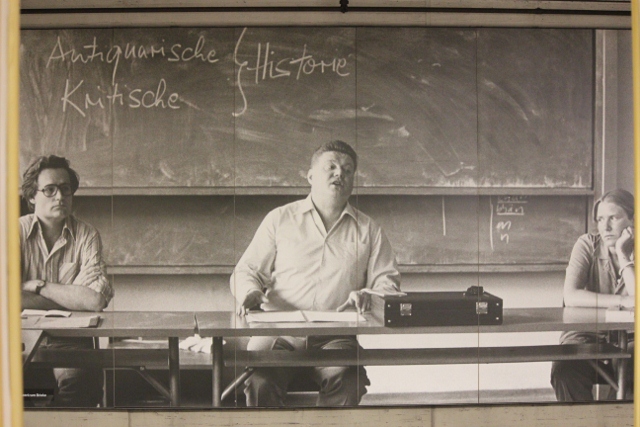 Adolfo Sánchez Vázquez y la Teoría Crítica de la sociedad tienen en común, a pesar de varias diferencias importantes, el partir de una interpretación de Marx y del marxismo sin caer en el dogmatismo predominante hasta los años ochenta del siglo XX. En lo siguiente vamos a concentrarnos, en lo referente a la tradición de la Teoría Crítica a uno de los seguidores, alumnos y colaboradores más importantes de Horkheimer, Adorno, Marcuse, Benjamin y Neumann, muy probablemente el más relevante entre los hoy en día vivos: Alfred Schmidt. Aparte de la gran seriedad con la cual ha desarrollado sus trabajos, también es indicada esta decisión por el hecho que Schmidt es el autor de esta tradición teórica que más conocimiento directo tiene de la obra de Marx.
Para Adolfo Sánchez Vázquez, como también para los autores de la Teoría Crítica, una de las cuestiones filosóficas fundamentales es la de la relación entre el idealismo y el materialismo (premarxiano) y la del carácter, al fin y al cabo materialista, de una interpretación de Marx orientada a la praxis.[1]
«Vitali Vygodsky: un clásico del marxismo»: Jaime Ortega Reyna y Víctor Hugo Pacheco Chávez
 Resumen
El presente trabajo busca aportar elementos tanto biográficos como de análisis en torno a la obra del intelectual soviético Vitali Vygodsky. Dicho autor contribuyó, de manera decisiva, durante el siglo XX al esclarecimiento de los principales problemas de la teoría marxista y la crítica de la economía política. Su obra representa una renovada versión del marxismo en el seno del antiguo bloque socialista. El artículo rastrea datos biográficos, de la recepción de su obra e introduce un análisis sucinto de sus principales obras.
Palabras clave: marxismo, Unión Soviética, Vygodsky
Cuando alguien escucha pronunciar el apellido Vygodsky de inmediato puede evocar al gran psicólogo soviético Lev Semionoviche Vygotsky (1896-1934) que dedicó su vida a entender los problemas del lenguaje y el pensamiento. Sin embargo, en este artículo queremos referirnos a otro Vygodsky, que lleva por nombre Vytaly (o Vitali) Solomonovich y que fue uno de los máximos exponentes del marxismo desarrollado en la Unión Soviética. Desconocemos sí entre ambos personajes existió algún vínculo familiar. Lo que sí podemos afirmar con seguridad es que ambos tuvieron una afinidad intelectual electiva: el estudio, en muy distintas áreas del conocimiento, de la obra de Carlos Marx.
«Los diez principios de la psicología histórico-cultural»: Moisés Esteban Guitart
 Resumen
Según la psicología cultural no es posible entender la conducta y mente humana sin analizar el contexto histórico, institucional, social y cultural en el que se expresa y se desarrolla. Bajo esta perspectiva, el fenómeno psicológico es el producto y resultado de la participación en situaciones y actividades socioculturales a través de las cuales las personas se apropian del conjunto de artefactos valorados por una comunidad en un momento histórico determinado (la lengua, oral y escrita, la notación matemática, el uso de las nuevas tecnologías). El origen de estas ideas se encuentra en la escuela histórico- cultural liderada por Vygotski, en la antigua Unión Soviética. En el artículo se exponen diez principios asumidos por esta escuela: 1) la conciencia humana como objeto de estudio; 2) la génesis social de la conciencia y conducta humana; 3) el principio de la significación; 4) el desarrollo cultural de la conducta humana; 5) los cuatro estadios en el dominio de signos; 6) el principio de la mediación; 7) el carácter práctico de la actividad humana; 8) la función planificadora del lenguaje; 9) la “zona de desarrollo próximo” y, finalmente, 10) el método dialéctico.
Palabras clave
psicología cultural – escuela histórico-cultural – Vygotski – mediación semiótica – zona de desarrollo próximo.
«Marx’s Method in Capital»: David Harvey and Alex Callinicos
Marx’s Method in Capital
David Harvey & Alex Callinicos
Marxism 2012 Conference
London | July 2012
Richard Levins on Dialectics
 Dialectics is a way of dealing with complexity and change in the natural and social sciences.
Richard Levins is an ex-tropical farmer turned ecologist. He has engaged in activist and theoretical struggles for Puerto Rican independence, against wars and imperialism, for ecological agriculture in Cuba and against reductionism in science.
«La dialéctica del trabajo abstracto, valor y precio»: Mario Robles L. Báez
 Nuestra conceptualización del así llamado ‘problema de la transformación de los valores de las mercancías en precios de producción’ responde a un interpretación particular de la dialéctica de la inversión de Marx, es decir, de la negación de la ley basada en el valor y el plusvalor, que corresponde a la presentación del momento del capital-en-general donde “el precio” es “determinado por el trabajo”, por la ley basada en la libre competencia, que corresponde a la presentación del momento de la multiplicidad del capital donde “el trabajo” es “determinado por el precio” (G.2: 175). Con base en esta inversión, el ‘problema de la transformación’ de Marx es re-conceptuado como un doble movimiento inverso en él que, en el primer movimiento, se transforman los ‘valores’ de las mercancías en ‘precios de producción’ y, en el movimiento inverso, se transforman los ‘precios de producción’ a los ‘valores’ finales y definitivos de las mercancías. Como además concebimos que el ‘problema de la transformación’ y el ‘problema de la reducción’ del trabajo están dialécticamente relacionados, sostendremos que es precisamente por medio de la determinación de los ‘precios de producción’ y, por lo tanto, de los ‘valores’ finales de las mercancías en cuanto productos del capital que se resuelve la reducción de los diferentes tiempos de trabajos en sentido fisiológico-abstractos, directos e indirectos, de diferente complejidad e intensidad objetivados en la producción de las mercancías en las diferentes ramas de la producción a tiempos de trabajo social-abstracto puestos o validados socialmente por el capital productivo como un todo en la circulación.
«Abstraction versus Contradiction: Observations on Chris Arthur’s The New Dialectic and Marx’s ‘Capital’»: Roberto Finelli
 Abstract
This intervention concerns the different statute of abstraction in Marx’s work. By means of a critical confrontation with Chris Arthur’s work, Finelli presents his thesis of the presence of a double theory and fuction of abstraction in Marx’s work. In the early Marx, until the German Ideology, abstraction is, in accordance with the traditional meaning of this term, a product of the mind, an unreal spectre. More exactly, it consists in negating the common essence belonging to labouring humanity and projecting it, as alienated universal, into the idea of philosophy, into the state of politics and into the money of the market. In the later Marx, the nature of abstraction is, rather than mental, practical. It is directly related to the quantity without quality of capitalist labour, and it is the product of the systemic connection of machines to labour-power. In contrast to Arthur, Finelli maintains that practical abstraction in the Marx of Capital is not located in the zone of exchange and the market, where there is the mediation of money. On the contrary, it is located in the zone of production, which, for Marx, is a social ensemble not mediated by money but by relations of technological domination.
Keywords
abstraction, formal determination, presupposed-posited, opposition-contradiction, abstractionemptying out, dissimulation. The New Dialectic and Marx’s ‘Capital
«The russian spinozists»: Andrey Maidansky
 ABSTRACT. The article deals with the history of Russian Spinozism in the 20th century, focusing attention on three interpretations of Spinoza’s philosophy – by Varvara Polovtsova, Lev Vygotsky, and Evald Ilyenkov. Polovtsova profoundly explored Spinoza’s logical method and contributed an excellent translation of his treatise De intellectus emendatione. Later Vygotsky and Ilyenkov applied Spinoza’s method to create activity theory, an explanation of the laws and genesis of the human mind.
KEY WORDS: philosophy of Spinoza, Spinozism, Polovtsova, Vygotsky, Ilyenkov, Russian Marxism, activity theory, logical method
When looking over the legion of interpretations which have escorted Spinoza’s philosophy in the course of the past three centuries, one immediately recalls an ironic phrase of the scholastics: auctoritas nasum cereum habet. It seems that Spinoza’s teaching has been interpreted in all possible ways. It was already Hegel who had sufficient reason to complain that Spinoza’s doctrine had been too often judged in a rough and ready manner.1 In Russia of XIX century this ordinary state of affairs was complicated by a generally hostile attitude towards the philosophy of Spinoza. Though his doctrine appeared at the epicenter of impassioned polemics with the participation of leading Russian philosophers – Vladimir Solov’ëv, Alexander Vvedenskij, Lev Shestov, Semën Frank, – not one of them declared his devotion to Spinoza’s teaching. Only somewhat later would V. Polovtsova, L. Vygotskij and E. Il’enkov devote themselves to continue his inquisitio veri. They had to go against the general current of Russian philosophy, although at times the latter was becoming more sympathetic to Spinoza’s (or rather to alleged Spinozistic) ideas. I do not intend here to survey the various Spinozistic tendencies in Russian philosophy; I would like to explore somewhat of its Spinozistic “mainstream.”
«The Labour Theory of Value: Materialist versus Idealist Interpretations»: Andrew Brown
 This paper presents a novel interpretation and affirmation of Marx’s initial arguments for the labour theory of value in Capital. The materialist principles that (i) powers are materially based, and (ii) ‘labour’ articulates nature and society, are developed so as to validate and emphasise Marx’s opening arguments. The argument is presented as a novel addition to existing critiques of ‘systematic dialectics’ and of ‘value form theory’. Though having some resemblance to critical realism, the materialist and dialectical underpinnings of the argument are drawn from the philosophy of E.V. Ilyenkov.
Keywords: Capitalism; Dialectics; Labour Theory of Value; Marxism; Methodology
Introduction
Amongst the current literature on Marx’s method, a group of authors including Arthur (e.g.
2002b), Reuten (e.g. 2004a), Smith (e.g. 1990) and Williams (e.g. 2001) have, in recent years, advanced our understanding of Marx and hence of capitalism very significantly. These authors have articulated the need to develop a comprehension of capitalism systematically from abstract to concrete with great clarity, drawing explicit inspiration from Hegel (Brown, Slater and Spencer, 2002). They argue, in different ways, that Marx tries to break free from classical political economy through the employment of this essentially Hegelian method of ‘systematic dialectics’ (despite Marx’s own critique of Hegel).
«Marxismo crítico en México: Adolfo Sánchez Vázquez y Bolívar Echeverría»: Stefan Gandler
 El Fondo de Cultura Económica pondrá a circular en breve el libro Marxismo crítico en México: Adolfo Sánchez Vázquez y Bolívar Echeverría, en el que el autor, el filósofo alemán Stefan Gandler, reivindica las aportaciones que esos dos pensadores mexicanos han hecho a la filosofía mundial, con un punto de vista contrario al eurocentrismo imperante en los estudios filosóficos. Como una primicia para los lectores de La Jornada, ofrecemos las primeras páginas de este libro a manera de adelanto. Se trata del prólogo que escribió Michael Lowy y que a su vez, también a contracorriente de los usos y costumbres del ámbito académico, no sólo ubica, reseña, alumbra hacia el contenido del libro, sino que infunde un saludable espíritu crítico al mismo
Este hermoso libro nos habla de la contribución latinoamericana -en este caso, mexicana- a la renovación del marxismo crítico.
Stefan Gandler logró no sólo exponer, de manera profunda y coherente -¡pero no acrítica!-, el pensamiento de Adolfo Sánchez Vázquez y Bolívar Echeverría, su biografía, la evolución de sus ideas, la bibliografía completa de sus obras, sus convergencias y divergencias, sino también aportó la demostración de que la ruptura con el eurocentrismo es una condición indispensable para una verdadera universalización de la teoría crítica.
«Spinoza, Ilyenkov and Western Marxism – meeting the challenges of the global crisis»: Corinna Lotz and Penny Cole
 Introduction
Evald Ilyenkov took Spinoza’s philosophy as the starting point for his own critique of positivism and mechanical materialism. While this assumed a strictly philosophical form, its political source was Ilyenkov’s profound conviction that a turn towards materialist dialectics was critical for the future of the Soviet Union.
Ilyenkov’s position as an “orthodox heretic” philosopher may help to explain why he identified so closely with Benedict Spinoza. Like Spinoza some 300 years earlier, he was a child of his time, but in equally deep conflict with proponents of dogma. In Spinoza’s case it was religious dogma, in both its Judaic and Christian forms. With Ilyenkov it was Marxist dogma turned into a state religion through Stalinism – and dogma’s ugly sister – the mechanistic positivist scientism which invaded Soviet philosophy during the 1960s. Ilyenkov championed those sides of the 17th century philosopher’s ideas which made a decisive impact in the late 18th century on Hölderlin and Hegel, and later on Feuerbach, Marx and Engels. He drew on Lenin to establish materialist dialectics once again as the theory of knowledge of Marxism. Like Lenin, Ilyenkov found himself swimming against the tide but was not deflected from his goals.
«Marx’s Theory of the Money Commodity»: Anitra Nelson
Abstract
Marx defines the commodity in a unique way. His theory of the money commodity is a unique commodity theory of money. It developed from a political critique of the utopian socialists’ concepts of money, labour time and exchange value. Besides using Hegel’s dialectical method, Marx also adapted certain ideas from his elaboration of ‘measure’ in the Logic to develop his concept of money. Similarly his framework for relating ‘price’, which appears in circulation, and ‘value’, the essential relation in production, can be compared with Hegel’s passages on the ‘force’ and its ‘manifestation’ in the Phenomenology of the Spirit. These influences on Marx’s thoughts on money appear in the Grundrisse but inform the final version of his theory of money in Capital I, too.
1 Introduction
Marx was a nineteenth century political intellectual unconstrained by the disciplinary rigour or specialisation insisted on by late twentieth century academia. Marx’s writings can be studied as sociology, philosophy, politics, economics, history, even as literature, though if studied from simply one perspective his work loses much of its richness and original message. An interdisciplinary approach is especially pertinent to Marx’s theory of money, which is definitely not just an economic theory. Marx was a scholar and a revolutionary. The development of his unique concept of money seems to have been strongly influenced by his background in Hegelian and Young Hegelian philosophy as well as by his political views. Certainly if looked at purely as an economic theory various aspects of it make little sense.
Reading Marx’s Capital with David Harvey

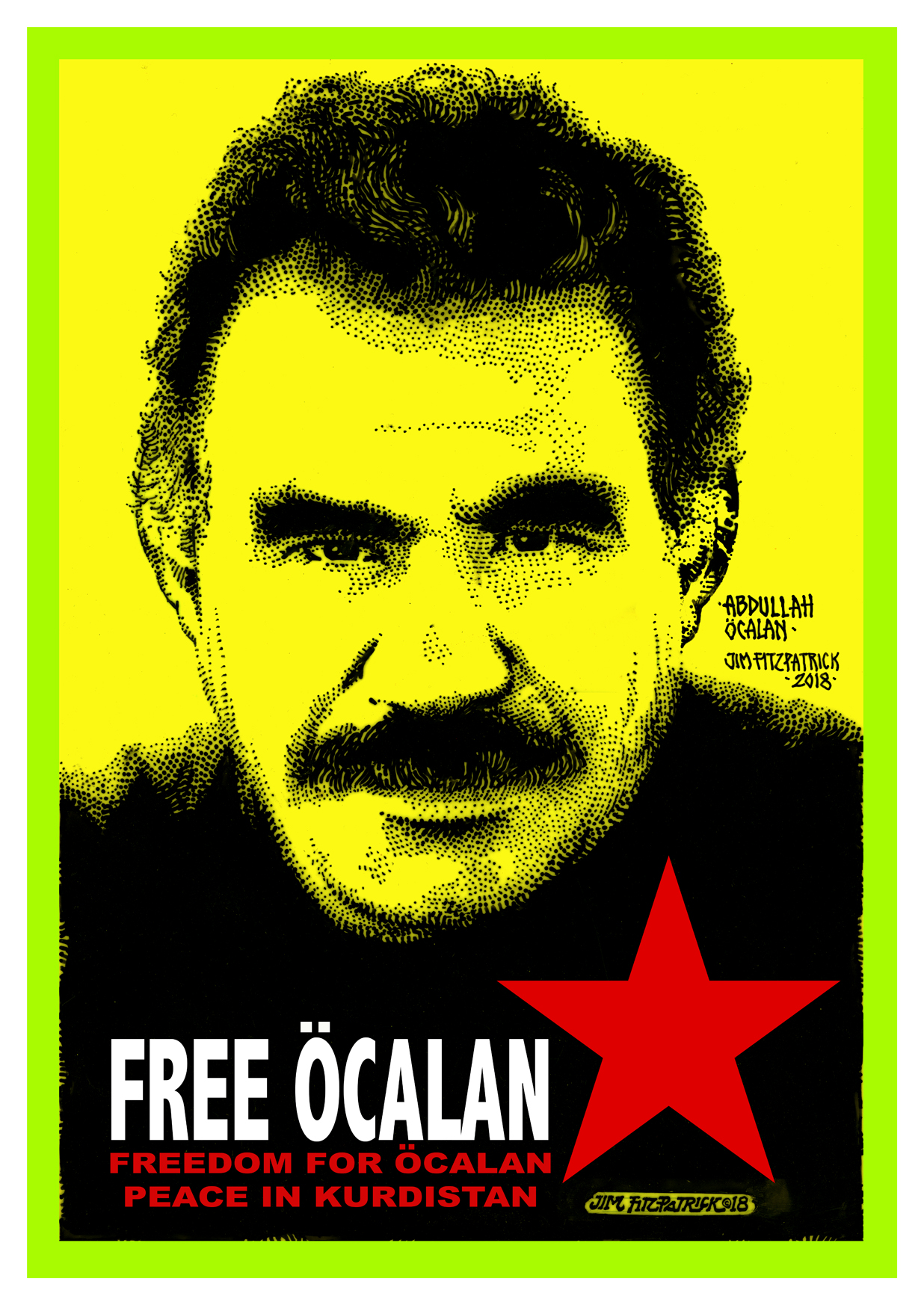
Free Öcalan


Fundación Infancia y Aprendizaje

Colección de libros Marxismo Crítico

Historical Materialism


CIPEC (Centro de Investigación en Pensamiento Crítico)

Centro para la Investigación como Crítica Práctica

Memoria Revista de Crítica Militante

Revista Laberinto






Marx desde cero




 marxismocritico.com