
 It is common to understand the diverse «processes» in Latin America — in the period marked initially by Zapatismo in the mid-1990s and later by the emergence of left or popular governments in Venezuela, Bolivia, and Ecuador along with center-left governments in Brazil, Uruguay, and Argentina — within the theoretical framework of a return or recuperation of the left following the fall of the East Bloc. This kind of formulation has a number of problems. On the one hand, it is too optimistic (since the left is still in retreat and the tide of the neoliberal counterrevolution has not been turned). On the other hand, it misses the specificity of the processes: the way in which they were notable attempts to reinvent or rediscover left politics after the eclipse of strategic political thinking shared by both official Marxism and by the «end-of-history» view that emanated from the right wing.
  Congreso Internacional
 Recently I. Elbe reconsidered ‘the new readings of Marx in BRD since 1965’ in his book amounting to 600 pages. ( Cf. Elbe 2010 ) Above all the first chapter ‘Basic reflections of value theory’ has interested me. So I also would like to retrospect ‘the new readings of Capital in Japan since 1960s’.
 Text from
 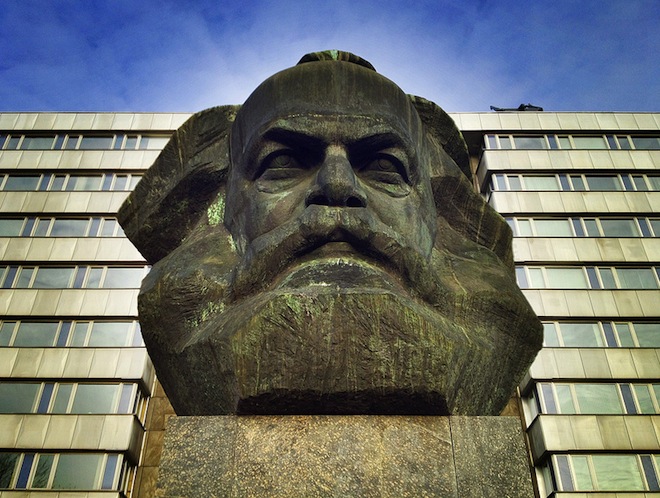 The objective of the following observations is to offer a rough overview of central ways of reading Marx’s theory. These are to be presented – by means of a few selected topics – as Marxisms that can be relatively clearly delimited from one another, and the history of their reception and influence will be evaluated with regard to the common-sense understanding of “Marxist theory.”
A distinction will be made between the hitherto predominant interpretation of Marx, primarily associated with political parties (traditional Marxism, Marxism in the singular, if you will), and the dissident, critical forms of reception of Marx (Marxisms in the plural), with their respective claims of a “return to Marx.” The first interpretation is understood as a product and process of a restricted reading of Marx, in part emerging from the “exoteric” layer of Marx’s work, which updates traditional paradigms in political economy, the theory of history, and philosophy. Systematized and elevated to a doctrine by Engels, Kautsky, et al, it succumbs to the mystifications of the capitalist mode of production and culminates in the apologetic science of Marxism-Leninism. The other two interpretations, specifically Western Marxism as well as the German neue Marx-Lektüre (“new reading of Marx”), usually explore the “esoteric” content of Marx’s critique and analysis of society, often consummated outside of institutionalized, cumulative research programs, by isolated actors in the style of an “underground Marxism.”
In order to characterize both ways of reading, some strongly truncated theses, limited to a few aspects, must suffice. In particular the ambitious proposition, first formulated by Karl Korsch, of an “application of the materialist conception of history to the materialist conception of history itself” – one that goes beyond the mere presentation of intellectual history, towards an immanent theoretical critique that critically considers the connection between historical forms of praxis and theoretical formations of Marxism – cannot be carried out here. In addition, a consideration of those readings which are critical of Marx or Marxism can also be disregarded here, insofar as their picture of Marx usually corresponds to that of traditional Marxism.
I therefore begin with the hegemonic interpretative model of traditional Marxism, and only at the end of my presentation will I conclude with a few positive determinations of what I regard as the fundamental systematic intention of Marx’s work. I do this primarily because a differentiated reading of Marx’s work can only be gained in the course of the learning processes of Western Marxism and the neue Marx-Lektüre. Leer más…
 RESEÑA DE LA ECONOMÍA ARGENTINA EN SU LABERINTO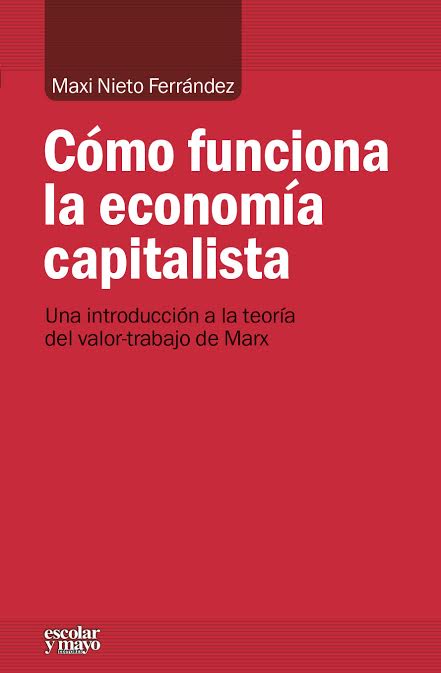
 Coloquio Internacional
 Existen dos vertientes generales dentro de la teoría económica marxista por la manera en que determinan los conceptos más relevantes (el valor, los precios, la tasa de ganancia, etc.): la simultaneista y la temporalista.
 Lo que sigue es el epílogo (escrito en el mes de julio de 2015) al libro
  A team based at the
  Presentamos la conferencia de la Dra. Frigga Haug, especialista en la obra de Rosa Luxemburg y quien nos presenta un acercamiento desde el feminismo a la obra de dicha autora. El acercamiento propuesto involucra directamente la concepción de la política de la autora polaca».
  Mucha gente piensa que las cooperativas son empresas pequeñas y de propiedad local, como tiendas de comestibles, cafeterías o tiendas de bicicletas, que ofrecen a las personas la oportunidad de traba-jar en organizaciones no-capitalistas, igualitarias y participativas. En reali-dad, el movimiento cooperativista estadounidense está vinculado a agen-cias federales cuya agenda está promoviendo el neoliberalismo, tanto en el interior del país como en el extranjero, y los propios líderes del movi-miento cooperativista son de ideas neoliberales. Muchas de las llamadas cooperativas son, en la práctica, empresas capitalistas guiadas por el áni-mo de lucro. Incluso en lo abstracto, los principios cooperativistas de las cooperativas más pequeñas hacen posibles las políticas cooperativas neo-liberales. Todo esto, no obstante, plantea la cuestión de qué habría de ser una cooperativa basada en valores socialistas, y el pueblo chino de Nanjie representa un ejemplo vivo de ello.
  En un artículo para The Prime Russian Maganize (en su edición sobre el Marxismo), el poeta Alexei Tsvetkov escribió este retrato de Évald Iliénkov, el último Marxista Soviético y una de los más grandes y originales pensadores de la Unión Soviética. Tsvetkov nos ofrece un retrato de una figura realmente única cuyas obras merecen ser releídas y traducidas, pero también un retrato poco habitual de los tiempos y la atmósfera en la que vivió.



















 marxismocritico.com