
Archivo
Segunda sesión del Seminario Marx Revisitado: «Michael Heinrich, ¿Cómo leer El Capital de Marx?»: Luis Arizmendi y Alejandro Fernando González
 2da. Sesión 20 de marzo:
Michael Heinrich, ¿Cómo leer El Capital de Marx? Indicaciones de lectura y comentario del comienzo de El Capital, Escolar y Mayo Editores, 2011. Comentan: Mtro. Luís Arizmendi y Lic. Fernando González
«Entrevista a Andrew Kliman»: Esteban Mercatante
 A continuación publicamos una conversación con el marxista norteamericano Andrew Kliman. Kliman es autor de Reclaiming Marx’s “Capital”, que defiende el llamado enfoque temporalista de la teoría del valor de Marx, y de The Failure of capitalist production. The Underlying causes of the Great Recession [El fracaso de la producción capitalista, las causas subyacentes de la Gran Recesión]. Es profesor en la Universidad de Pace. En esta oportunidad conversamos sobre su visión de la crisis, su teoría sobre la ley del valor, y sus opiniones sobre la situación del marxismo en los EE.UU.
Entrevista realizada en Julio de 2012
1- Recientemente publicaste The Failure of Capitalist Production [El fracaso de la producción capitalista], que es el resultado de una investigación sobre el funcionamiento de la economía norteamericana durante las últimas tres décadas. ¿Cuál es el principal resultado de tu investigación?
La Gran Recesión estaba a la espera de ocurrir. Había problemas no resueltos en el sistema de producción capitalista que se habían estado acumulado durante un tercio de siglo. La tasa de ganancia cayó y nunca llegó a recuperarse de forma sostenida, lo que derivó en tasas de crecimiento e inversión persistentemente débiles, lo cual a su vez resultó en cargas de deuda crecientes. Y estos problemas indujeron a los gobiernos a resolverlos o velarlos con políticas que permitieron una acumulación de deudas aún mayor.
«The interpretation of Capital: an interview with Michael Heinrich»: Xiaoping Wei
 Apart from your recent article, which has been translated into Chinese, which books have you written?
My first book, my PhD thesis, was Die Wissenschaft vom Wert (The Science of Value). It was first published in 1991 and a considerably extended edition appeared in 1999. After all the discussions of the late 1960s and 1970s, it was an attempt to determine the peculiar scientific kernel of Marx’s project of a Critique of Political Economy. I was occupied with the difference, on the one hand between early and late Marx, on the other hand with the difference between Marx and classical political economy but also with the difference between Marx and modern neoclassical economics. I tried to describe Marx’s fundamentally new project of critique of political economy, a project, which was not only meant to add a new theory to the existing theories, but to practice a critique of a whole science, to articulate a scientific revolution. But in this project of Marx’s you can also find some ambivalences: on the one hand, Marx broke with the old field of economic science, on the other in some of his inquiries he remained in this field, without realizing it. The simultaneity of break with this field, leaving this field and remaining in this field, caused certain problems in Marx’s theory, for example the well known “transformation problem.” The transformation from values to prices of production I can understand as a problem which is caused by this incomplete break with the field of political economy. It is not really a problem of Marx’s new theory; it is a problem of a mixture between old elements (which Marx had already criticized) and new elements.
Leer más…
«Crisis theory and the great recession»: Riccardo Bellofiore
 Riccardo Bellofiore – Crisis theory and the great recession: a personal journey from Marx to Minsky
*****
DPU: http://dpu.mirovni-institut.si/index.php
FB stran: https://www.facebook.com/pages/Delavs…
«An Introduction to the Three Volumes of Karl Marx’s Capital»: Michael Heinrich
 The global economic crisis and recession that began in 2008 had at least one unexpected outcome: a surge in sales of Karl Marx’s Capital. Although mainstream economists and commentators once dismissed Marx’s work as outmoded and flawed, some are begrudgingly acknowledging an analysis that sees capitalism as inherently unstable. And of course, there are those, like Michael Heinrich, who have seen the value of Marx all along, and are in a unique position to explain the intricacies of Marx’s thought.
Heinrich’s modern interpretation of Capital is now available to English-speaking readers for the first time. It has gone through nine editions in Germany, is the standard work for Marxist study groups, and is used widely in German universities. The author systematically covers all three volumes of Capital and explains all the basic aspects of Marx’s critique of capitalism in a way that is clear and concise. He provides background information on the intellectual and political milieu in which Marx worked, and looks at crucial issues beyond the scope of Capital, such as class struggle, the relationship between capital and the state, accusations of historical determinism, and Marx’s understanding of communism. Uniquely, Heinrich emphasizes the monetary character of Marx’s work, in addition to the traditional emphasis on the labor theory of value, thus highlighting the relevance of Capital to the age of financial explosions and implosions.
“16 Tesis de Economía Política. Tesis III″: Enrique Dussel
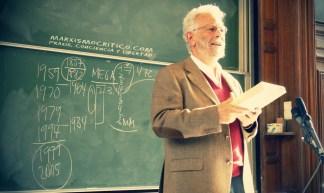 «El ciclo equivalencial: valor de cambio, dinero y mercado«: tercera conferencia de Enrique Dussel sobre la crítica de la economía política de Marx de su curso ” 16 Tesis de Economía Política”
«The Contradictions of Capital»: David Harvey
 University of Warwick
Distinguished Lecture Series
14 February 2013
David Harvey is the Distinguished Professor of Anthropology at the Graduate Center of the City University of New York. He is a leading political economist and social theorist of international standing. He is a highly cited academic and the author of many books and essays. Professor Harvey received his BA, MA and PhD from Cambridge University and was formerly Professor of Geography at John Hopkins University, Halford Mackinder Professor of Geography at the University of Oxford and Senior Research Fellow at St Peter’s College Oxford.
His numerous awards include Outstanding Contributor Award of the Association of American Geographers, the Centenary Medal from the Royal Scottish Geographical Society and the Patron’s Medal of the Royal Geographical Society for contributions to critical human
«Directly and Indirectly Social Labor: What Kind of Human Relations Can Transcend Capitalism?»: Peter Hudis
 In exploring how to go “beyond capitalism,” we need to first ask why it has been so difficult to develop a comprehensive alternative to capitalism. One reason is the nature of capitalism, which creates the false impression that alienated human relations are natural and immutable. Capital’s ability to naturalize conditions of oppression is central to its ideological dominance. Another reason for the difficulty in envisioning an alternative is the failed attempts to emancipate humanity from capitalism. The failure of many revolutions to create a truly new society solidifies the view that there is no alternative to being subordinated to social laws outside our control. And there is yet a third reason that it has been hard to develop an alternative—the decline of interest in Marx’s work over the past few decades. Marx was not just one of many important thinkers. Marx was the founder of a unique philosophy of revolution that contained a specific concept of a new society. The less direct study and discussion there is of Marx’s works, the harder it becomes to envision an alternative to capitalism itself.
For this reason, we aim to seriously explore Marx. It will not do to focus on bits and pieces of his work that may or may not be to our liking. We instead have to grapple with his ideas as a whole. But grappling with his ideas as a whole entails grappling with his ideas in their specificity. Without doing so it is not possible to grasp Marx’s ideas at all. So let’s take a closer look at the work that contains Marx’s most detailed discussion of a non-capitalist society—his 1875 Critique of the Gotha Program.
«Antecedentes históricos de la recepción de El Capital en España y Latinoamérica»: Ángelo Narváez León
 1. La formación de El Capital dentro del imaginario político europeo.
Sabemos, por palabras del propio Marx –y revisiones y comentarios de Engels–, cuáles fueron las intenciones concretas de El Capital en cuanto contribución a la formación teórica y práctica del proletariado europeo en su lucha contra el capitalismo. Ahora bien: el correlato histórico entre las propuestas intencionales particulares de los movimientos populares y de masas no tiene una relación causal necesaria, ni opera mediante una proyectividad teleológica con la formación y nutrición del imaginario político mediante el influjo de las formaciones conceptuales, sino que es este correlato el que se construye retrospectivamente una vez que los acontecimientos han ocurrido en su propia contingencia, de modo tal que dicho correlato histórico sólo es necesario en cuanto implica una necesidad de contingencia concebible en su propia realidad. Es necesario, para desprenderse de cualquier anclaje teleológico y determinista, plantear una necesidad real, universal y concreta dentro de los límites de la formación del imaginario político europeo y latinoamericano, es decir, una necesidad a posteriori, retroactiva, histórica y divergente. Frente a ésta necesidad, nuestra labor será preguntarnos por la capacidad política efectiva de Marx y Engels, y los “marxistas” posteriores, por establecer a El Capital como un eje central formativo de los trabajadores: o, formulado como pregunta, preguntarse por rol que jugó efectivamente El Capital en la formación intelectual del proletariado europeo –español específicamente– y latinoamericano desde su publicación hasta los albores de la segunda mitad del Siglo XX.
«Finance and the realization problem in Rosa Luxemburg: a ‘circuitist’ reappraisal»: Riccardo Bellfiore and Marco Passarella
 Article showing that Rosa Luxemburg’s analysis of capitalist accumulation is framed within a ‘circuitist’ macroeconomic reading of capitalism as a monetary production economy
Introduction
The aim of this chapter is to show that Rosa Luxemburg’s analysis of capitalist accumulation is framed within a ‘circuitist’ macroeconomic reading of capitalism as a monetary production economy. The strengths and limits of her approach are to be found elsewhere than suggested by usual criticisms, especially those advocated by Marxist authors. Rosa Luxemburg cannot be reduced to the uncertain theoretical status of an ‘under-consumptionist’. On the contrary, she presents a clear (although incomplete) picture of the macro-monetary and sequential working of the capitalist process.
This chapter is organized as follows. The next section examines Luxemburg’s comments on how the enlarged reproduction scheme is introduced in volume II of Marx’s Capital. The third, fourth, and fifth sections summarize, first, the orthodox attack by Bukharin, and then the more sympathetic interpretations provided by Michał Kalecki and Joan Robinson. The sixth and seventh sections emphasize the affinities and differences of Luxemburg’s circuitist perspective with the contemporary theory of the monetary circuit. The eighth section concentrates on the problem of the monetization of profits and interests. Some concluding remarks are provided in the last section.
«O novo padrão da dependência: a América Latina e o Brasil na actual divisão internacional do trabalho»: Jaime Osorio, Marcelo Dias Carcanholo e Mathias Seibel Luce
Seminário:
A TEORIA MARXISTA DA DEPENDÊNCIA E O CAPITALISMO LATINO-AMERICANO NO SÉCULO XXI
Lançamento do livro Padrão de reprodução do capital: contribuições da Teoria Marxista da Dependência (Boitempo Editorial)
Organização:
Núcleo de História Econômica da Dependência Latino-Americana (HEDLA/UFRGS) e Boitempo Editorial
Mesa-redonda:
O novo padrão da dependência: a América Latina e o Brasil na atual divisão internacional do trabalho
«16 Tesis de Economía Política. Tesis 1»: Enrique Dussel
 Primera conferencia de Enrique Dussel sobre la crítica de la economía política de Marx de su curso » 16 Tesis de Economía Política»
«La unidad mundial de la acumulación de capital en su forma nacional históricamente dominante en América Latina. Crítica de las teorías del desarrollo, de la dependencia y del imperialismo»: Juan Iñigo Carrera
 La cuestión
El modo de producción capitalista es el modo históricamente específico de regirse el proceso de vida humana en el cual la capacidad para organizar el trabajo social se presenta como un atributo automático materializado en el producto de ese mismo trabajo. Esta relación social objetivada, el capital, pone entonces en marcha el trabajo social sin otro fin inmediato que el producir más de esa capacidad para organizar automáticamente el trabajo social objetivada en su producto, más de la misma relación social objetivada, más capital, o sea, capital acumulado. De este automatismo brota su potencia como forma históricamente específica de desarrollarse las fuerzas productivas materiales del trabajo social, pero también su limitación como tal y la necesidad que lleva en sí de superarse en su propio desarrollo.
Dada su necesidad de expandir la producción material como si esta expansión no llevara consigo la necesidad de límite alguno originado en la misma forma social que la rige, la unidad del proceso de acumulación de capital tiene un contenido necesariamente mundial.
Leer más…
«Statistical Evidence of Falling Profits as Cause of Recession»: J. A. Tapia Granados
 Tapia Granados, José A. “ Statistical Evidence of Falling Profits as Cause of Recession A Short Note”, Review of Radical Political Economics December 2012 vol. 44 no. 4 484-493.
Data on 251 quarters of the U.S. economy show that recessions are preceded by declines in profits. Profits stop growing and start falling four or five quarters before a recession. They strongly recover immediately after the recession. Since investment is to a large extent determined by profitability and investment is a major component of demand, the fall in profits leading to a fall in investment, in turn leading to a fall in demand, seems to be a basic mechanism in the causation of recessions.
«The Four Drafts of Capital: Toward a New Interpretation of the Dialectical Thought of Marx»: Enrique Dussel
 The first century following Marx’s death (1883–1983) began under Engels’s authority, then continued under the hegemony of the Second International (Kautsky, Lenin, Rosa Luxemburg, etc.). The Leninist period of the Second International was brief, and it quickly fell under the domination of Stalinism. The second century of Marx (l983–2083) has begun with “perestroika,” with the collapse of existing socialism in Eastern Europe, and with the massive publication of hitherto unknown manuscripts. Marx in his second century will be something very different from in his first century. He will be a Marx whose critical thought will be in the hands of humanity— critical of capitalism and, in a positive way (opening its democratic and creative era), of existing socialism. We are perhaps nearer to Marx than ever. Engels himself too often confused in his “we” (Marx and I) what belonged to Marx and what Engels had added. Moreover, due to an understandable defensiveness, he could not take a clear, archaeological vision of Marx’s theoretical discoveries as we can today, thanks to the discoveries we will discuss in this article. Kautsky, Lenin, and many other subsequent Marxists had even less access to the texts with which we are now acquainted.
It is a question, then, of a complete rereading of Marx, with new eyes: as a Latin American, from the growing poverty of the peripheral world, the underdeveloped and exploited of capitalism at the end of the twentieth century. Marx is, in the periphery, today, more pertinent than in the England of the mid-nineteenth century.
Reading Marx’s Capital with David Harvey

Free Öcalan



Fundación Infancia y Aprendizaje

Colección de libros Marxismo Crítico

Historical Materialism


CIPEC (Centro de Investigación en Pensamiento Crítico)

Centro para la Investigación como Crítica Práctica

Memoria Revista de Crítica Militante

Revista Laberinto






Marx desde cero





 marxismocritico.com