
Archivo
«Henryk Grossman: Capitalist Expansion and Imperialism»: Rick Kuhn
 MARX AND Engels identified the process of capitalist globalization in the Communist Manifesto:
The need of a constantly expanding market for its products chases the bourgeoisie over the entire surface of the globe. It must nestle everywhere, settle everywhere, establish connections everywhere.…
The bourgeoisie, by the rapid improvement of all instruments of production, by the immensely facilitated means of communication, draws all, even the most barbarian, nations into civilization. The cheap prices of commodities are the heavy artillery with which it forces the barbarians’ intensely obstinate hatred of foreigners to capitulate. It compels all nations, on pain of extinction, to adopt the bourgeois mode of production… Leer más…
«Crise do Capitalismo Contemporâneo: lógicas, contradições e saídas»: Marcelo Dias Carcanholo
 Palestra realizada pelo Pet-Economia/UFES
Tema: «Crise do Capitalismo Contemporâneo: lógicas, contradições e saídas«
Marcelo Dias Carcanholo, Professor do Depto de Economia (UFF/RJ).
«Marxist crisis theory to 1932 and to the present: reflections on Henryk Grossman’s ‘Fifty years of struggle over Marxism» Rick Kuhn
 Henryk Grossman’s article and pamphlet ‘Fifty years of struggle over Marxism, 1883‐1932‘ provided a survey of Marxism and particularly Marxist crisis theory since Marx’s death. He identified both innovations in and major departures from Marx’s own approach amongst those who called themselves Marxists. The processes of innovation and departure have both continued over the period since. This paper explores Grossman’s assessments of Marxist crisis theories up to 1932, subsequent theoretical developments and grounds these in an account of the material circumstances of their production.
«La “Nueva Solución” al problema de la transformación: Una crítica solidaria»: Fred Moseley
 Abstract
This paper critically evaluates the “new solution” to the transformation as presented by Foley and Duménil and others, from the perspective of the author’s “macro-monetary” interpretation of Marx’s theory. The main issue emphasized is the method of determination of the inputs of constant capital and variable capital in Marx’s theory–whether these inputs are taken as given as quantities of money capital or derived from given quantities of physical goods.
JEL classification: E11; D46
Keywords: Marx, Sraffa, Transformation Problem
Resumen
Este trabajo evalúa críticamente la “nueva solución” a la transformación tal como fue presentada por Foley y Duménil y otros, desde la perspectiva de la interpretación “macro-monetaria” que tiene el autor de la teoría de Marx. El cuestionamiento principal que se enfatiza es el método de determinación de los insumos de capital constante y capital variable en la teoría de Marx–si esos insumos se toman como cantidades de capital dinero dadas o se derivan de las cantidad de bienes físicos.
Clasificación JEL: E11; D46
Palabras clave: Marx, Sraffa, Transformation Problem
«Critique of Heinrich: Marx did not Abandon the Logical Structure»: Fred Moseley
Heinrich’s article is mainly about the falling rate of profit and crisis theory, but another important point has to do with Marx’s logical method in Capital, and in particular with the levels of abstraction of capital in general and competition. Heinrich argues that Marx encountered difficulties in the Manuscript of 1861-63 concerning this logical structure, and as a result of these difficulties, Marx abandoned this logical structure in the final versions of Capital.
I argued in a 1995 paper that Heinrich is wrong about Marx abandoning the logical structure of capital in general and competition after 1863 (Moseley 1995). Capital in general and competition refer to the two main levels of abstraction in Marx’s theory – the production of surplus-value and the distribution of surplus-value. The key point of this logical structure is that the production of surplus-value is theorized prior to the distribution of surplus-value; i.e. the total amount of surplus-value is determined (by the total surplus labor) prior to its division into individual parts (first the equalization of the profit rate across industries and then the further division of the total surplus-value into commercial profit, interest, and rent). The pre-determined total surplus-value is taken as given, as pre-determined (as a “limit”; see below), in the subsequent theory of the distribution of surplus-value; i.e. in the division of this pre-determined total surplus-value into individual parts.
«La Determinación de la “Expresión Monetaria del Tiempo de Trabajo” (“MELT”) en el caso del Dinero no mercancía»: Fred Moseley
 Abstract
This paper suggests a way to determine the “monetary expression of labor” (the “MELT”) in today’s regime of inconvertible credit money, a way that is consistent with Marx’s general theory of money and is quantitatively the same as Marx’s determination of the MELT in the case of the inconvertible fiat money of his time. In order to explain this method of determination of the MELT in the case of modern inconvertible credit money, the paper first reviews Marx’s determination of the MELT in the case of commodity money and in the case of the inconvertible fiat money of his time. The final section of the paper discusses the similarities and the differences between my interpretation and Saros’s (2007) interpretation of the MELT in the case of inconvertible fiat money.
JEL classification: B51, E11
Keywords: commodity money, fiat money, credit money, monetary expression of labor time
Resumen
Este trabajo sugiera una manera para determinar la “expresión monetaria del tiempo de trabajo” (el “MELT” por sus siglas en inglés, monetary expression of labor time) en el régimen actual de dinero crédito inconvertible, una manera que es consistente con la teoría general del dinero de Marx y que es cuantitativamente igual a la determinación de Marx del MELT para el caso de dinero fiduciario inconvertible de su tiempo. Para explicar este método de determinación del MELT en el caso de dinero crédito inconvertible moderno el trabajo primero revisa la determinación del MELT que hace Marx en el caso del dinero mercancía y en el caso del dinero fiduciario inconvertible de su tiempo. La sección final del trabajo discute las similitudes y diferencias entre mi interpretación y la interpretación de Saros (2007) del MELT en el caso de dinero fiduciario inconvertible
Clasificación JEL: B51, E11
«La crisi capitalista com a recompossició del sistema»: Ivan Gordillo
 L’agost del 2013 es complí el sisè aniversari de l’inici de la crisi actual. El 3 d’agost de 2007, llegíem a la premsa econòmica que els hedge funds de Bear Stearns es declaraven en fallida: «Com si fos una epidèmia, la crisi en el sector de les hipoteques d’alt risc —subprime— ja s’ha cobrat les primeres víctimes oficials dins del banc d’inversions Bear Stearns. Dimecres passat, l’entitat presentava els informes necessaris perquè dos dels seus hedge funds —fons d’inversió lliure— s’acollissin al capítol 15 de la bancarrota estatunidenca. […] Ambdós fons han hagut d’acollir-se al títol 15 de la Llei de Bancarrotes perquè van ser fundats fora dels límits dels Estats Units, a les illes Caiman, per ser exactes.»[1]
Això va ser tan sols el començament. De l’agost de 2007 al setembre de 2008, les fallides dins del sector financer a causa de la crisi de les hipoteques escombraria als EUA van ser una constant. El mateix banc Bear Stearns feia fallida el març de 2008. El 15 de setembre de 2008 s’ensorrà el banc d’inversions Lehman Brothers, un d’aquells que hauria entrat en la posterior definició de «massa gran per deixar-lo caure». L’únic supervivent del crac del 29 desapareixia.
«El valor de las obras de arte desde una perspectiva marxista»: José María Durán Medraño
 Resumen
Este artículo trata de plantear una serie de cuestiones preliminares en torno al estudio del valor de las obras de arte desde una perspectiva marxista, es decir, desde una perspectiva que tenga en cuenta la teoría laboral del valor desarrollada por Marx. El artículo comienza con una serie de cuestiones preliminares que desde nuestro punta de vista son fundamentales a la hora de exponer el problema del valor/precio de las obras de arte. Continúa examinando críticamente planteamientos recientes sobre la teoría de formación precios en Adam Smith; y concluye volviendo a Marx y la teoría laboral del valor con el fin de proponer un posible camino para la investigación futura.
Palabras clave: Valor, precio, arte, mercancía, trabajo.
Abstract
The article examines several questions regarding the value of works of art from a Marxist point of view, that is, from a point of view that takes into account Marx’s labour theory of value. The article begins with a series of preliminary questions that from our point of view are basic in order to present the value/price problem of works of art. It follows by a critical examination of some recent approaches regarding Smith’s theory of price formation; and it ends turning to Marx and his labour theory of value to put forward a possible direction for future investigations.
Key words: Value, price, art, commodity, labour.
«Social and Physical Form: Ilyenkov on the Ideal and Marx on the Value-Form»: Andrew Chitty
 E.V. Ilyenkov’s philosophy represents an extraordinarily ambitious attempt to use the idea that human social activity has determinate ‘forms’ to achieve three different goals: an account of the categories of thought, an account of our knowledge of the natural world, and an account of human consciousness. Overarching these goals, and incorporating them, is another: that of giving an account of mind based on social activity.
Ilyenkov’s conception of the ideal, or of ideality, plays a central role in this project. We could go as far as to say that for Ilyenkov ‘ideality’ is the most fundamental feature of human mindedness. By demonstrating that ideality is an objective yet non-physical feature of social activities, and of the things used and produced by social activities, Ilyenkov aims to show that an elementary human mindedness inheres in these activities and things, which makes possible the fully-fledged human mindedness that characterises individual reflective human beings.
«The Trade Deficit: Beyond the Myth of Currency Manipulation»: Anwar Shaikh
 The US has run a massive trade deficit for over 30 years. In recent times, there has been a growing chorus of commentators who seek to place the blame on our trading partners, most notably China, just as in an earlier time others had targeted Japan and Germany. It is said that the problem stems not from our reduced international competitiveness, but rather from the manipulation of exchange rates by our more successful trading partners.
This claim is not based on any direct evidence, but rather on an inference derived from standard international trade theory, which predicts that free trade will automatically lead to balanced trade. From this particular theoretical perspective, our large and persistent large trade deficit must be rooted in some obstacles to free trade. The large surpluses of our trading partners such as China then make them natural candidates for our opprobrium. Of course, if the standard theory is incorrect, this line of inference collapses. I wish to argue that the standard theory is wrong, on both theoretical and empirical grounds, and that free trade does not automatically eliminate trade imbalances. On the contrary, free trade reflects international competitiveness, and persistent trade deficits are symptoms of persistent competitive weakness.
«Límites y perspectivas de la globalización neoliberal y nuevas formas de manifestación del imperialismo contemporáneo»: Abelardo Mariña Flores
 Resumen
Este trabajo analiza algunos aspectos del contradictorio despliegue de la globalización neoliberal en la actualidad. En el plano de la dinámica económica, se observan signos de recesión en algunos países destacadamente los centros del capitalismo mundial; aunque otros países continúan con altas tasas de expansión económica. En el plano estructural, se experimenta una transformación de la economía mundial que está modificando el peso relativo de los distintos países y bloques y que ha reconfigurado y profundizado las interdependencias entre los mismos. Las contradicciones económicas coyunturales y estructurales han generado una creciente conflictividad internacional, el despliegue de formas más crudas de manifestación del imperialismo, pero también el desarrollo de opciones a la globalización neoliberal, particularmente en América Latina.
Palabras clave: globalización; imperialismo; economía mundial; recesión.
«A Marxist in Keynes’ Court»: Tim Shenk
 Maurice Dobb was one of John Maynard Keynes’ favorite students. He was also a committed Marxist and a member of the Communist Party of Great Britain.
No economist — maybe no human — has ever been better at scorn than John Maynard Keynes. He was a masterful debater when he wanted to be. But, like the proper scion of Britain’s elite that he was, Keynes preferred to laugh at his enemies. In 1925, sympathizers with the Soviet Union were treated to a world-class exhibition of this disdain. Keynes had just returned from his first trip to the USSR, and he was ready to wax polemical.
“How can I accept a doctrine,” he asked, “which sets up as its bible, above and beyond criticism, an obsolete economic textbook which I know to be not only scientifically erroneous but without interest or application to the modern world? How can I adopt a creed which, preferring the mud to the fish, exalts the boorish proletariat above the bourgeois and intelligentsia who, with whatever faults, are the quality of life and surely carry the seeds of all human advancement? Even if we need a religion, how can we find it in the turbid rubbish of the Red bookshops.” “It is hard,” he concluded, “for an educated, decent, intelligent son of Western Europe to find his ideals here, unless he has first suffered some strange and horrid process of conversion which has changed all his values.”
«El capitalismo y la economía científica. Una expresión matemática del Tomo I de El Capital»: por Sebastián Hdez. y Alan Deytha
 El Capitalismo y la Economía Científica. Una expresión matemática del Tomo I de El Capital es un libro escrito por los estudiantes de economía A. Sebastián Hdez. Solorza y Alan A. Deytha Mon, publicado el 7 de marzo de 2013 por editorial Palibrio, donde se presenta una posible vía de formalización matemática del Tomo I de El Capital de Karl Marx.
Esta obra presenta una formalización matemática sencilla, clara y concreta de la teoría económica contenida en el Tomo I de El Capital de Karl Marx para estudiantes y académicos interesados en estudiar y desarrollar la teoría económica marxista.
Leer más…
«Entropía e información: En la ciencia y en la Economía Política»: Paul Cockshott
Conferencia dictada por el doctor Paul Cockshott del departamento de ciencias de la computación de la Universidad de Glasgow. La entropía es uno de los conceptos difíciles de la Física contemporánea; sin embargo es imprescindible para entender el mundo físico. El dr. Cockshott nos hace ver por qué la economía científica debe utilizarlo también. La conferencia es impartida en inglés aunque estamos trabajando para tener una versión en castellano.
AVB
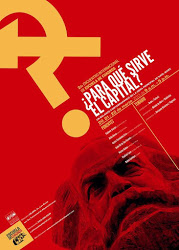
«¿Para qué sirve El Capital? Un balance contemporáneo de la obra principal de Karl Marx»: Ponencias de Néstor Kohan, Carlos Fernández Liria, Iñaki Gil de San Vicente y Rubén Zardoya entre otros.
 Por
Por Entre el 30 de mayo y el 1 de junio se realizó el 2do Encuentro Internacional de Escuela de Cuadros con el título “¿Para qué sirve El Capital? Un balance contemporáneo de la obra principal de Karl Marx”.
Reading Marx’s Capital with David Harvey

Free Öcalan



Fundación Infancia y Aprendizaje

Colección de libros Marxismo Crítico

Historical Materialism


CIPEC (Centro de Investigación en Pensamiento Crítico)

Centro para la Investigación como Crítica Práctica

Memoria Revista de Crítica Militante

Revista Laberinto






Marx desde cero





 marxismocritico.com