
Archivo
«Bolívar Echeverría, Modelos elementales de la oposición campo-ciudad»: Reseña de Victor Hugo Pacheco Chávez
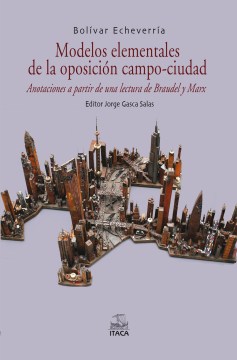 Bolívar Echeverría, Modelos elementales de la oposición campo-ciudad. Anotaciones a partir de una lectura de Braudel y Marx,
México, Ítaca, 2013. 107 pp.
Suele ocurrir que hay autores cuyo legado se enriquece constantemente por la obra póstuma, la cual viene a llenar los huecos de aquello que escribieron en vida, Bolívar Echeverría no ha sido la excepción. Se ha hecho énfasis en ubicar a Echeverría como deudor explicito de la Teoría Crítica, o con una influencia mayor de Martin Heidegger.1 Pero poco se ha profundizado sobre su relación con la obra de Fernand Braudel.2 La publicación de Modelos elementalesde la oposición campo-ciudad, nos permitirá calibrar la importancia de esta relación.
«Gramsci, la otra política. Descifrando y debatiendo los Cuadernos de la cárcel»: Una conversación con el Dr. Lucio Oliver Costilla
 El día de hoy gracias al apoyo de Editorial Ítaca podemos platicar con el Dr. Lucio Oliver Costilla, el tema es de singular interés el pensamiento político de Gramsci, y en particular de la obra que está coordinando llamado Gramsci: La otra Política, un buen debate presenta esta conversación.
«La relevancia política de la resistencia intelectual. Prólogo a «¿Una política sin clases?», de Ellen Meiksins Woods»: Eduardo Sartelli
 La relevancia política de la resistencia intelectual
 «Marx and Freud in Latin America»: Reviewed by George García Quesada
 Bruno Bosteels
Marx and Freud in Latin America: Politics, Psychoanalysis, and Religion in Times of Terror
Verso, London and New York, 2012. 336pp., £19.99 / $29.95
ISBN 9781844677559
Reviewed by George García Quesada
Marxism, psychoanalysis and aesthetic avant-gardes have been probably the most important European contributions to the critique of culture and society in the twentieth century. This book aims to interpret the reception of the former two intellectual currents in Latin America, and particularly the theoretical and political problems arising from their resulting local versions; but it also seeks to establish a dialogue between the history of that reception and the contemporary problems of the Left. This integration of past and present – necessarily mediated by the reflection on memory, as we will indicate later – is crucial for Bosteels’ approach to these problems.
«The Irreconcilable Inconsistencies of Neoclassical Macroeconomics: A False Paradigm»: Reviewed by Jelle Versieren
 John Weeks
The Irreconcilable Inconsistencies of Neoclassical Macroeconomics: A False Paradigm
Routledge, New York, 2012. 304pp., £85 hb
ISBN 9780415680226
In this book Weeks has turned the logic of neoclassical (full employment) and synthesis models (less-than-full employment) against itself. Whereas (post-)Keynesian models explain growth of income as a multiplier process of investment and consumption – the analysis of the effects of excess aggregate demand on income and output – the initial neoclassical real model does not rely on money income as a dynamic variable (109). In a post-Keynesian dynamic system, relative prices and commodity quantities interact in an asymmetrical and complex way. Neoclassical economists cannot explain this interactive process of relative prices and quantity output, and falsely presume the independence of demand from the absolute price level (40-9). The neoclassical model gives a formalised coherent explanation of changes of the real price and the real value of a single commodity, but it fails to relate the equal relationship of nominal price change to the real price change. Knowing the real value of a commodity with a nominal price is an ex post facto scientific activity. The neoclassical economists instead think aprioristically. The process of calculating constant prices contains a reduction of concrete commodities to an empty abstract single commodity without giving a ground of reasoning. To have constant prices, an index number has to be assigned, which is not an arbitrary inference (107). Because the one-stage neoclassical models rest on market clearing price flexibility, this index number problem is not an arbitrary measure in the monetary model.
«Capitalism, the infernal machine»: An interview with Fredric Jameson
 Representing Capital: A Reading of Volume One
The literary critic and Marxist political theorist, Fredric Jameson, has written Representing Capital: A Reading of Volume One, a book that revisits Karl Marx’s most important work, Capital.
On one level it may seem odd evaluating a book almost 150 years old. How much relevance and practical applicability could it have to the world we currently inhabit? Yet to overlook Capital — as is too often the case — is to miss its searing critique and keen insight.
It is not coincidental that it addresses key elements of the situation we find ourselves in today: how the rich got so rich, how the poor got so poor and how all the various fixes and proposed solutions are based on the illusion that capitalism can somehow be made to meet the needs of the majority of people and still be capitalism.
In short, Marx and Capital is onto something worth exploring. I talked with Jameson by phone recently about this:
«Crisis económica y teorías de la crisis. Un ensayo sobre Marx y la ciencia económica»: Paul Mattick
 En Crisis económica y teorías de la crisis —que en esta edición se ha subtitulado Un ensayo sobre Marx y la «ciencia económica»—, Paul Mattick presenta una revisión general de las teorías que se han propuesto en los dos últimos siglos para explicar las crisis económicas.
La reedición de este libro no podría ser más oportuna, ahora que el capitalismo hace agua por muchos flancos y suenan cada vez más huecas las afirmaciones sobre su carácter estable, acorde con la naturaleza humana y creador de abundancia para todos.
«The Postcolonial Gramsci»: Edited by Neelam Srivastava and Baidik Bhattacharya
 This collection of essays sets out to argue a new theoretical framework underpinned by a Gramscian point of view. By SHELLEY WALIA
THE ideas of Antonio Gramsci as they evolved in the context of his position as one of the leading political thinkers and leaders of the Italian working-class movement and as they took shape during his long imprisonment led to a reappraisal of cultural, political and literary forces. The defence of democratic culture and the role of the peasantry are central to the understanding of his project of responding to imperial/fascist/capitalist histories. It is only the beginning, with one having proved nothing as yet; the hard realities confronting the postcolonial critic deserve hard answers.
The collection of essays in The Postcolonial Gramsci set out to argue a new theoretical framework underpinned by a Gramscian point of view in dealing with postcolonial studies from the Marxist and post-Marxist points of view. The contributors to the book situate the cultural and political logic of Gramsci’s notions of liberation and ideology and of the role of intellectuals and the working of hegemonic political economy within postcolonial studies in order to reconceptualise the nature of class, power and the conditions of existence in colonial and modern societies in Africa, China and India.
«Jean-Paul Bronckart y Christian Bota (2011) – Bajtín desenmascarado. Historia de un mentiroso, una estafa y un deliro colectivo -«: Reseña de Hélène Maurel-Indart
 «El caso Bajtín: ¿el fin de un tabú?».- El examen riguroso, completo y convincente al que proceden Jean Paul Bronckart y Cristian Bota sobre la paternidad de Bajtín respecto a ciertos textos de Volóshinov y Medvédev era muy esperado. El tema es complejo y persisten, según los mismos autores, zonas oscuras sobre ciertos aspectos. Sin embargo, tras la lectura de este libro-investigación comprendemos cómo pudo construirse a partir de los años 1960 la figura de M. Bajtín en detrimento del reconocimiento de los aportes hechos por Volóshinov y Medvédev, fallecidos demasiado tiempo atrás como para poder defenderse y hacer valer la autenticidad y originalidad de sus respectivas obras. Apoyándose al mismo tiempo en elementos biográficos e históricos en la primera parte y en el análisis comparativo de los textos en la segunda, los dos especialistas de Bajtín se entregan a una auténtica demostración.
«Capital as a Social Kind: Definitions and Transformations in the Critique of Political Economy»: Howard Engelskirchen
 Reviewed by Bill Bowring
In this new book Howard Engelskirchen presents an original analysis of the nature of capital, and a set of tasks for curing its ills. In an engaging interview at Left Forum 2011 in New York (http://www.youtube.com/watch?v=Jmln6NtDMGk), Engelskirchen succinctly defined “capital as a social kind” as being the intersection of the separation of workers from their means of production, and the separation of the enterprises from each other. Much of the book under review is the working out of this basic idea.
Engelskirchen is a veteran teacher of law and philosophy, and his book brings together a lifetime’s research and activism, under the banner of a militant commitment to scientific realism. Engelskirchen is also a serious scholar of Karl Marx, in English and in German, and this is especially evident in Chapter 4, “The concept of capital in the Grundrisse”, written for a forthcoming collection In Marx’ Laboratory. Critical Interpretations of the Grundrisse. In part the book contains articles written between 2004 and 2008, but Engelskirchen draws together a wide range of themes in order to conclude with his precepts for “Winning the battle of democracy” (Chapter 7).
«La crisis global y el capital ficticio»: Consuelo Silva Flores y Claudio Lara Cortés. [Coordinadores]
 Rosa María Marques. Paulo Nakatani. Reinaldo Carcanholo. Mauricio de Souza Sabadini. Claudio Lara Cortés. [Autores de Capítulo]
…………………………………………………………………………
Colección Grupos de Trabajo.
ISBN 978-956-9372-03-2
ARCIS. CLACSO.
Santiago de Chile.
Diciembre de 2013
A la memoria de
Reinaldo Carcanholo,
colega, amigo y compañero de ruta.
«Repensar a Marx y «El Capital»»: Néstor Kohan
 Video de Nestor Kohan comentando una síntesis de las principales hipótesis y tesis del libro «Nuestro Marx – Fetichismo y poder en el pensamiento de Karl Marx». — Publicado en el estado español por Editorial LA OVEJA ROJA: laovejaroja@laovejaroja.es y en Argentina por Editorial BIBLOS. info@editorialbiblos.com
«Karl Marx»: by Bertell Ollman and Kevin Anderson (eds)
 Reviewed by Hans G Despain
This collection of articles is an excellent source for contemporary Marxian social analysis. It is an anthology of thirty four articles addressing a wide range of topics. This collection of articles well illustrates the relevance and depth of Marxian analysis. It is an excellent reference. Its intended audience is primarily young theorists interested in the application of Marxian social theory.
The financial collapse of 2007-8 generated a resurgent interest in Marx. Marx is certainly a deep and fruitful resource for topics of political economy. One quickly discovers much more. Marx is a social theorist and philosopher par excellence. Marx develops theories about history and its movement (see 497-537). He had a deep interest in the relationship between social institutions and human motivation (see 346-401). He developed important insights into the human consciousness and how our beliefs are shaped and formed (see 3-130). He theorized about culture and religion (see 405-93). Marx understood that capitalistic-state politics and power offer us impressive inspiration for explaining phenomena such as imperialism (see 183-237), colonialism, slavery and race relations (see 541-63). His ideas have been further developed and extended to understand gender relations (see 565-605) and the relationship between human beings and the natural environment (see 609-51). Marxian social theory and philosophy is a perceptual shift, self-transformational, and (potentially) liberating.
Presentación de la nueva edición del «Nuestro Marx» de Néstor Kohan con Belén Gopegui, Carlos Frabetti y Carlos Alberto Castillo
 ¡Este sábado tenemos acto! A las 19:00 estaremos en la librería Dalcò (C/ Olmo, 18, m Antón Martín) presentando Nuestro Marx.
Contaremos con la intervención de Belén Gopegui, Carlos Frabetti y Carlos Alberto Castillo. Esperamos veros allí.
«Bolívar Echeverría. Crítica e Interpretación»: por Jaime Ortega Reyna y Víctor Hugo Pacheco
 En esta ocasión, gracias a editorial ITACA, podemos charlar sobre la obra «Bolívar Echeverría. Crítica e Interpretación» compilada por Diana Fuentes, Carlos Oliva Mendoza e Isaac García Venegas, en donde se estudian diversos temas de que fueron objeto de estudio por parte de Bolívar Echeverría.
Reading Marx’s Capital with David Harvey

Free Öcalan



Fundación Infancia y Aprendizaje

Colección de libros Marxismo Crítico

Historical Materialism


CIPEC (Centro de Investigación en Pensamiento Crítico)

Centro para la Investigación como Crítica Práctica

Memoria Revista de Crítica Militante

Revista Laberinto






Marx desde cero





 marxismocritico.com