
Archivo
«Perspectives from the Circulation of Capital. Perspectives from the Accumulation of Capital»: David Harvey, Michael Roberts.

«Harvey contra Marx sobre las crisis del capitalismo, segunda parte: malinterpretando la rentabilidad»: Andrew Kliman
 Este artículo es la segunda parte de una crítica de Andrew Kliman a un borrador de un artículo de David Harvey, publicado en el tristemente difunto New Left Project. En la primera parte de la crítica hice una pequeña introducción a la polémica que subyace a este intercambio. En las próximas semanas publicaremos la respuesta de Harvey a Kliman y la contrarréplica de éste. Aprovecho para agradecer a Pau Llonch y a Antonio Dorado su revisión de la primera y segunda parte de la crítica.
Las pruebas son claras: desde el final de la Segunda Guerra Mundial hasta la Gran Recesión, la tasa de ganancia total de las corporaciones estadounidenses descendió, y este descenso se explica casi en su totalidad gracias a la Ley del Descenso Tendencial de la Tasa de Ganancia de Marx
La primera parte de este artículo se centró en la interpretación de David Harvey (Harvey 2014) de la Ley del Descenso Tendencial de la Tasa de Ganancia (LDTTG) de Marx, a medida que la producción capitalista se incrementa – una ley que Marx identificó como “la ley más importante de la economía política”. Resta por tratar la creencia de Harvey de que la LDTTG no ha operado desde los años 80.
Los datos de mano de obra que se trataron en la primera parte constituyen la única “prueba” de Harvey de que la LDTTG no ha actuado; no presenta pruebas directas al respecto de la tasa de ganancia (esto es: la cantidad de ganancia como porcentaje del volumen de capital invertido). Sin embargo, pone en tela de juicio las pruebas que hemos presentado tanto yo como otros que indican que la tasa de ganancia descendió realmente a lo largo de los años 80 y 90 (ver Figura 1) [1]. Leer más…
«David Harvey, monomaniacs and the rate of profit»: Michael Roberts
 David Harvey is a Distinguished Professor at the City University of New York (CUNY), Director of The Center for Place, Culture and Politics (http://pcp.gc.cuny.edu/) and author of numerous books. For over 40 years, he has been one of the world’s most trenchant and critical analysts of capitalist development. And he has developed a global audience for his on-line video lectures on reading Capital, (see http://davidharvey.org/). Harvey won the 2010 Isaac Deutscher prize for the best Marxist book of the year with The Enigma of Capital (http://www.amazon.com/Enigma-Capital-Crises-Capitalism/dp/0199836841).
I have commented on Harvey’s contributions to Marxist economics on various occasions on my blog.
https://thenextrecession.wordpress.com/2010/09/03/views-on-the-great-recession-david-harvey-and-anwar-shaikh/
https://thenextrecession.wordpress.com/2011/11/13/david-harvey-marxs-method-and-the-enigma-of-surplus/
https://thenextrecession.wordpress.com/2014/05/19/david-harvey-piketty-and-the-central-contradiction-of-capitalism/
Professor Harvey has always been critical of the view that Marx’s law of the tendency of the rate of profit to fall plays any significant role as a cause of crises under capitalism. In his award winning book, The enigma of capital, he states that “There is, therefore, no single causal theory of crisis formation as many Marxist economists like to assert. There is, for example, no point in trying to cram all of this fluidity and complexity into some unitary theory of, say, a falling rate of profit”. Leer más…
«La Argentina y la tendencia descendente de la tasa de ganancia 1910-2011»: Esteban Ezequiel Maito
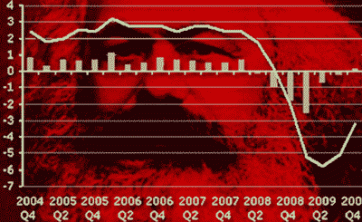 El trabajo presenta una estimación del comportamiento de la tasa de ganancia en la Argentina para el período 1910-2011, a partir de la elaboración de cinco series largas: productividad real del capital fijo en maquinaria (1874-2011), productividad real y nominal del capital fijo (1910-2011) y tasa de ganancia real y nominal sobre capital fijo (1910-2011). Todas las series muestran una tendencia descendente de la rentabilidad, de acuerdo con lo planteado por Marx, en virtud del aumento relativo de los gastos en inversión respecto a los gastos en fuerza de trabajo, la cual constituye la fuente propia de la ganancia. Como en los demás países en los que existen estimaciones, la primera mitad de la década de los setenta y los años siguientes, estuvieron marcados por un brusco descenso de la tasa de ganancia, cuya recuperación posterior no logró alcanzar los niveles previos. La tendencia descendente de la tasa de ganancia se da con independencia de los cambios en la distribución del ingreso, cuyos efectos sobre la rentabilidad se encuentran más relacionados con los ciclos de corto y mediano plazo.
Palabras clave: Tasa de ganancia – Argentina – Productividad del capital – Distribución del ingreso – Acumulación
Argentina and the tendency of the rate of profit to fall 1910-2011
This work presents an estimation of the profit rate evolution in Agentina for the period 1910-2011, on the basis of five long time series: real machine fixed capital productivity (1874-2011), real and nominal fixed capital productivity (1910-2011), and real and nominal profit rate on fixed capital (1910-2011). All these series show a tendency to fall, according to Marx´s approach, due to relative increase on investment expenses in relation to labor force´s, which represent the profit source. Like estimations for other countries, the first part of the seventies and the following years were signed by a great fall in the profit rate, which later recovery couldn´t reach the previous levels. The tendency of the profit rate to fall takes place beyond any change on income distribution, which effects over profitability are more related with short and medium place cycles.
Key words: Profit rate – Argentina – Capital productivity – Income distribution – Accumulation
«Marxist theory of crisis: The nature of the current long depression»: Michael Roberts
 I made a presentation to the Marxism Festival 2014 over the weekend (http://marxismfestival.org.uk/). The presentation was called The nature of the current Long Depression. There were three things that I wanted to argue in that presentation.
First, I argued that Marx’s law of the tendency of the rate of profit to fall was the underlying cause of the cycle of recurrent crises (booms and slumps) in modern economies, including the Great Recession. Suffice it to say that mainstream economics has no convincing explanation of recurrent crises. As Nobel economics prize winner Eugene Fama put it: “We don’t know what causes recessions. I’m not a macroeconomist so I don’t feel bad about that. We’ve never known. Debates go on to this day about what caused the Great Depression. Economics is not very good at explaining swings in economic activity….If I could have predicted the crisis, I would have. I don’t see it. I’d love to know more what causes business cycles.”
Now Thomas Piketty, author of the best-selling economics book of the 21st century, called Capital in the 21st century (see my posts, http://thenextrecession.wordpress.com/2014/04/23/a-world-rate-of-profit-revisited-with-maito-and-piketty/) has been quick to dismiss Marx’s law as plain wrong in fact. As Piketty puts it in his book, with the same title as Marx’s 19th century version: “the rate of return on capital is a central concept in many economic theories. In particular, Marxist analysis emphasises the falling rate of profit – a historical prediction that has turned out to be quite wrong”. Leer más…
«¿Posibilidad o necesidad de la crisis? La economía heterodoxa y la gran recesión»: Juan Pablo Mateo Tomé y Alberto Garzón Espinosa
 Resumen
Este artículo analiza las explicaciones de la crisis económica que estalla en 2007-08, conocida como la Gran Recesión, llevadas a cabo por autores pertenecientes a una serie de corrientes de carácter heterodoxo, como la [neo]marxista, postkeynesiana y radical. El propósito será esclarecer si se posee
una teoría de la posibilidad o necesidad de la crisis, ya que constituye un elemento importante respecto del carácter y alcance de la teoría económica de la dinámica capitalista. Para ello se va a caracterizar el conjunto de explicaciones a partir del papel de las finanzas, la distribución del ingreso (y la demanda), la política económica (neoliberal), la (sobre) producción y la evolución de la tasa de ganancia. Se concluye que, salvo excepciones, las corrientes heterodoxas sustentan una concepción de la crisis como mera posibilidad.
Palabras clave: Teoría de la crisis; Heterodoxia; Finanzas; Rentabilidad; Distribución del ingreso; Neoliberalismo. Leer más…
«La transitoriedad histórica del capital. La tendencia descendiente de ganancia desde el siglo XIX»: Esteban Ezequiel Maito
 Resumen
El artículo presenta estimaciones de la tasa de ganancia para catorce países en el largo plazo. La rentabilidad muestra una clara tendencia descendente, si bien existen períodos de recuperación parcial, tanto en los países centrales como en los periféricos. El comportamiento de la tasa de ganancia confirma así las previsiones hechas por Marx de su tendencia y la transitoriedad histórica del modo de producción. Finalmente, se realiza una estimación de la tasa de ganancia mundial para las últimas décadas, destacándose también el papel particular de China en la rentabilidad sistémica durante el último decenio.
Palabras clave: Tasa de ganancia – Marx – Modo de producción.
Abstract
This article presents profit rate estimates in fourteen countries on the long term. Profitability shows a clear downward trend, although there are recovery periods, both in core and peripheral countries. The profit rate trend confirms Marx predictions and the historic transience of capitalist mode of production. Finally, it’s done an estimate of the world profit rate for the last decades, also highlighting the function of China in systemic profitability in recent years.
Keywords: Profit rate – Marx – Mode of production. Leer más…
«David Harvey, Piketty y la contradicción central del capitalismo»: Michael Roberts
 David Harvey es un reconocido profesor marxista de Antropología y Geografía en el Centro de Graduados de la Universidad de la Ciudad de Nueva York. Harvey es bastante crítico del libro de Piketty. Reconoce que Piketty proporciona datos de gran importancia sobre la desigualdad de la riqueza y de los ingresos en las principales economías capitalistas desde que el capitalismo se convirtió en el modo dominante de producción y las relaciones sociales desde 1750. » Lo que Piketty sí muestra estadísticamente (y deberíamos estar en deuda con él y sus colegas por eso) es que el capital ha tendido a lo largo de su historia a producir cada vez mayores niveles de desigualdad. Esto , para muchos de nosotros, no es noticia. Era, además, exactamente la conclusión teórica de Marx en el Tomo I de su ‘El Capital'».
Pero, como apunta Harvey, Piketty nada dice sobre las crisis recurrentes de producción y de inversión del capitalismo. Piketty «no nos dice por qué la crisis de 2008 se produjo y por qué está tomando tanto tiempo para tantas personas para salir de debajo de la doble carga del desempleo y de millones de casas perdidas en una prolongada ejecución hipotecaria . No ayuda a entender por qué el crecimiento es actualmente tan lento en EE.UU. en comparación con China, y por qué Europa está bloqueada en una política de austeridad y de una economía de estancamiento». Leer más…
«Piketty against Piketty. The tendency of the rate of profit to fall in United Kingdom and Germany since XIX century confirmed by Piketty’s data»: Esteban Ezequiel Maito
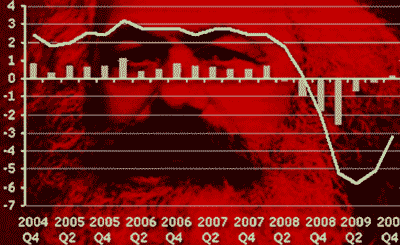 ABSTRACT – In Capital in 21st century, Thomas Piketty criticizes Marxian theory and the law of the tendency of the rate of profit to fall in the long term. His main argument, asserted by other authors since decades, is related to the capacity of increases in productivity to counterweight the tendency. The French author establishes a stable “rate of return” too, but this rate and his critics on Marx are founded on a neoclassical perspective. Thus Piketty denies the validity of the law but changing its determinations as a result of the labor theory of value and the valorization process. When a proper definition of the matter in Marxian terms is done, Piketty’s data itself confirms the law of the tendency of the rate of profit to fall.
Introduction
The work of Karl Marx has had a widespread influence in different academic disciplines. However, the interpretation of his work has been influenced by specific historical contexts. The current global crisis has renewed interest in his theory and its implications for the analysis of economics and modern history. The latter has involved a growing debate, not only between the Marxist school and neoclassical and Keynesian schools, but also within Marxism. Leer más…
«David Harvey, Piketty and the central contradiction of capitalism»: Michael Roberts
David Harvey is the well-known Marxist Professor of Anthropology and Geography at the Graduate Center of the City University of New York. Harvey has a new book out and has also reviewed Thomas Piketty’s (http://davidharvey.org/2014/05/afterthoughts-pikettys-capital/). Harvey is pretty critical of Piketty’s book. Harvey recognises that Piketty provides powerful data on the inequality of wealth and income in the major capitalist economies since the capitalism became the dominant mode of production and social relations from about 1750. “What Piketty does show statistically (and we should be indebted to him and his colleagues for this) is that capital has tended throughout its history to produce ever-greater levels of inequality. This is, for many of us, hardly news. It was, moreover, exactly Marx’s theoretical conclusion in Volume One of his version of Capital.”
But, as Harvey says, Piketty says nothing about recurrent crises of production and investment in capitalism. Piketty “does not tell us why the crash of 2008 occurred and why it is taking so long for so many people to get out from under the dual burdens of prolonged unemployment and millions of houses lost to foreclosure. It does not help us understand why growth is currently so sluggish in the US as opposed to China and why Europe is locked down in a politics of austerity and an economy of stagnation. “ Leer más…
«El euro, caballo de Troya del FMI en Europa»: Xabier Arrizabalo Montoro
 Trescientos cuarenta y cuatro euros mensuales, 344. Ésta es la pérdida salarial que, en promedio, sufrió cada trabajador español sólo en 2006. Es el resultado de la caída de participación de los salarios en el PIB, desde el 63,3% de 1993 hasta el 54,9% de 2006; pérdida que totalizó 82.927 millones de euros y, por tanto, 4.130 euros anuales por trabajador o los 344 mensuales mencionados.
El período 1993-2006 abarca desde la entrada en vigor del Tratado de Maastricht, que inicia oficialmente el camino hacia el euro, hasta justo antes del estallido de la crisis. Se trata, por consiguiente, del período del euro, en cuyo marco se decía “España va bien”. Y esta pérdida salarial sintetiza con claridad el significado del euro, la intencionalidad con la que fue impuesto. De hecho, supone una caída de participación, en promedio simple anual, del 0,65%, mientras en el período 1978-93 fue del 0,28% y en el período 2006-2013, ya en la crisis actual, del 0,49%.
Videos del «Encuentro de reflexión y discusión sobre la crisis actual. Homenaje a los 40 años de la publicación de El Capitalismo Tardío de Ernest Mandel»
 En México, se celebraron el 8, 9 y 10 de Octubre, unas interesantes jornadas que debatieron sobre la imprescindible obra del economista marxista Ernest Mandel.
Sedes: Instituto de Investigaciones Económicas y Facultad de Economía, UNAM.
IIEC: 9:30 a 14:00 hrs. Auditorio Mtro. Ricardo Torres Gaitán y Sala devideoconferencias
FE: 17:00 a 20:00 hrs. Sala Jesús Silva Herzog, Edificio B.
Leer más…
«A la izquierda de la crisis: el discurso heterodoxo»: Michel Husson
 Esta contribución toma como punto de partida los debates – que pueden ser considerado exóticos o esotéricos – entre economistas marxistas, principalmente anglosajones. A continuación, se amplia en tres ámbitos: el regreso de las ideas keynesianas, el debate sobre el desarrollo concreto de la crisis y una incursión en las preocupaciones ecologistas. Para volver en un bucle a la idea de que la lectura marxista hace subir a la superficie cuestiones fundamentales sobre el capitalismo contemporáneo. No hace falta decir que este ensayo de discurso sobre los discursos refleja un punto de vista personal y no trata de considerarlos de acuerdo con su influencia relativa . El objetivo de esta contribución es más bien sugerir una posible explicación para la contradicción que existe entre la aparente gran coherencia de la argumentación keynesiana o regulacionista y su limitada capacidad de pesar en el debate público, para no hablar de las políticas que finalmente se llevan a la práctica.
«Marxist crisis theory to 1932 and to the present: reflections on Henryk Grossman’s ‘Fifty years of struggle over Marxism» Rick Kuhn
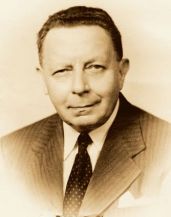 Henryk Grossman’s article and pamphlet ‘Fifty years of struggle over Marxism, 1883‐1932‘ provided a survey of Marxism and particularly Marxist crisis theory since Marx’s death. He identified both innovations in and major departures from Marx’s own approach amongst those who called themselves Marxists. The processes of innovation and departure have both continued over the period since. This paper explores Grossman’s assessments of Marxist crisis theories up to 1932, subsequent theoretical developments and grounds these in an account of the material circumstances of their production.
«Critique of Heinrich: Marx did not Abandon the Logical Structure»: Fred Moseley
Heinrich’s article is mainly about the falling rate of profit and crisis theory, but another important point has to do with Marx’s logical method in Capital, and in particular with the levels of abstraction of capital in general and competition. Heinrich argues that Marx encountered difficulties in the Manuscript of 1861-63 concerning this logical structure, and as a result of these difficulties, Marx abandoned this logical structure in the final versions of Capital.
I argued in a 1995 paper that Heinrich is wrong about Marx abandoning the logical structure of capital in general and competition after 1863 (Moseley 1995). Capital in general and competition refer to the two main levels of abstraction in Marx’s theory – the production of surplus-value and the distribution of surplus-value. The key point of this logical structure is that the production of surplus-value is theorized prior to the distribution of surplus-value; i.e. the total amount of surplus-value is determined (by the total surplus labor) prior to its division into individual parts (first the equalization of the profit rate across industries and then the further division of the total surplus-value into commercial profit, interest, and rent). The pre-determined total surplus-value is taken as given, as pre-determined (as a “limit”; see below), in the subsequent theory of the distribution of surplus-value; i.e. in the division of this pre-determined total surplus-value into individual parts.
Reading Marx’s Capital with David Harvey

Free Öcalan



Fundación Infancia y Aprendizaje

Colección de libros Marxismo Crítico

Historical Materialism


CIPEC (Centro de Investigación en Pensamiento Crítico)

Centro para la Investigación como Crítica Práctica

Memoria Revista de Crítica Militante

Revista Laberinto






Marx desde cero





 marxismocritico.com