
Archivo
«Ruy Mauro Marini e a dialética da dependência»: Documentário
 Ruy Mauro Marini e a dialética da dependência
Série Realidade Brasileira
Realização: Editora Expressão Popular e Escola Nacional Florestan Fernandes
Coordenação Geral: Cecília Luedemann e Miguel Yoshida
Ruy Mauro Marini e a dialética da dependência, produzido pela Editora Expressão Popular e pela Escola Nacional Florestan Fernandes faz parte da série Realidade Brasileira, destinada aos estudos em escolas do ensino médio, universidades, bibliotecas públicas, pontos de cultura e movimentos sociais. O principal objetivo desta publicação é disponibilizar para a juventude um material preparado a partir de ampla pesquisa bibliográfica sobre os lutadores sociais brasileiros, contando com a contribuição de especialistas no tema. Leer más…
«Marx Global»: Entrevista con Jan Hoff
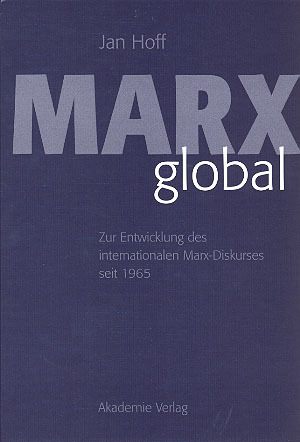 El libro de Jan Hoff Marx Global representa sin duda el estudio más completo de las diferentes interpretaciones de la crítica marxiana de la economía política desde los años 60 hasta la actualidad. En esta entrevista, el autor presenta las cuestiones principales de este trabajo, reexamina las grandes interpretaciones y propone descentrar nuestro enfoque de Marx poniendo en primer plano algunos debates ampliamente ignorados en Europa o en los Estados Unidos.
En tu libro, Marx Global1, propones una cartografía exhaustiva y ambiciosa de los debates en economía política marxista desde 1965. Puedes presentarnos los objetivos principales de esta obra? Por que las interpretaciones de Marx deben ser examinadas a la luz de su contexto de elaboración geográfico, social y político?
J.H.: El objetivo principal de Marx Global hace referencia al contexto específico de Alemania, donde siempre ha habido una cantidad considerable de investigaciones sobre Marx y su crítica de la economía política. Hoy, existen tres revistas alemanas dedicadas no solamente al marxismo en general (como es el caso, por ejemplo, de Actuel Marx) sino a los «estudios marxianos» (o a la «marxología» como habría dicho Maximilien Rubel). En Alemania, mucha gente sigue leyendo El Capital y participan en debates que giran en torno a cuestiones metodológicas, la teoría del valor, la teoría de las crisis, etc. Leer más…
Video de la presentación del libro “Capitalismo y economía mundial” de Xabier Arrizabalo Montoro
 El Instituto Marxista de Economía (IME), la Universidad Arte y Ciencias Sociales (ARCIS) y la Universidad de Concepción (UdeC), contribuyeron al acto de presentación del libro “Capitalismo y economía mundial” de Xabier Arrizabalo Montoro. Intervinieron en el acto: José Luis Baranda, miembro del IME; María José Paz, profesora de economía de la UCM; Ana Colchero, economista y escritora mexicana; Jesús de Blas, doctor en economía por la UCM y el autor. Leer más…
«Internationalizing Marx»: An Interview with Jan Hoff
 This interview was conducted by Vincent Chanson and Frédéric Monferrand, philosophers from Nanterre, France, and originally published in the French-language web journal Période.
Vincent Chanson and Frédéric Monferrand: Your book Marx global. Zur Entwicklung des internationalen Marx-Diskurses seit 1965 (Berlin 2009) offers a very exhaustive and ambitious mapping of debates in Marxist political economy since 1965. Could you summarize the main goals of the book? Why must the interpretations of Marx be examined with regard to their geographical, social, and political context?
Jan Hoff: Marx global addresses a specific context that is typical for Germany. There is still a considerable amount of research that primarily focuses on Marx and his critique of political economy as an object of study. At the moment we have three German journals that are devoted not to Marxism in general, like Actuel Marx, for example, but exclusively to “Marx studies” – or, as Maximilien Rubel would have it, to “Marxology.” Many people in Germany still read Capital and participate in debates about methodological questions, value theory, theory of crisis, etc. Leer más…
«Algunas ideas sobre Piketty»: David Harvey
 Thomas Piketty ha escrito un libro llamado El Capital en el Siglo XXI que ha causado un cierto revuelo. Defiende los impuestos progresivos y un impuesto global sobre la riqueza como la única forma de contrarrestar las tendencias hacia la creación de una forma de capitalismo “patrimonial” marcada por lo que califica como desigualdades de riqueza y renta “aterradoras”. A su vez, documenta de una forma minuciosa y difícil de refutar, cómo la desigualdad social tanto en riqueza como en renta ha evolucionado a lo largo de dos siglos, con un énfasis particular en el rol de la riqueza. Destruye la idea ampliamente extendida de que el capitalismo de libre mercado extiende la riqueza y que el mayor bastión en la defensa de libertades individuales. El capitalismo de libre mercado, cuando se hayan ausentes las intervenciones redistributivas del Estado produce olgarquías antidemocráticas, tal y como demuestra Piketty. Esta demostración ha dado alas a la indignación liberal mientras que ha enfurecido al Wall Street Journal. Leer más…
«Afterthoughts on Piketty’s Capital»: David Harvey
 Thomas Piketty has written a book called Capital that has caused quite a stir. He advocates progressive taxation and a global wealth tax as the only way to counter the trend towards the creation of a “patrimonial” form of capitalism marked by what he dubs “terrifying” inequalities of wealth and income. He also documents in excruciating and hard to rebut detail how social inequality of both wealth and income has evolved over the last two centuries, with particular emphasis on the role of wealth. He demolishes the widely-held view that free market capitalism spreads the wealth around and that it is the great bulwark for the defense of individual liberties and freedoms. Free-market capitalism, in the absence of any major redistributive interventions on the part of the state, Piketty shows, produces anti-democratic oligarchies. This demonstration has given sustenance to liberal outrage as it drives the Wall Street Journal apoplectic.
The book has often been presented as a twenty-first century substitute for Karl Marx’s nineteenth century work of the same title. Piketty actually denies this was his intention, which is just as well since his is not a book about capital at all. It does not tell us why the crash of 2008 occurred and why it is taking so long for so many people to get out from under the dual burdens of prolonged unemployment and millions of houses lost to foreclosure. It does not help us understand why growth is currently so sluggish in the US as opposed to China and why Europe is locked down in a politics of austerity and an economy of stagnation. What Piketty does show statistically (and we should be indebted to him and his colleagues for this) is that capital has tended throughout its history to produce ever-greater levels of inequality. This is, for many of us, hardly news. It was, moreover, exactly Marx’s theoretical conclusion in Volume One of his version of Capital. Piketty fails to note this, which is not surprising since he has since claimed, in the face of accusations in the right wing press that he is a Marxist in disguise, not to have read Marx’s Capital. Leer más…
«El desarrollo de la Teoría de la Distribución del Plusvalor de Marx en los Manuscritos de 1861-63»: Fred Moseley

He argumentado en múltiples trabajos (Moeseley 1993, 2000, 2002) que la teoría del plusvalor de Marx se estructura en términos de dos niveles básicos de abstracción: (1) la producción de plusvalor, en la que se determina la cantidad total de plusvalor en la economía como un todo y (2) la distribución del plusvalor, en la se la cantidad total de plusvalía predeterminada se divide en partes individuales (tasas de ganancia iguales, ganancia comercial, interés y renta). En la teoría de la distribución del plusvalor, la cantidad de plusvalor a ser distribuido se toma como dado, ya determinado por la anterior teoría de la producción del plusvalor. Esta premisa cuantitativa clave se repite en muchas ocasiones en todos los borradores de El Capital, especialmente en los borradores del Volumen 3 de El Capital en el Manuscrito de 1861-63 y en el Manuscrito de 1864-65. Otros autores también han enfatizado en la determinación previa del plusvalor total en la teoría de la distribución del plusvalor de Marx como: Paul Mattick, David Yaffe y Duncan Foley.
Los Grundrisse se encuentran prácticamente en su totalidad al nivel de abstracción del capital en general, el cual se divide en tres secciones: el proceso de producción del capital, el proceso de circulación del capital y una breve sección sobre el capital y la ganancia. Además hay pocas discusiones breves sobre la igualación de las tasas de ganancias entre industrias, un aspecto de la distribución del plusvalor, y un tema que Marx mencionó en repetidas ocasiones “no pertenece aquí” (es decir, no pertenece a la sección del capital en general), sino que pertenece a la “futura investigación de la competencia”. Marx también afirmó claramente en estas breves discusiones que el plusvalor total se determina previo a su distribución, y específicamente previo a la igualación de las tasas de ganancia. Por ejemplo:
EPIC intervista Riccardo Bellofiore
 Riccardo Bellofiore è docente di «Analisi Economica», «Economia Monetaria», «International Monetary Economics» e «La Dimensione Storica in Economia: le Teorie» presso il Dipartimento di Scienze Aziendali, Economiche e Metodi Quantitativi (DSAEMQ) dell’Università di Bergamo.
«Historical Materialism at Sixteen»: Peter D. Thomas
 In the age of austerity, the world has witnessed a wide range of social movements fighting back. The 2014 Historical Materialism conference, taking place this weekend at Toronto’s York University, aims to contribute to a discussion on both austerity and resistance, and how to extend and revitalize Left critique and praxis.
Peter D. Thomas is a lecturer in the history of political thought at Brunel University, London. He is the author of The Gramscian Moment: Philosophy, Hegemony and Marxism. He is a member of the editorial board of Historical Materialism: Research in Critical Marxist Theory, and co-editor of the Historical Materialism Book Series.
In this interview, we discuss the trajectory of the Historical Materialism initiative, his view on Western Marxism and its legacy, and the importance of Antonio Gramsci for the wide range of movements that have emerged in the last decade all around the world. The interview was conducted by George Souvlis, a PhD candidate in history at the European University Institute, Florence. Leer más…
«Profiting Without Producing: How Finance Exploits Us All»: A lecture by Costas Lapavitsas
 The lecture by Costas Lapavitsas, Professor of Economics at the School of Oriental and African Studies, University of London celebrates the release by Verso Press of Profiting Without Producing: How Finance Exploits Us All. Lapavitsas explores the roots of the recent economic crisis in terms of «financialization,» the most salient feature of which is the rise of financial profit, in part extracted directly from households through financial expropriation, and discusses the options available for controlling finance and resolutions to the current crisis.
Leer más…
«Financial times»: Joseph Choonara – A review of Costas Lapavitsas, Profiting Without Producing: How Finance Exploits Us All –
 Profiting Without Producing: How Finance Exploits Us All (Verso, 2013), £20
In the substantial body of Marxist literature emerging in the wake of the economic crisis that began in 2007-8, two broad positions have been evident.1 The first emphasises that the crisis erupted as a result of long-term tendencies within the capitalist process of production, generally focusing on a decline in the rate of profit in the post-war decades that has not subsequently been fully reversed. Exponents of this position include Robert Brenner and Anwar Shaikh, along with various writers who have been published in this journal, notably Michael Roberts, Guglielmo Carchedi, Andrew Kliman and Chris Harman.2 The second position concentrates on the specifically financial dimension of the crisis and typically downplays the tendency for the rate of profit to decline. The work under review confirms its author, Costas Lapavitsas, as one of the most important and intellectually sophisticated representatives of this position.
Of course, the two positions cannot be neatly disentangled. All of those mentioned above who fall into the first camp have been forced to grapple with the undeniable financial aspect of the crisis. Lapavitsas, too, is at pains to point out that finance cannot be understood without tracing its origins in wider processes within the capitalist economy. It is neither entirely autonomous of production, nor is it a parasitic outgrowth feeding upon it. Leer más…
«Engels’ Edition of the Third Volume of Capital and Marx’s Original Manuscript»: Michael Heinrich
ABSTRACT.- In 1993, Marx’s manuscript of 1864-65, used by Engels as the basis for Volume III of Capital, became available as part of the Marx-Engels Gesamtausgabe (MEGA). It is therefore now possible to compare the original ms. with the version published by Engels. This comparison reveals that Engels made significant modifications, despite his own claim to have restricted his role to one of faithfully presenting Marx’s own work. Changes to Marx’s text include design of headings, insertion of sub-headings, and textual transpositions, omissions and insertions. The changes have real impacts on the text, especially in the area of crisis theory, the theory of credit, and the relation between capitalism and commodity production. Marx’s thinking was far more ambivalent and much less developed that it appears to be on the basis of Engels’ editing, and it is doubtful whether the materials were available to complete Capital. In any case, future study of Marx’s thought must turn to the MEGA mss. rather than to Engels’ Volume III.
«Towards an unknown Marx: a commentary on the manuscripts of 1861-63»: Enrique Dussel
 This book is the first complete commentary on Marx’s manuscripts of 1861-63, works that guide our understanding of fundamental concepts such as ‘surplus-value’ and ‘production price’.
Towards an Unknown Marx: A Commentary on the Manuscripts of 1861-63. By Enrique Dussel. Translated by Yolanda Angulo. London: Routledge, 2001. xl; 273 pp. This work, originally written in Spanish, is the first analysis of Marx’s voluminous notebooks written between 1861 and 1863. These notebooks contain the well-known Theories of Surplus Value, a second draft (after the Grundrisse) of parts 2-4 of the first volume of Capital, and a first draft of most of volume 3 of Capital.
«Introduction to Marxist Economics»: Ben Fine
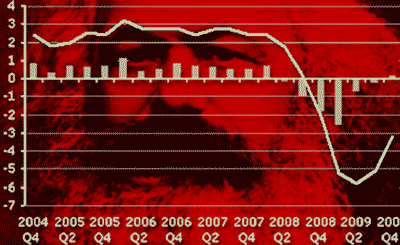 Ben Fine from SOAS University explains the fundamental ideas of Marxist Economics as a part of lecture series «What you won’t learn in an economics degree: an introduction to heterodox economics».
The lecture was hosted by Post-Crash Economics Society Manchester and Manchester’s Political Economy Institute.
To watch the videos of the previous lectures go to
http://www.post-crasheconomics.com/ev…
On the 4th of February we are lucky to have the Marxist economist Ben Fine from SOAS University in London for the fifth instalment in our lecture series “What You Won’t Learn in an Economics Degree: an Introduction to Heterodox Economics”. Fine is one of the Uk’s best known Marxists and has authored and co-authored a number of books on the subject, including an introduction to Marx’s capital. Marxist economics is often misunderstood or even scoffed at because of its perceived political implications. However, with the global economy in crisis, some believe it’s now hard not to take seriously many of the things Marx wrote about capitalism’s systemic tendency toward catastrophe.
According to the Marxist analysis, labour is the sole source of ‘value’, and capitalists make a profit by paying labourers wages lower than the value the labourers produce. However, as technology develops, capitalists tend to substitute capital for labour to increase productivity. This has the perverse effect of lowering the amount of labour performed – and therefore the surplus produced – in the economy as a whole. As the rate of profit falls, this manifests itself in periodic crises as capitalists cut back to try and recover profits.
Cátedra de pensamiento crítico: «16 Tesis de Economía Política»: Enrique Dussel
 Desde miércoles 29 de enero, de 14 a 16 hs la Universidad Autónoma de la Ciudad de México -UACM se inició la «Cátedra de Pensamiento Crítico ” a cargo del Profesor Enrique Dussel -rector interino de dicha casa de estudios-, con el tema 16 Tesis de Economía Política.
Reading Marx’s Capital with David Harvey

Free Öcalan


Fundación Infancia y Aprendizaje

Colección de libros Marxismo Crítico

Historical Materialism


CIPEC (Centro de Investigación en Pensamiento Crítico)

Centro para la Investigación como Crítica Práctica

Memoria Revista de Crítica Militante

Revista Laberinto






Marx desde cero





 marxismocritico.com