
Archivo
«An Introduction to the History of Crisis Theories»: Anwar Shaikh
 Introduction
This paper is about the history of crisis theories. Broadly speaking, the term «crisis» as used here refers to a generalized set of failures in the economic and political relations of capitalist reproduction. In particular, the crises we seek to examine are those towards which the system is internally driven, by its own principles of operation. As we shall see, it is in the nature of capitalist production to be constantly exposed to a variety of internally and externally generated disturbances and dislocations. But only at certain times do these «shocks» set off general crises. When the system is healthy, it rapidly revives from all sorts of setbacks; when it is unhealthy, practically anything can trigger its collapse. What we seek to examine is different explanations of how and whyy the system periodically becomes unhealthy.
I Reproduction and Crisis
Consider how peculiar capitalist society is. It is a complex, interdependent social network, whose reproduction requires a precise pattern of complementarity among differen productive activities: and yet these activities are undertaken by hundreds of thousands of individual capitalists who are only concerned with their private greed for profit. Is is a class structure, in which the continued existence of the capitalist class requires the continued existence of the working class: and yet no blood lines, no tradition, no religious principle announces who is to rule and who is to be ruled. Is is a cooperative human comunity, and yet it ceaselessly pits each against the other: capitalist against worker, but also capitalist against capitalist and worker against worker.
«The profit rate in the presence of financial markets: a necessary correction»: Alan Freeman
In the past two decades the number, variety, and monetary value of marketable financial instruments, particularly securitized instruments, has grown by orders of magnitude. This is the most significant development in what many writers, for the most part Marxist, term ‘financialisation’1. It brings to light, however, an anomaly in the way they calculate the profit rate. This calculation takes no account of the capital tied up in these instruments.
This article shows that when this omission is corrected, there is a consistent long-run fall in the UK and US rate of profit which, contrary to the figures widely used by Marxists, have both fallen almost monotonically since 1968.
Why does this matter? First, the profit rate figures prominently in Marx’s own theory, as is clear from his published works. It is the explicit subject of the first 15 chapters of Capital Volume III (Marx, 1981: 117-378) and dominates the remaining analysis. Second, the results shed light on current debates about the cause of the present extended crisis. A significant group of writers (see Choonara, 2011) argue that this is recent in origin, unconnected with the serious difficulties that beset Western economies in the 1970s, and follows a recovery from that crisis, brought about by neoliberalism, in the 1980s. Thus Husson:
«After the generalized recessions of 1974-5 and 1980-82, a new phase opened in the functioning of capitalism, one which one could for convenience call neo-liberal. The beginning of the 1980s was a real turning point. A fundamental tendency towards increasing the rate of exploitation was unleashed, and that has led to a continuous rise in the rate of profit» (2008).
Leer más…
«Michael Heinrich, Marx’s law and crisis theory»: Michael Roberts
 Michael Heinrich is an exponent of what is known as the ‘New German Reading of Marx’, which interprets the theory of value that Marx presents in Capital as a socially specific theory of ‘impersonal social domination’. He is a collaborator on the MEGA edition of Marx and Engel’s complete works and has published several philological studies of Capital. He has also authored a work on Marx’s theory of value, The Science of Value, which is forthcoming in the Historical Materialism book series. And recently he has published An Introduction to all Three Volumes of Capital as his first full-length work to appear in English.
I am not going to do a critique of Heinrich’s views on the theory of value, as this has been done by Guglielmo Carchedi in his book, Behind the Crisis (see chapter 2). But I am moved to respond to a recent article of Heinrich’s in the American Monthly Review, entitled Crisis theory, the law of the tendency of the rate of profit to fall and Marx’s studies in the 1870s (monthlyreview.org).
In this article, Heinrich makes the following points: 1) Marx’s law is inconsistent because its categories are indeterminate; 2) it is empirically unproven and even unjustifiable on any measure of verification; 3) Engels badly edited Marx’s works to distort his view on the law in Capital Vol 3; 4) Marx himself in his later works of the 1870s began to have doubts about the law as the cause of crises and started to abandon it in favour of some theory that took into account credit, interest rates and the problem of realisation (similar to Keynesian theory); 5) Marx died before he could present these revisions of his crisis theory, so there is no coherent Marxist theory of crisis.
¿Para qué sirve El Capital?: Iñaki Gil de San Vicente
 Texto escrito para el 2do Encuentro de Escuela de Cuadros que se llevará a cabo en la Fundación Centro de Estudios Latinoamericanos Rómulo Gallegos (CELARG), Caracas, del 30 de mayo al 1 de junio del 2013.
Estamos reunidos aquí para reflexionar sobre una interrogante ¿Para qué sirve El Capital? La respuesta es simple e inmediata: para avanzar al comunismo mediante la revolución socialista. El Capital fue escrito para ser la obra cumbre de toda la impresionante praxis revolucionaria de Marx, pero también de Engels. Será esta respuesta inmediata la que oriente este texto. Sin la perspectiva práctica revolucionaria, sin la perspectiva política en suma, nada del marxismo es comprensible, y por tanto El Capital es ininteligible. Ahora bien, como iremos viendo, la política marxista no se reduce a la politiquería parlamentarista por muy de izquierdas y de masas que diga ser, y menos todavía burguesa y reformista, sino que en sí misma, la política revolucionaria es la síntesis del resto de prácticas económicas.
«From the Oil Crisis to the Great Recession: Five crises of the world economy»: J. A. Tapia Granados
 ABSTRACT — This article makes the case that the global economy has gone through five crises since the 1970s to the present. This implies not only that the world economy is a real entity, but also that the usual view that poses national economies as units of economic analysis is an approach with major limitations. The paper discusses the concept of “economic crisis” and provides data indicating that the world economy, not national economies, is the major unit to be analysed when trying to understand the economic reality of our time, and particularly the reality of crises. These crises are discrete, countable phenomena, distinctive states of an entity that can be properly called world economy, or world capitalism. Data on capital formation, on growth of the world output, of monetary aggregates, of unemployment rates and on industrial activity indicate five major “dips” of the global economy, i.e., world recessions, in (i) the mid 1970s, (ii) the early 1980s, (iii) the early 1990s, (iv) the early 2000s, and (v) the Great Recession that provisionally can be dated 2007-2009. To a large extent business cycle chronologies of national economies such as those produced by the NBER, the OECD, or other institutions are largely consistent with these five crises of the world economy which, obviously, had different manifestations in different nations and economic regions.
«Rethinking Microeconomics: A Proposed Reconstruction»: Anwar Shaikh
 I. Introduction
Microeconomics is important because individual agents make choices, and choices have personal and social consequences. Incentives do matter, and they do affect individual choices. But it does not follow that individual decision making is characterized by the rules of so-called rational choice and rational expectations or by the reductive incentives they embody. Nor does it follow that aggregates can be analyzed in terms of representative agents. The historical, empirical and analytical evidence against this set of hypotheses is overwhelming. One purpose of this paper is to survey this evidence. But a larger purpose is to demonstrate that the central empirical findings of microeconomics do not require any such foundation, because they can be derived from a wide range of individual decision making modes. Aggregates are shown to be «robustly indifferent» to their microfoundations because shaping structures such as budget constraints and social influences which generally play decisive roles in producing aggregate patterns.
Once it is understood that very different types of microfoundations can give rise to the same market-level or economy-wide patterns, we can partition microeconomics into two types of propositions. Empirically grounded propositions which can be derived from a wide variety of microfoundations: downward sloping demand curves, differential income elasticities for necessary goods, income-driven consumption functions, etc. And propositions which depend on the specific characterization of individual behavior: where the assumed foundation is rational choice, this latter set includes the usual theorems on the efficiency, harmony and general optimality of market processes. The advantage of proceeding in this manner is that it greatly expands the room for the possible characterizations of individual economic behavior while retaining key microeconomic
patterns which play an important role in economic analysis.
«Marx, Kalecki , Keynes y la estrategia socialista: la superioridad de la economía política del trabajo sobre la economía política del capital»: John Bellamy Foster
 Para ver con perspectiva histórica el estancamiento económico que afecta a los EEUU y a otras economías capitalistas avanzadas hay que retrotraerse a la grave desaceleración de 1974-75, que marcó el fin de la prosperidad de posguerra. La interpretación dominante de la recesión de mediados de los 70 dice que el pleno empleo de la primera época keynesiana sentó las bases de la crisis al robustecer la posición del trabajo en relación con el capital. [1] Según han venido sosteniendo muchos destacados economistas de izquierda cuya visión no difiere en este punto de la corriente académica dominante, el problema era la existencia de una clase capitalista “demasiado débil” y una clase obrera “demasiado fuerte”. [2] Con distintas pruebas empíricas, se atribuía comúnmente la caída a un aumento de la participación salarial en el ingreso, con la consiguiente contracción de los beneficios empresariales. Lo que ha venido en llamarse “teoría de la crisis por contracción de beneficios”. [3]
La Monthly Review jugó un papel clave en la introducción de una variante radical de la perspectiva de la “contracción de beneficios causada por el pleno empleo” en los EEUU publicando en su número de octubre de 1974 el artículo seminal de Raford Boddy y James Crotty “Class Conflict, Keynesian Policies, and the Business Cycle” [Conflicto de clase, políticas keynesianas y ciclo económico] [4] Ese artículo iluminaba el bien establecido hecho de que los salarios y los costes de mano de obra por unidad crecen cuando se acerca el pico máximo del ciclo económico, apuntando indiciariamente al colapso del auge. Sin embargo, los autores pasaron a sugerir que el incremento de la participación salarial en el ingreso en condiciones de pleno empleo era responsable en buena medida del gran declive económico entonces en curso. “Los capitalistas –escribían—, guiados por algo más que su instinto de clase, piensan que el pleno empleo sostenido es manifiestamente absurdo… La maximización de beneficios precisa evitar el pleno empleo sostenido”. Al sostener eso, los autores opusieron su perspectiva a la del gran economista marxista polaco Michał Kalecki, así como a las posiciones de Josef Steindl y Howard Sherman. [5]
«Crisis Theory, the Law of the Tendency of the Profit Rate to Fall, and Marx’s Studies in the 1870s»: Michael Heinrich
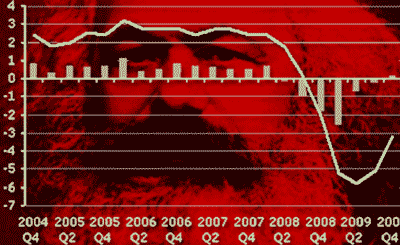 The development of crisis theory within the Marxian tradition has been central to much of our work in the last several years. The view that the various fragmentary references to crisis theory in the three volumes of Capital constitute a fully developed coherent structure, which only requires diligent exegesis, is a view that has never seemed sensible to us.
Recent research into the evolution of Marx’s manuscripts in connection with the production of the Marx-Engels-Gesamtausgabe (MEGA), the historical-critical edition of the complete writings of Karl Marx and Friedrich Engels, has confirmed our understanding in a very exciting way. It is now clear that Marx never ceased to develop his thinking on the phenomena of crises in capitalism, and never ceased to discard earlier formulations; for example, at the end of his life he was focused on questions of credit and crisis. Monthly Review rarely presents its readers with discussions of economic theory at a relatively high degree of abstraction; this, however, is such an occasion. We trust that the author’s exemplary clarity will permit ready access to readers with any degree of interest in Marx’s theory; for those who wish to become familiar with the conceptual outline of Marx’s work, we cannot do better than to recommend the author’s An Introduction to the Three Volumes of Karl Marx’s Capital (Monthly Review Press, 2012). —The Editors
Radical economic theories of the current economic crisis
Private Debt and the Current Crisis
«Entrevista a Andrew Kliman»: Esteban Mercatante
 A continuación publicamos una conversación con el marxista norteamericano Andrew Kliman. Kliman es autor de Reclaiming Marx’s “Capital”, que defiende el llamado enfoque temporalista de la teoría del valor de Marx, y de The Failure of capitalist production. The Underlying causes of the Great Recession [El fracaso de la producción capitalista, las causas subyacentes de la Gran Recesión]. Es profesor en la Universidad de Pace. En esta oportunidad conversamos sobre su visión de la crisis, su teoría sobre la ley del valor, y sus opiniones sobre la situación del marxismo en los EE.UU.
Entrevista realizada en Julio de 2012
1- Recientemente publicaste The Failure of Capitalist Production [El fracaso de la producción capitalista], que es el resultado de una investigación sobre el funcionamiento de la economía norteamericana durante las últimas tres décadas. ¿Cuál es el principal resultado de tu investigación?
La Gran Recesión estaba a la espera de ocurrir. Había problemas no resueltos en el sistema de producción capitalista que se habían estado acumulado durante un tercio de siglo. La tasa de ganancia cayó y nunca llegó a recuperarse de forma sostenida, lo que derivó en tasas de crecimiento e inversión persistentemente débiles, lo cual a su vez resultó en cargas de deuda crecientes. Y estos problemas indujeron a los gobiernos a resolverlos o velarlos con políticas que permitieron una acumulación de deudas aún mayor.
«The Failure of Capitalist Production: Underlying Causes of the Great Recession»: Andrew Kliman
 Economist Andrew Kliman discusses his book «The Failure of Capitalist Production: Underlying Causes of the Great Recession» (Pluto 2012). Many analyses of the Great Recession have been put forward from theories of unregulated finance, to Neoliberalism, to rising inequality. Kliman’s book is the first to put forward, based on in-depth empirical analysis of US data, that Marx’s theory of the Tendency of the Rate of Profit to Fall can explain these events. This talk will also present some of Kliman’s most recent work on the contentious issues of wages and inequality.
Kliman’s conclusions have immediate political implications. Short of a socialist transformation the only way to escape the ‘new normal’ of stagnation is to restore profitability through full-scale destruction of the value of existing capital assets, something not seen since the Depression of the 1930’s.
«Crisis theory and the great recession»: Riccardo Bellofiore
 Riccardo Bellofiore – Crisis theory and the great recession: a personal journey from Marx to Minsky
*****
DPU: http://dpu.mirovni-institut.si/index.php
FB stran: https://www.facebook.com/pages/Delavs…
«Class War and Labor’s Declining Share»: Fred Magdoff and John Bellamy Foster
 Workers in the United States are in a very difficult situation—one made significantly worse by the Great Recession and the very slow “recovery.” The latest data as we write this (available for January 2013) indicates that although the unemployment rate has declined from its peak and is now at 7.9 percent, when those working part time but wanting full-time jobs and those who have given up looking for work are added in, 14.4 percent of the labor force currently needs full-time employment.1 To give some idea of the meaning of such a large percentage needing full-time jobs, this represents 22 million people, compared to total nonfarm private-sector employment of about 113 million. Given the large portion of workers in part-time positions, there are currently less than 100 million full-time-equivalent jobs left in the private sector.2 With the public sector hiring few if any workers for the foreseeable future, and no New Deal-type works program in the cards, the private sector will be the source of whatever job increases occur.
As if the current employment situation is not bad enough, there has also been a long-term decline in the relative power of the working class, with capital increasingly gaining the upper hand. One crucial indication of this is the stagnation or decline over decades of real wages (corrected for inflation). For a while workers’ lost ground with respect to wages was compensated for by more women entering the labor force so that households increasingly had two earners, helping to maintain household income. However, over the last decade there has even been a downward trend in median family income—decreasing from $54,841 in 2000 to $50,054 in 2011 (both in 2011 dollars).3 The financial impact of the Great Recession has had a devastating effect on many people—with millions declaring bankruptcy, losing homes to foreclosure, or being forced “underwater” (owing more than the worth) on their homes.
«El capitalismo en el atolladero»: Michel Husson
 Es evidente que la crisis capitalista no ha terminado. Cinco años después de que estallase, este texto es un resumen actualizado de trabajos anteriores (1) que adopta tres perspectivas. La primera parte ofrece una visión general de las principales tendencias del capitalismo después del gran giro liberal de los años 1980. La segunda utiliza ese marco interpretativo para definir las coordenadas de la crisis actual. Finalmente, la última parte aborda específicamente las características concretas de la crisis en Europa.
«¿Podría Keynes poner fin a la crisis? Presentando el multiplicador marxista»: Guglielmo Carchedi
 Para Marx, la causa inmediata de la crisis es la caída de la tasa media de ganancia (ARP). 1 Un número creciente de estudios han demostrado que esta tesis no sólo es lógicamente consistente, sino que también es apoyada por un material empírico sólido y en crecimiento. 2 Si la decreciente rentabilidad es la causa del desplome, el desplome sólo terminará si la rentabilidad de la economía, se embarca en una senda de crecimiento sostenido. Entonces, la pregunta pertinente es: ¿pueden las políticas keynesianas restaurar la rentabilidad de la economía? ¿Pueden poner fin al desplome?
Leer más…
Reading Marx’s Capital with David Harvey

Free Öcalan



Fundación Infancia y Aprendizaje

Colección de libros Marxismo Crítico

Historical Materialism


CIPEC (Centro de Investigación en Pensamiento Crítico)

Centro para la Investigación como Crítica Práctica

Memoria Revista de Crítica Militante

Revista Laberinto






Marx desde cero





 marxismocritico.com