
Archivo
«The interpretation of Capital: an interview with Michael Heinrich»: Xiaoping Wei
 Apart from your recent article, which has been translated into Chinese, which books have you written?
My first book, my PhD thesis, was Die Wissenschaft vom Wert (The Science of Value). It was first published in 1991 and a considerably extended edition appeared in 1999. After all the discussions of the late 1960s and 1970s, it was an attempt to determine the peculiar scientific kernel of Marx’s project of a Critique of Political Economy. I was occupied with the difference, on the one hand between early and late Marx, on the other hand with the difference between Marx and classical political economy but also with the difference between Marx and modern neoclassical economics. I tried to describe Marx’s fundamentally new project of critique of political economy, a project, which was not only meant to add a new theory to the existing theories, but to practice a critique of a whole science, to articulate a scientific revolution. But in this project of Marx’s you can also find some ambivalences: on the one hand, Marx broke with the old field of economic science, on the other in some of his inquiries he remained in this field, without realizing it. The simultaneity of break with this field, leaving this field and remaining in this field, caused certain problems in Marx’s theory, for example the well known “transformation problem.” The transformation from values to prices of production I can understand as a problem which is caused by this incomplete break with the field of political economy. It is not really a problem of Marx’s new theory; it is a problem of a mixture between old elements (which Marx had already criticized) and new elements.
Leer más…
«The necessary reconstitution of the historical dialectic»: István Mészáros
 AS WE know, the modern state was not formed as a result of some direct economic determination, as a mechanical super-structural outcrop, in conformity to a reductivist view of the sup-posedly one-sided material domination of society, as presented in the vulgar Marxist conception of these matters. Rather, it was dialectically constituted through its necessary reciprocal interaction with capital’s highly complex material ground. In this sense, the state was not only shaped by the economic foundations of society but it was also most actively shaping the multifaceted real-ity of capital’s reproductive manifestations throughout their his-torical transformations, both in the ascending and in the de-scending phase of development of the capital system.
In this complex dialectical process of reciprocal interchange the historical and the transhistorical determinations have been closely intertwined, even if in the course of the capital system’s descending phase of development we had to witness a growing violation of the historical dialectic, especially under the impact of the deepening structural crisis. For the defence of the estab-lished mode of societal reproduction at all cost, no matter how wasteful and destructive its impact by now even on nature, can only underline the historical anachronism and the corresponding untenability of a once all-powerful mode of productive societal reproduction, which tries to extend its power in a “globalized form” at a time when the absolute systemic limits of capital are being activated on a global scale.
“16 Tesis de Economía Política. Tesis III″: Enrique Dussel
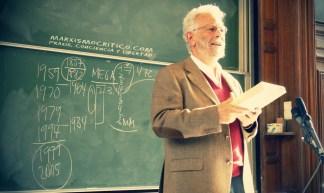 «El ciclo equivalencial: valor de cambio, dinero y mercado«: tercera conferencia de Enrique Dussel sobre la crítica de la economía política de Marx de su curso ” 16 Tesis de Economía Política”
“16 Tesis de Economía Política. Tesis II″: Enrique Dussel
 «El ciclo productivo, trabajo vivo y valor» segunda conferencia de Enrique Dussel sobre la crítica de la economía política de Marx de su curso ” 16 Tesis de Economía Política”
«16 Tesis de Economía Política. Tesis 1»: Enrique Dussel
 Primera conferencia de Enrique Dussel sobre la crítica de la economía política de Marx de su curso » 16 Tesis de Economía Política»
«The Four Drafts of Capital: Toward a New Interpretation of the Dialectical Thought of Marx»: Enrique Dussel
 The first century following Marx’s death (1883–1983) began under Engels’s authority, then continued under the hegemony of the Second International (Kautsky, Lenin, Rosa Luxemburg, etc.). The Leninist period of the Second International was brief, and it quickly fell under the domination of Stalinism. The second century of Marx (l983–2083) has begun with “perestroika,” with the collapse of existing socialism in Eastern Europe, and with the massive publication of hitherto unknown manuscripts. Marx in his second century will be something very different from in his first century. He will be a Marx whose critical thought will be in the hands of humanity— critical of capitalism and, in a positive way (opening its democratic and creative era), of existing socialism. We are perhaps nearer to Marx than ever. Engels himself too often confused in his “we” (Marx and I) what belonged to Marx and what Engels had added. Moreover, due to an understandable defensiveness, he could not take a clear, archaeological vision of Marx’s theoretical discoveries as we can today, thanks to the discoveries we will discuss in this article. Kautsky, Lenin, and many other subsequent Marxists had even less access to the texts with which we are now acquainted.
It is a question, then, of a complete rereading of Marx, with new eyes: as a Latin American, from the growing poverty of the peripheral world, the underdeveloped and exploited of capitalism at the end of the twentieth century. Marx is, in the periphery, today, more pertinent than in the England of the mid-nineteenth century.
«The Universal and the Particulars in Hegel’s Logic and Marx’s Capital»: Fred Moseley
 I have argued in a number of papers (please see References) that there are two main stages (or levels of abstraction) in Marx’s theory in Capital. The first stage has to do with the production of surplus-value and the determination of the total surplus-value, and the second stage has to do with the distribution of surplus-value and the division of the pre-determined total surplus-value into individual parts (equal rates of profit, commercial profit, interest, and rent). The total amount of surplus-value is determined at the first stage (the production of surplus-value) and then this predetermined magnitude is presupposed in the second stage (the distribution of surplus-value). This key quantitative presupposition of the prior determination of the total surplus-value is repeated many times, in all the drafts of Capital, as I have shown in my papers. Thus, there is a clear logical progression from the determination of the magnitude of the total surplus-value in the first stage to the determination of the individual parts in the second stage. Other authors who have presented similar interpretations of the production and distribution of surplus-value and the prior determination of the total surplus-value in Marx’s theory include Paul Mattick, Roman Rosdolsky, Enrique Dussel, David Yaffe, and Duncan Foley.
«El fetichismo de la mercancía»: Reinaldo Carcanholo
 “El carácter fetichista de la mercancía y su secreto”, una sección del primer volumen del “El Capital” (Carlos Marx, 1867) presentado por el economista brasileño Reinaldo Carcanholo.
«Marx’s Critique of (Ricardian) Political Economy, the Quantity Theory of Money and Credit Money»: John Milios
 Abstract
The Marxist concept of value is very frequently equated, whether explicitly or merely tacitly, with the corresponding Ricardian concept of “labour expended”. This paper argues that unlike the Ricardian theory of value, the Marxist theory of value is a monetary theory. In the Marxist system, the value of a commodity is expressed not through itself but through its distorted forms of appearance, in prices. Moreover, it cannot be defined in isolation, but exclusively in relation to all other commodities, in a process of exchange. In this relation of exchange value is materialised in money. The essential feature of the “market economy” (of capitalism) is thus not simply commodity exchange but monetary circulation and money. Commodity exchange presupposes thus the (positive) prices of all commodities involved. In other words, prices are not determined after the establishment of a non-monetary equilibrium system of barter between “production sectors”, like the Sraffian “linear production systems”. On the contrary, barter is for Marx non-existing, as all exchange transactions are made up of separate acts of exchange of commodities with money.
«L’aliénation, concept majeur du Capital»: Lucien Sève
 Une conférence de Lucien Sève donnée dans le cadre du séminaire «Marx au 21ème siècle».
13 octobre 2012
«Un nuovo Marx. Filologia e interpretazione dopo la nuova edizione storico-critica (MEGA2)»: Roberto Fineschi
 Introduzione
«Is Marx’s Theory of Value Still Relevant?»: Alfredo Saad-Filho
 Abstract
This paper assesses the internal consistence of four views of Marx’s theory of value, the ‘traditional Marxism’ associated with Dobb, Meek and Sweezy, Sraffian interpretations of Marx, value-form theory (especially the Rubin tradition) and the ‘new interpretation’ of value theory. On the basis of a critique of these approaches, a class interpretation of this theory is outlined, in which value theory is structured in and through the primacy of class relations in capitalism. Finally, the potential relevance of the class interpretation of Marx’s value theory is briefly assessed in the light of contemporary political, economic and social problems.
The title of this paper is deliberately provocative, on at least three grounds. First, it implies that the ‘relevance’ of social theories needs to be assessed historically, and it may change as the subject of analysis is transformed over time. Second, it suggests that Marx’s theory of value may have been relevant in the past – perhaps when it was first developed, or maybe under what became known as competitive capitalism – but it may no longer be tenable in the phase of ‘global capitalism’. Third, if this is the case, what are critics of capitalism supposed to do? – is there another theory that may offer a similarly powerful denunciation of capitalism as Marx’s, with the same scientific rigour, and the same degree of commitment to the search for postcapitalist alternatives? It is impossible to address these issues in the confines of a single paper. This essay answers these questions unevenly and only partially, in three sections. The first reviews the strengths and shortcomings of different interpretations of Marx’s theory of value, the ‘traditional Marxism’ associated with Dobb, Meek and Sweezy, Sraffian interpretations of Marx, value-form theory (especially the Rubin tradition) and the ‘new interpretation’ of value theory. The second offers an interpretation of value theory based on the primacy of class relations. This interpretation is not entirely original, as it draws on an extensive literature developed over several decades.
«Breaking away from Capital? Theorising activity in the shadow of Marx»: Peter E Jones
 Abstract
The paper reflects on the relationship between the understanding of human activity which Marx expresses in Capital and the theoretical model of activity offered by an influential contemporary variant of Activity Theory. The paper argues that this variant departs significantly from Marx’s conception of human activity and its role in what he calls the ‘labour process’. In particular, Activity Theory has failed to distinguish between the labour process and the valorization process, a distinction which is fundamental to Capital and to Marx’s theoretical and political perspective more generally. The paper also argues that this conceptual conflation is also evident in the theoretical discourse of the founders of the Activity Theory tradition. The paper goes on to consider the theoretical and practical implications of this departure from the method and conclusions of Capital.
«Revisiting Marx’s Concept of Alienation»: Marcello Musto
 I. Introduction
Alienation was one of the most important and widely debated themes of the twentieth century, and Karl Marx’s theorization played a key role in the discussions. Yet contrary to what one might imagine, the concept itself did not develop in a linear manner, and the publication of previously unknown texts containing Marx’s reflections on alienation defined significant moments in the transformation and dissemination of the theory.
The meaning of the term changed several times over the centuries. In theological discourse it referred to the distance between man and God; in social contract theories, to loss of the individual’s original liberty; and in English political economy, to the transfer of property ownership. The first systematic philosophical account of alienation was in the work of G.W.F. Hegel, who in The Phenomenology of Spirit (1807) adopted the terms Entaüsserung (literally self-externalization or renunciation) and Entfremdung (estrangement) to denote Spirit’s becoming other than itself in the realm of objectivity. The whole question still featured prominently in the writings of the Hegelian Left, and Ludwig Feuerbach’s theory of religious alienation in The Essence of Christianity (1841) – that is, of man’s projection of his own essence onto an imaginary deity – contributed significantly to the development of the concept. Alienation subsequently disappeared from philosophical reflection, and none of the major thinkers of the second half of the nineteenth century paid it any great attention. Even Marx rarely used the term in the works published during his lifetime, and it was entirely absent from the Marxism of the Second International (1889–1914).
Reading Marx’s Capital with David Harvey

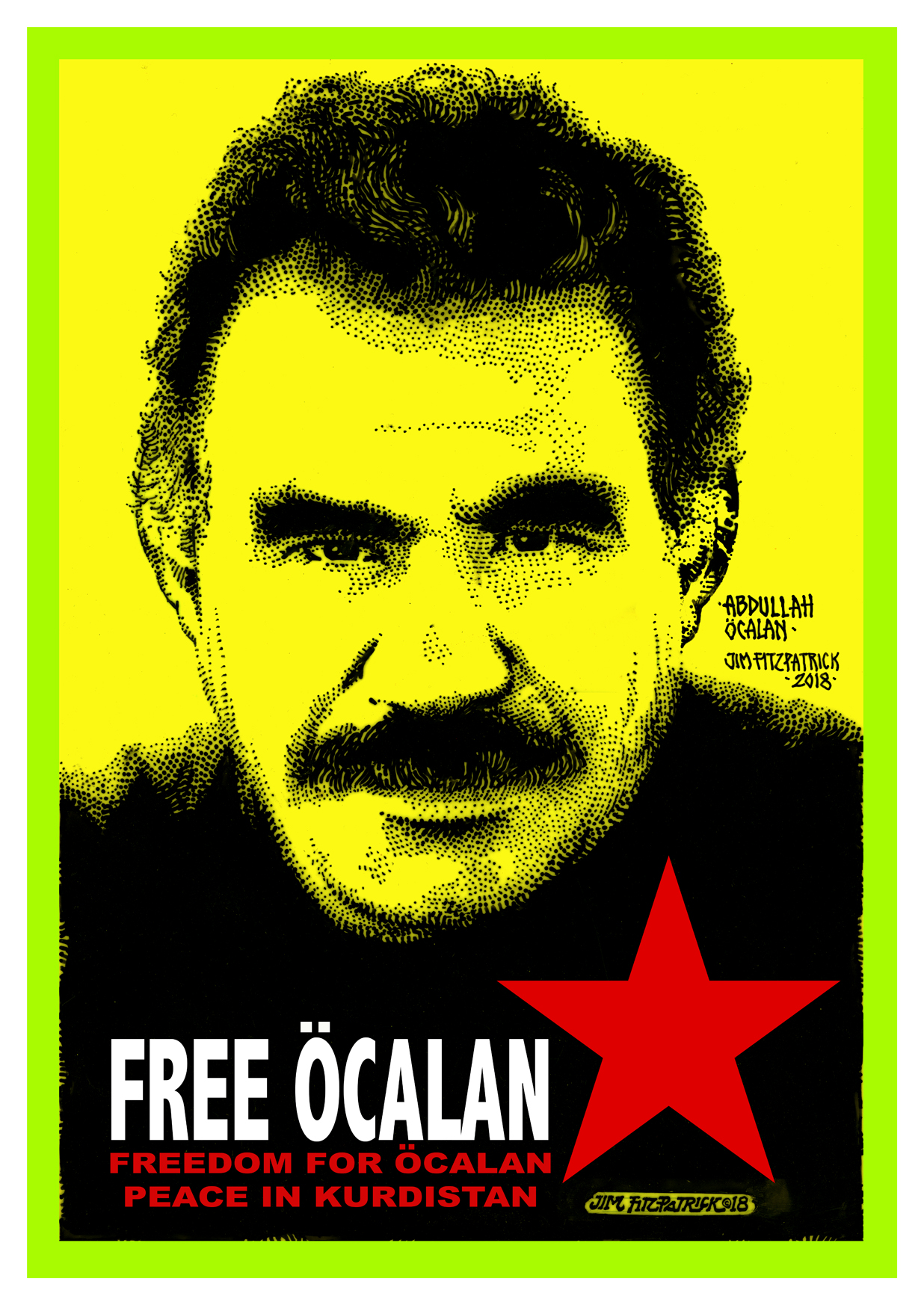
Free Öcalan


Fundación Infancia y Aprendizaje

Colección de libros Marxismo Crítico

Historical Materialism


CIPEC (Centro de Investigación en Pensamiento Crítico)

Centro para la Investigación como Crítica Práctica

Memoria Revista de Crítica Militante

Revista Laberinto






Marx desde cero




 marxismocritico.com