
Archivo
Nueva edición de «La dialéctica leninista y la metafísica del positivismo» de Evald Iliénkov
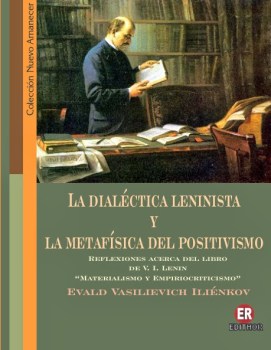 Título: La dialéctica leninista y la metafísica del positivismo
Autor: Evald Iliénkov
Rústico
242 páginas
15×21 cm
Año de la edición: 2014
ISBN: 978-9978-346-06-8
Precio: $6.00 (USD)
«Lenin’s Encounter with Hegel after Eighty Years: A Critical Assessment»: Kevin B. Anderson
 “Lenin renewed authentic Marxism not least by a recourse to the “core” of the Hegelian dialectic (“Contradiction is the root of all movement and life”) and to the selfsame Hegelian Logic…Thus it was precisely orthodox Marxism, restored by Lenin, which presupposed a knowledge of Hegel; as against a vulgar, traditionless, and schematic Marxism which, in isolating Marx — as if his thought emerged like a shot out of a pistol — isolated itself from Marx.”
Ernst Bloch (1962 [1949], 382-83)
“He did not read or study Hegel seriously until 1914-15. Also, if one considers it objectively, one notices a great difference in tone and content between the Notebooks on the Dialectic and Materialism and Empirio-Criticism. Lenin’s thought becomes supple, alive …in a word, dialectical. Lenin did not fully understand the dialectic until 1914, after the collapse of the International… Here we see the significance of the profound reticence of the Stalinists toward the Notebooks, who for a long time put them aside in favor of Materialism and Empirio-Criticism.”
Henri Lefebvre (1959, 85)
“The emphasis that Lenin put on “dialectic proper, as a philosophic science” separated him from all other post-Marx Marxists, not only up to the Russian Revolution but also after the conquest of power… What was most manifest of what he had gained from the 1914-15 Hegel studies was that the Hegelian dialectic needs to be studied “in and for itself”…That Lenin kept his direct encounter with the Hegelian dialectic — his Abstract of Hegel’s Science of Logic — to himself, however, shows the depth of the economist mire into which the whole Second International, and not just the German Social-Democracy, had sunk; revolutionaries stood on the same ground!”
Raya Dunayevskaya (1991 [1982], 116)
«Marx Global»: Entrevista con Jan Hoff
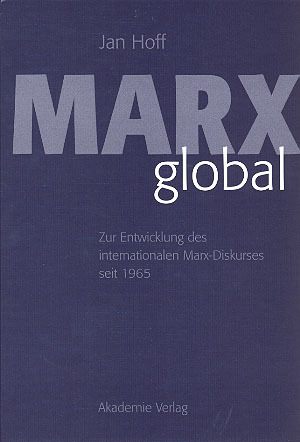 El libro de Jan Hoff Marx Global representa sin duda el estudio más completo de las diferentes interpretaciones de la crítica marxiana de la economía política desde los años 60 hasta la actualidad. En esta entrevista, el autor presenta las cuestiones principales de este trabajo, reexamina las grandes interpretaciones y propone descentrar nuestro enfoque de Marx poniendo en primer plano algunos debates ampliamente ignorados en Europa o en los Estados Unidos.
En tu libro, Marx Global1, propones una cartografía exhaustiva y ambiciosa de los debates en economía política marxista desde 1965. Puedes presentarnos los objetivos principales de esta obra? Por que las interpretaciones de Marx deben ser examinadas a la luz de su contexto de elaboración geográfico, social y político?
J.H.: El objetivo principal de Marx Global hace referencia al contexto específico de Alemania, donde siempre ha habido una cantidad considerable de investigaciones sobre Marx y su crítica de la economía política. Hoy, existen tres revistas alemanas dedicadas no solamente al marxismo en general (como es el caso, por ejemplo, de Actuel Marx) sino a los «estudios marxianos» (o a la «marxología» como habría dicho Maximilien Rubel). En Alemania, mucha gente sigue leyendo El Capital y participan en debates que giran en torno a cuestiones metodológicas, la teoría del valor, la teoría de las crisis, etc. Leer más…
«Reflexions entorn del feminisme»: Silvia Federici i Miren Etxezarreta,
 Silvia Federici, professora de la Hofstra University, de Nova York, i autora, entre d’altres, de Calibán y la bruja. Mujeres, cuerpo y acumulación primitiva, és probablement la pensadora feminista més influent dels darrers anys. La setmana passada, convidada per l’editorial Traficantes de Sueños, va visitar Barcelona per presentar Revolución en punto cero. Trabajo doméstico, reproducción y luchas feministas, una recopilació dels seus escrits que recull 30 anys d’investigacions i de reflexions de l’activista italiana.
Leer más…
Video de la presentación del libro “Capitalismo y economía mundial” de Xabier Arrizabalo Montoro
 El Instituto Marxista de Economía (IME), la Universidad Arte y Ciencias Sociales (ARCIS) y la Universidad de Concepción (UdeC), contribuyeron al acto de presentación del libro “Capitalismo y economía mundial” de Xabier Arrizabalo Montoro. Intervinieron en el acto: José Luis Baranda, miembro del IME; María José Paz, profesora de economía de la UCM; Ana Colchero, economista y escritora mexicana; Jesús de Blas, doctor en economía por la UCM y el autor. Leer más…
«Internationalizing Marx»: An Interview with Jan Hoff
 This interview was conducted by Vincent Chanson and Frédéric Monferrand, philosophers from Nanterre, France, and originally published in the French-language web journal Période.
Vincent Chanson and Frédéric Monferrand: Your book Marx global. Zur Entwicklung des internationalen Marx-Diskurses seit 1965 (Berlin 2009) offers a very exhaustive and ambitious mapping of debates in Marxist political economy since 1965. Could you summarize the main goals of the book? Why must the interpretations of Marx be examined with regard to their geographical, social, and political context?
Jan Hoff: Marx global addresses a specific context that is typical for Germany. There is still a considerable amount of research that primarily focuses on Marx and his critique of political economy as an object of study. At the moment we have three German journals that are devoted not to Marxism in general, like Actuel Marx, for example, but exclusively to “Marx studies” – or, as Maximilien Rubel would have it, to “Marxology.” Many people in Germany still read Capital and participate in debates about methodological questions, value theory, theory of crisis, etc. Leer más…
«Algunas ideas sobre Piketty»: David Harvey
 Thomas Piketty ha escrito un libro llamado El Capital en el Siglo XXI que ha causado un cierto revuelo. Defiende los impuestos progresivos y un impuesto global sobre la riqueza como la única forma de contrarrestar las tendencias hacia la creación de una forma de capitalismo “patrimonial” marcada por lo que califica como desigualdades de riqueza y renta “aterradoras”. A su vez, documenta de una forma minuciosa y difícil de refutar, cómo la desigualdad social tanto en riqueza como en renta ha evolucionado a lo largo de dos siglos, con un énfasis particular en el rol de la riqueza. Destruye la idea ampliamente extendida de que el capitalismo de libre mercado extiende la riqueza y que el mayor bastión en la defensa de libertades individuales. El capitalismo de libre mercado, cuando se hayan ausentes las intervenciones redistributivas del Estado produce olgarquías antidemocráticas, tal y como demuestra Piketty. Esta demostración ha dado alas a la indignación liberal mientras que ha enfurecido al Wall Street Journal. Leer más…
«Piketty against Piketty. The tendency of the rate of profit to fall in United Kingdom and Germany since XIX century confirmed by Piketty’s data»: Esteban Ezequiel Maito
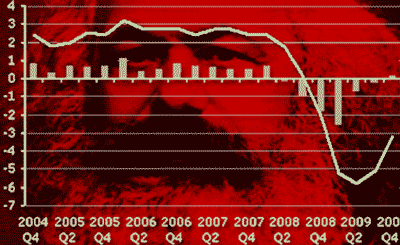 ABSTRACT – In Capital in 21st century, Thomas Piketty criticizes Marxian theory and the law of the tendency of the rate of profit to fall in the long term. His main argument, asserted by other authors since decades, is related to the capacity of increases in productivity to counterweight the tendency. The French author establishes a stable “rate of return” too, but this rate and his critics on Marx are founded on a neoclassical perspective. Thus Piketty denies the validity of the law but changing its determinations as a result of the labor theory of value and the valorization process. When a proper definition of the matter in Marxian terms is done, Piketty’s data itself confirms the law of the tendency of the rate of profit to fall.
Introduction
The work of Karl Marx has had a widespread influence in different academic disciplines. However, the interpretation of his work has been influenced by specific historical contexts. The current global crisis has renewed interest in his theory and its implications for the analysis of economics and modern history. The latter has involved a growing debate, not only between the Marxist school and neoclassical and Keynesian schools, but also within Marxism. Leer más…
«David Harvey, Piketty and the central contradiction of capitalism»: Michael Roberts
 David Harvey is the well-known Marxist Professor of Anthropology and Geography at the Graduate Center of the City University of New York. Harvey has a new book out and has also reviewed Thomas Piketty’s (http://davidharvey.org/2014/05/afterthoughts-pikettys-capital/). Harvey is pretty critical of Piketty’s book. Harvey recognises that Piketty provides powerful data on the inequality of wealth and income in the major capitalist economies since the capitalism became the dominant mode of production and social relations from about 1750. “What Piketty does show statistically (and we should be indebted to him and his colleagues for this) is that capital has tended throughout its history to produce ever-greater levels of inequality. This is, for many of us, hardly news. It was, moreover, exactly Marx’s theoretical conclusion in Volume One of his version of Capital.”
But, as Harvey says, Piketty says nothing about recurrent crises of production and investment in capitalism. Piketty “does not tell us why the crash of 2008 occurred and why it is taking so long for so many people to get out from under the dual burdens of prolonged unemployment and millions of houses lost to foreclosure. It does not help us understand why growth is currently so sluggish in the US as opposed to China and why Europe is locked down in a politics of austerity and an economy of stagnation. “ Leer más…
«Afterthoughts on Piketty’s Capital»: David Harvey
 Thomas Piketty has written a book called Capital that has caused quite a stir. He advocates progressive taxation and a global wealth tax as the only way to counter the trend towards the creation of a “patrimonial” form of capitalism marked by what he dubs “terrifying” inequalities of wealth and income. He also documents in excruciating and hard to rebut detail how social inequality of both wealth and income has evolved over the last two centuries, with particular emphasis on the role of wealth. He demolishes the widely-held view that free market capitalism spreads the wealth around and that it is the great bulwark for the defense of individual liberties and freedoms. Free-market capitalism, in the absence of any major redistributive interventions on the part of the state, Piketty shows, produces anti-democratic oligarchies. This demonstration has given sustenance to liberal outrage as it drives the Wall Street Journal apoplectic.
The book has often been presented as a twenty-first century substitute for Karl Marx’s nineteenth century work of the same title. Piketty actually denies this was his intention, which is just as well since his is not a book about capital at all. It does not tell us why the crash of 2008 occurred and why it is taking so long for so many people to get out from under the dual burdens of prolonged unemployment and millions of houses lost to foreclosure. It does not help us understand why growth is currently so sluggish in the US as opposed to China and why Europe is locked down in a politics of austerity and an economy of stagnation. What Piketty does show statistically (and we should be indebted to him and his colleagues for this) is that capital has tended throughout its history to produce ever-greater levels of inequality. This is, for many of us, hardly news. It was, moreover, exactly Marx’s theoretical conclusion in Volume One of his version of Capital. Piketty fails to note this, which is not surprising since he has since claimed, in the face of accusations in the right wing press that he is a Marxist in disguise, not to have read Marx’s Capital. Leer más…
«El desarrollo de la Teoría de la Distribución del Plusvalor de Marx en los Manuscritos de 1861-63»: Fred Moseley

He argumentado en múltiples trabajos (Moeseley 1993, 2000, 2002) que la teoría del plusvalor de Marx se estructura en términos de dos niveles básicos de abstracción: (1) la producción de plusvalor, en la que se determina la cantidad total de plusvalor en la economía como un todo y (2) la distribución del plusvalor, en la se la cantidad total de plusvalía predeterminada se divide en partes individuales (tasas de ganancia iguales, ganancia comercial, interés y renta). En la teoría de la distribución del plusvalor, la cantidad de plusvalor a ser distribuido se toma como dado, ya determinado por la anterior teoría de la producción del plusvalor. Esta premisa cuantitativa clave se repite en muchas ocasiones en todos los borradores de El Capital, especialmente en los borradores del Volumen 3 de El Capital en el Manuscrito de 1861-63 y en el Manuscrito de 1864-65. Otros autores también han enfatizado en la determinación previa del plusvalor total en la teoría de la distribución del plusvalor de Marx como: Paul Mattick, David Yaffe y Duncan Foley.
Los Grundrisse se encuentran prácticamente en su totalidad al nivel de abstracción del capital en general, el cual se divide en tres secciones: el proceso de producción del capital, el proceso de circulación del capital y una breve sección sobre el capital y la ganancia. Además hay pocas discusiones breves sobre la igualación de las tasas de ganancias entre industrias, un aspecto de la distribución del plusvalor, y un tema que Marx mencionó en repetidas ocasiones “no pertenece aquí” (es decir, no pertenece a la sección del capital en general), sino que pertenece a la “futura investigación de la competencia”. Marx también afirmó claramente en estas breves discusiones que el plusvalor total se determina previo a su distribución, y específicamente previo a la igualación de las tasas de ganancia. Por ejemplo:
«Marx en su (Tercer) Mundo»: Entrevista a Néstor Kohan. ICAIC
 Marx en su (Tercer) Mundo. Entrevista a Nestor Kohan. Instituto Cubano de Arte e Industria Cinematográficos ICAIC (realizada por el escritor Julio Cesar Guanche – La Habana, Cuba). Videoteca contracorriente.
EPIC intervista Riccardo Bellofiore
 Riccardo Bellofiore è docente di «Analisi Economica», «Economia Monetaria», «International Monetary Economics» e «La Dimensione Storica in Economia: le Teorie» presso il Dipartimento di Scienze Aziendali, Economiche e Metodi Quantitativi (DSAEMQ) dell’Università di Bergamo.
«Historical Materialism at Sixteen»: Peter D. Thomas
 In the age of austerity, the world has witnessed a wide range of social movements fighting back. The 2014 Historical Materialism conference, taking place this weekend at Toronto’s York University, aims to contribute to a discussion on both austerity and resistance, and how to extend and revitalize Left critique and praxis.
Peter D. Thomas is a lecturer in the history of political thought at Brunel University, London. He is the author of The Gramscian Moment: Philosophy, Hegemony and Marxism. He is a member of the editorial board of Historical Materialism: Research in Critical Marxist Theory, and co-editor of the Historical Materialism Book Series.
In this interview, we discuss the trajectory of the Historical Materialism initiative, his view on Western Marxism and its legacy, and the importance of Antonio Gramsci for the wide range of movements that have emerged in the last decade all around the world. The interview was conducted by George Souvlis, a PhD candidate in history at the European University Institute, Florence. Leer más…
«Los Manuscritos de 1844 de Marx en mi vida y en mi obra»: Adolfo Sánchez Vázquez
 Los organizadores del presente ciclo de mesas redondas sobre «Capitalismo mundial y crítica total de la sociedad burguesa. Karl Marx, 1844-1994 a 150 años de los Manuscritos de París», decidieron generosamente abrir un espacio, a modo de un homenaje que a la vez me abruma y me honra, tomando en cuenta —supongo yo— la atención que he prestado desde hace ya más de treinta años a la obra juvenil marxiana que constituye el hilo conductor de este ciclo. Los textos míos que tienen que ver más directamente con esa obra (Las ideas estéticas de Marx, Filosofía de la praxis y Filosofía y economía en el joven Marx) han sido objeto de las dos exposiciones que hemos escuchado: por parte de Silvia Duran con respecto al primero de ellos, de Jorge Veraza, en relación con los dos restantes, antes citados. Ya por el simple hecho de prestarles semejante atención, expreso a ambos ponentes mi más sincero agradecimiento.
Aunque me referiré más adelante a ambas exposiciones en cuanto que se ocupan, desde diferentes ángulos de dos campos temáticos que he cultivado: la estética y la filosofía de la praxis, quiero anunciarles que voy a hablar, en primer lugar, de mi relación o trato con los Manuscritos de 1844. Me permito recordar a los presentes, jóvenes en su mayoría, que desde que yo me ocupé por primera vez de esta obra juvenil marxiana en un ensayo titulado «Ideas estéticas en los Manuscritos económico-filosóficos de Marx» han pasado treinta y tres años. La distancia en el tiempo con los otros textos míos, antes mencionados es menor, aunque no mucho menos. Desde entonces, ha corrido mucha agua bajo el puente de la teoría, pero sobre todo bajo el de la práctica. Y como yo no he querido nadar contra esa corriente, debo advertir que los textos antes citados no son los mismo para mí (es decir, no tienen una identidad inmutable), ni yo soy tampoco el mismo en relación a ellos. Lo cual no significa, como habremos de ver, que deje de reconocer cierta permanencia en el cambio: justamente la que me permite en estos tiempos de desencantos, incertidumbres y rupturas sinceras u oportunistas, seguir considerándome marxista. Leer más…
Reading Marx’s Capital with David Harvey

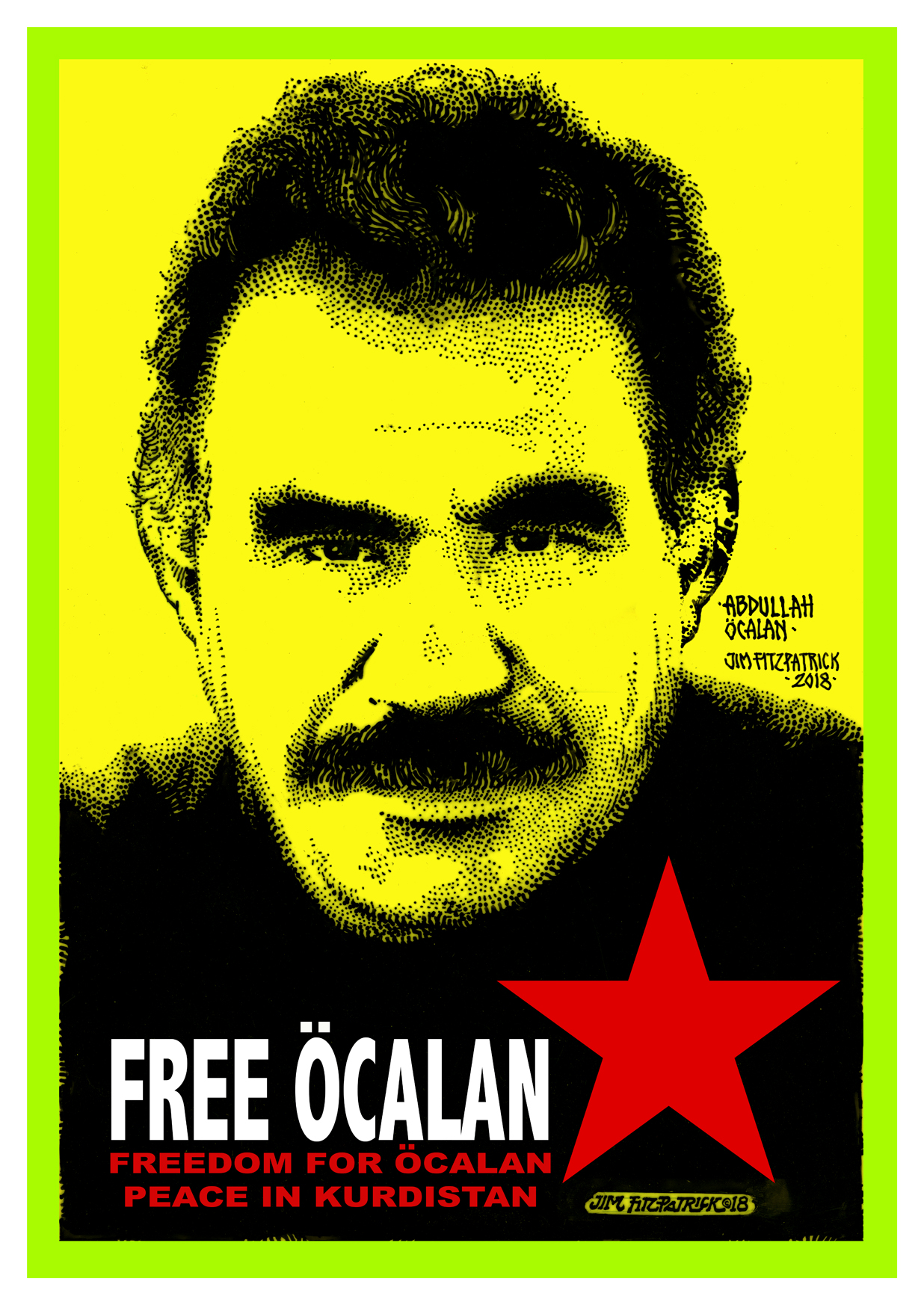
Free Öcalan


Fundación Infancia y Aprendizaje

Colección de libros Marxismo Crítico

Historical Materialism


CIPEC (Centro de Investigación en Pensamiento Crítico)

Centro para la Investigación como Crítica Práctica

Memoria Revista de Crítica Militante

Revista Laberinto






Marx desde cero




 marxismocritico.com