
Archivo
«Dialéctica y capital: Elementos para una reconstrucción de la crítica de la economía política»: Robles Báez, Mario L. Compilador
 México DF: UAM-X, CSH, Depto. de Producción Económica; 2005 México DF: UAM-X, CSH, Depto. de Producción Económica; 20051ra. edición Págs. 318 ISBN: 9703104681 |
||

|
Reedición de «Dialéctica de lo abstracto y lo concreto en «El Capital» de Marx»: Evald Ilyenkov
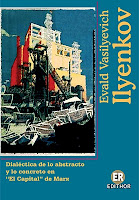 Título: Dialéctica de lo abstracto y lo concreto en «El Capital» de Marx
«Money, Marx, and Gold» entrevista a Alan Freeman
 The guest this week is the Heterodox or Marxist Economist Alan Freeman. We talk about why gold is still relevant in this Late Capitalist moment even though we’re off the gold standard. And we discuss gold’s special relationship to money.
«Why Could Marx Not Complete Capital?»: Michael R. Krätke
 York University, Department of Political Science Seminar Series 2011.
«Probabilidad, economía y la teoría del valor trabajo»: Emmanuel Farjoun y Moshe Machover
 Introducción
En nuestro libro Leyes del caos, publicado por Verso en 1983, abogamos por un desplazamiento metodológico básico en los fundamentos de la economía política.1Economistas y filósofos económicos a menudo han señalado la naturaleza esencialmente indeterminada y estadística de categorías económicas tales como precio y tasa de ganancias.2 Los marxistas, en particular, han reconocido que esta indeterminación tiene sus raíces en la naturaleza desordenada, descoordinada y caótica de las relaciones de mercado capitalistas.3 Sin embargo, en la práctica (teórica), el enfoque tomado por todas las escuelas económicas, marxistas y no marxistas por igual, es predominantemente determinista: las categorías económicas básicas son teorizadas como cantidades numéricas determinadas, interrelacionadas por medio de leyes deterministas. En Leyes del caos, abogamos por el abandono de esta metodología en favor de un marco conceptual totalmente probabilístico, que no solamente le preste servicio verbal a la naturaleza estadística de las categorías económicas básicas, sino que actualmente se incorpore dentro de sus modelos teóricos. Estas categorías, sostenemos nosotros, deberían ser teorizadas como “variables de azar”, interconectadas por leyes estadísticas. También intentamos mostrar cómo, tal metodología, aplicada a la teoría económica marxista, puede producir una versión probabilística, reconstruida y moderna, de la teoría del valor trabajo, capaz de trascender la profunda crisis teórica de la economía política marxista tradicional. En nuestra opinión, esta crisis se debe en gran parte a la mediación determinista errónea que plantea la teoría tradicional, entre valores y precios de mercado, siendo el eslabón mediador los llamados precios de producción.
«La Dialéctica de la Tasa de Ganancia y los Precios en la Conceptualización del Capital de Marx»:Mario Robles L. Báez
 Marx señala claramente que el objeto de su trabajo científico-filosófico es el concepto de capital en cuanto el sujeto económico que domina y rige el movimiento de la sociedad capitalista. La presentación de los resultados de sus investigaciones sobre el capital se encuentra en varios de sus manuscritos originales, algunos de los cuales Marx mismo publicó después de una exhaustiva reelaboración. En El Capital, quizás su obra más importante y completa sobre la presentación de este concepto, el capital es concebido como un universal concreto y, por lo tanto, como una totalidad, que se desenvuelve a sí mismo,conteniendo dentro de sí las partes, diferenciaciones o momentos, que lo componen y determinan. Como tal, éste es puesto allí como el resultado tanto del texto como un todo como del conjunto de momentos y categorías que conforman su estructura lógica de presentación, donde sus momentos no sólo son articulados sistemáticamente de manera dialéctica, sino además su orden de presentación no coincide con aquellos que corresponden a su surgimiento y desenvolvimiento histórico. Después de Marx, para los economistas políticos marxistas ha sido, sin embargo, una tarea difícil comprender plenamente este concepto, debido sobre todo a que la sociedad capitalista es una realidad invertida, producida y dominada por el capital y que, por lo tanto, el capital mismo se les presenta como un objeto muy peculiar de investigación. Esta dificultad se ha hecho evidente por las diferentes apreciaciones opuestas entre sí, no sólo de la naturaleza ontológica de la concepción del capital mismo, sino también del método de presentación de suestructura lógica que se ha manifestado en una larga y continua controversia sobre los diferentes momentos de determinación que la conforman y de su articulación dialéctica en los diferentes textos en que Marx presenta este concepto.
«Marx’x notes on method a ‘reading’ of the 1857 Introduction»: Stuart Hall
 Prefatory note
This is a shortened version of a paper on Marx’s 1857 Introduction presented to and discussed in a series of Centre seminars. It has been somewhat revised in the light of those discussions, though I have not been able to take account of some further, more substantive criticisms generously offered by John Mepham, among others. The 1857 Introduction is Marx’s most substantial text on ‘method’, though even here many of his formulations remain extremely condensed and provisional. Since the Introduction presents such enormous problems of interpretation, I have largely confined myself to a ‘reading’ of the text. The positions taken by Marx in the Introduction run counter to many received ideas as to his ‘method’. Properly grasped and imaginatively applied – as they were in the larger corpus of the Grundrisse to which they constantly refer – they seem to me to offer quite striking, original and seminal points of departure for the ‘problems of method’ which beset our field of study, though I have not been able to establish this connection within the limits of the paper. I see the paper, however, as contributing to this on-going work of theoretical and methodological clarification, rather than as simply a piece of textual explication. I hope this conjuncture will not be lost in the detail of the exposition.
«Marx contra Vogt. Apuntes para una biografía intelectual de los años 1860-1861»: Marcello Musto
 A través del último volumen de la Marx-Engels Gesamtausgabe (MEGA2), accedemos a la publicación completa de la correspondencia de Karl Marx entre 1860-1861: un capítulo demasiado poco explorado de su biografía intelectual. Este período comprende la redacción del polémico escrito El señor Vogt, los esbozos de El capital, los artículos periodísticos para el New York Tribune y para el Die Presse, además de los estudios realizados a través de minuciosas lecturas, las vicisitudes de su salud y la incierta fortuna de su existencia, causada por la profunda miseria que lo oprimía.
«Entrevista a Diego Guerrero sobre el Resumen completo de El capital de Marx»: por Revista Laberinto
La entrevista que el lector tiene ante sí, es el resultado de las cuestiones que se le trasladaron a nuestro colaborador, Diego Guerrero, en relación al libro Un resumen completo del Capital, publicado en 2008 por Ediciones Maia. La introducción de este libro, a modo de artículo, pudimos leerla en el número 29 de nuestra revista y no fue esta la única vez en la que se hizo referencia a dicho libro pues en el número 32 pudimos leer una reseña sobre el mismo, realizada por Encarna Ruíz Galacho. A través de esta entrevista queremos aprovechar la ocasión para poder profundizar con el autor, en las interesantes cuestiones que en él aparecen y que sin duda podrán inducir a profundas reflexiones. Esperamos que les resulte útil e interesante a nuestros lectores.
«Economic crisis and socialist revolution: Henryk Grossman’s Law of accumulation, its first critics and his responses»: Rick Kuhn
 Abstract
Henryk Grossman was the first person to systematically explore Marx’s explanation of capitalist crises in terms of the tendency for the rate of profit to fall and to place it in the context of the distinction between use and exchange value. His The law of accumulation and breakdown of the capitalist system remains an important reference point in the Marxist literature on economic crises. That literature has been plagued by distortions of Grossman’s position which derive from early hostile reviews of his book. These accused Grossman of a mechanical approach to the end of capitalism and of neglecting factors which boost profit
rates. Grossman, in fact, contributed a complementary economic element to the recovery of Marxism undertaken by Lenin (particularly in the area of Marxist politics) and Lukács (in philosophy). In both published and unpublished work, Grossman also dealt with and even anticipated criticisms of his methodology and treatment of countertendencies to the tendency for the rate of profit to fall. Far from being mechanical, his economic analysis can still assist the struggle for working class self-emancipation.
«La economía de la sociedad capitalista y sus crisis recurrentes»: Foladori Guillermo y Melazzi Gustavo
 Este trabajo tiene su origen en un compromiso con quienes crean la riqueza a disposición de la humanidad: los trabajadores.
Pero el disfrute de esa riqueza ha sido y es extremadamente desigual. Cualquier propuesta ética, de justicia social, está obligada a enfrentar esta realidad. Pero es imposible hacerlo sin tener claro el funcionamiento del sistema en que vivimos, el capitalismo. De allí la necesidad de un material sencillo pero riguroso, que explique a fondo la economía y la sociedad, para construir entre todos una real alternativa.
Esperamos que quienes participen de la rebeldía frente a las pavorosas injusticias que nos rodean, y comprometen incluso la vida en el planeta, encuentren en este trabajo una ayuda
que esclarezca y consolide actitudes.
«Primitive Accumulation and Capitalist Accumulation: Economic Categories and Social Constitution»: Werner Bonefeld
Abstract
The distinction between ‘inquiry’ (Forschung) and ‘presentation’ (Darstellung) is important for the understanding of Capital. Its ‘mode of presentation’ (Darstellungweise) does not follow the narrative history of capitalist development but begins with the finished forms – money, commodities, exchange value, etc. – in which capitalist social relations reproduce themselves. It is not until the analysis of primitive accumulation in Part VIII that the historical presuppositions of the analysis of chapter 1 are presented. Marx’s critique of political economy is thus in reverse order to the actual, historical sequence in which the social relations underlying these categories developed. The paper argues that although these underlying relations seemingly disappear in capitalist social forms, they are constitutive of it.
Introduction
Over the last decade there has been an increase in the trafficking of women and children. New markets have emerged in human organs and babies. The proprietors of labour power are confronted not only with new forms of exploitation (see Caffentzis, 2003). They are also transformed into a dissectible resource to be operated on and sold. These developments have let some commentators to argue that we are witnessing the re-emergence of conditions of primitive accumulation (see, amongst others, Dalla Costa, 1995, 2003, de Angelis, 2001). These works show clearly that Marx’s insight according to which ‘a great deal of capital, which appears today in the United States without certificate of birth, was yesterday, in England, the capitalist blood of children’ (Marx, 1983, p. 707), remains a powerful judgement of contemporary conditions.
The paper argues that primitive accumulation describes not just the period of transition
that led to the emergence of capitalism. Its systematic content is in fact constitutive of
capitalist social relations. It is the premise and presupposition of capitalistically organised
social relations. Capitalist social relations rest on the divorce of the mass of the population from the means of production. This divorce was the result of primitive accumulation and is the historical presupposition and constitutive basis of capitalist social relations. At issue is thus the transformation of capitalism’s historical presupposition in dispossession into the constitutive premise of its existence. The conclusion looks at the consequences for socialist practice.
«The Economic Crisis & Left Responses Video»
 The Economic Crisis & Left Responses was convened by Marxist-Humanist Initiative on November 6, 2010 at Pace University in lower Manhattan. Panel 1 features Brendan Cooney, Roslyn Bologh, Richard Wolff, Andrew Kliman, and Ray McKay (chair). Panel 2 features Paul Mattick, Walter Daum, Mac Intosh, and Brendan Cooney (chair). Panel 3 features Barry Finger, Anne Jaclard, Fred Moseley, Mike Dola (closing remarks), and Walter Daum (chair). Click here for the conference program, which includes links to speakers’ biographies, abstracts, and draft papers posted prior to the conference. Many of the papers prepared for the conference are now available online. Click here to view conference papers.
Seminario «La actualidad de Marx» UNAM-12 de diciembre 2011
 Descripción: Seminario La actualidad de Karl Marx Lunes 12 de diciembre de 2011 Plusvalor y trabajo vivo en Marx Enrique Dussel Universidad Autónoma Metropolitana, México COORDINADORES Alejandro Valle Baeza, José Guadalupe Sandoval, Carlos Morera
Leer más…
«The development of Marx’s theory of the distribution of surplus-value»: Fred Mosely
 Marx’s theory of the production and distribution of surplus-value is based on a fundamental methodological premise, which has not been sufficiently recognized: that the total amount of surplus-value is determined prior to and independent of the division of this total amount into individual parts. The individual parts of surplus-value are then determined at a subsequent stage of the analysis, with the predetermined total amount of surplus-value taken as a given magnitude. This premise was first discussed by Marx in the Grundrisse with respect to the equalization of rates of profit across different branches of production. In the second draft of Capital, written in 1861-63, parts of which have been only recently published in English, Marx also began with this premise as he worked out his theories of rent, interest, and merchant profit. In the remaining drafts of Capital, this fundamental premise is consistently adhered to and emphasized, especially in Volume 3, in which the distribution of surplus-value is the main subject.
Marx expressed this fundamental premise of his theory concerning the prior determination of the total amount of surplus-value in terms of the distinction between the stages of analysis of «capital in general» and «competition» (or «many capitals»). Capital in general refers to the essential properties that all capitals have in common. The most important common property of capitals is their capacity for self-expansion, i.e. their ability to produce surplus-value. Therefore, the main question addressed in the analysis of capital in general is the determination of the total amount of surplus-value produced in the capitalist economy as a whole. Competition refers to the relations among capitals, and, in particular, to the distribution of surplus-value among capitals, first among the different branches of production and then the further division of surplus-value into industrial profit, merchant profit, interest, and rent.
Reading Marx’s Capital with David Harvey

Free Öcalan



Fundación Infancia y Aprendizaje

Colección de libros Marxismo Crítico

Historical Materialism


CIPEC (Centro de Investigación en Pensamiento Crítico)

Centro para la Investigación como Crítica Práctica

Memoria Revista de Crítica Militante

Revista Laberinto






Marx desde cero





 marxismocritico.com