
Archivo
«An Introduction to the History of Crisis Theories»: Anwar Shaikh
 Introduction
This paper is about the history of crisis theories. Broadly speaking, the term «crisis» as used here refers to a generalized set of failures in the economic and political relations of capitalist reproduction. In particular, the crises we seek to examine are those towards which the system is internally driven, by its own principles of operation. As we shall see, it is in the nature of capitalist production to be constantly exposed to a variety of internally and externally generated disturbances and dislocations. But only at certain times do these «shocks» set off general crises. When the system is healthy, it rapidly revives from all sorts of setbacks; when it is unhealthy, practically anything can trigger its collapse. What we seek to examine is different explanations of how and whyy the system periodically becomes unhealthy.
I Reproduction and Crisis
Consider how peculiar capitalist society is. It is a complex, interdependent social network, whose reproduction requires a precise pattern of complementarity among differen productive activities: and yet these activities are undertaken by hundreds of thousands of individual capitalists who are only concerned with their private greed for profit. Is is a class structure, in which the continued existence of the capitalist class requires the continued existence of the working class: and yet no blood lines, no tradition, no religious principle announces who is to rule and who is to be ruled. Is is a cooperative human comunity, and yet it ceaselessly pits each against the other: capitalist against worker, but also capitalist against capitalist and worker against worker.
«Capitalismo y modernidad»: Antoni Domènech
 Seminario Teórico: Crítica Humanista del Capitalismo Total
Ponencia: Capitalismo y modernidad por Antoni Doménech
«The profit rate in the presence of financial markets: a necessary correction»: Alan Freeman
In the past two decades the number, variety, and monetary value of marketable financial instruments, particularly securitized instruments, has grown by orders of magnitude. This is the most significant development in what many writers, for the most part Marxist, term ‘financialisation’1. It brings to light, however, an anomaly in the way they calculate the profit rate. This calculation takes no account of the capital tied up in these instruments.
This article shows that when this omission is corrected, there is a consistent long-run fall in the UK and US rate of profit which, contrary to the figures widely used by Marxists, have both fallen almost monotonically since 1968.
Why does this matter? First, the profit rate figures prominently in Marx’s own theory, as is clear from his published works. It is the explicit subject of the first 15 chapters of Capital Volume III (Marx, 1981: 117-378) and dominates the remaining analysis. Second, the results shed light on current debates about the cause of the present extended crisis. A significant group of writers (see Choonara, 2011) argue that this is recent in origin, unconnected with the serious difficulties that beset Western economies in the 1970s, and follows a recovery from that crisis, brought about by neoliberalism, in the 1980s. Thus Husson:
«After the generalized recessions of 1974-5 and 1980-82, a new phase opened in the functioning of capitalism, one which one could for convenience call neo-liberal. The beginning of the 1980s was a real turning point. A fundamental tendency towards increasing the rate of exploitation was unleashed, and that has led to a continuous rise in the rate of profit» (2008).
Leer más…
“A estratexia do esquecemento do capitalismo / La estrategia del olvido del capitalismo” : Miren Etxezarreta
 Conferencia de Miren Etxezarreta en la XXX Semana Galega de Filosofia, “Filosofía y memoria”, 1 al 5 de abril de 2013, Pontevedra. Organizada por Aula Castelao de Filosofia. Duración de la intervención: 1:46:27
«The environmental crisis and capitalism»: Fred Magdoff and Lawrence Susskind
 The environmental damage being done to the earth has reached crisis proportions. Many causes have been proposed: too many people; industrial society; human ignorance or inability to control themselves; human nature (greed); and a «perpetual growth philosophy.» Discussion will be focused on how the inner logic and normal functioning of our economic system is contributing to this crisis.
Fred Magdoff is professor emeritus of plant and soil science at the University of Vermont. He is author of numerous articles and books on agriculture, world food problems, and the environment. He is coauthor with John Bellamy Foster of What Every Environmentalist Needs to Know About Capitalism (2011).
Lawrence Susskind, Department of Urban Studies and Planning; Director, MIT Science Impact Collaborative; Co-Director, Water Diplomacy Workshop
«La implosión del sistema europeo»: Samir Amin
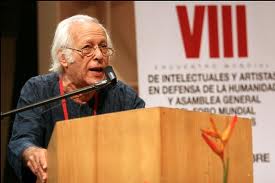 La opinión pública mayoritaria europea sostiene que Europa tiene todo lo que necesita para convertirse en una potencia económica y política comparable, y por lo tanto independiente de los Estados Unidos. La simple suma de sus poblaciones con sus respectivos PIB hace que parezca obvio. En cuanto a mí, creo que Europa sufre de tres desventajas principales que descartan esa comparación.
«Gender and Democracy in the Neoliberal Agenda: Feminist Politics, Past and Present»: Silvia Federici
 6th Subversive festival
13/05/2013, 21:00h, cinema Europa
Silvia Federici »Gender and democracy in the Neo-liberal agenda: feminist politics past and present
Moderator: Ankica Čakardić
As feminism has been institutionalized and subsumed to the neo-liberal agenda in the name of democratization, a feminist critique of liberal democracy is more urgent than ever. Federici discusses the role this grand illusion has played in feminist politics and contrasts it with the contribution feminist movements have made to democracy intended as self-government and egalitarian division of the commonwealth.
Marcello Musto presenta il suo libro «Ripensare Marx e i marxismi – Studi e saggi»

Palazzo Albani, Urbino, 17 maggio 2012
Marcello Musto presenta il suo libro «Ripensare Marx e i marxismi – Studi e saggi»
Introduzione di Domenico Losurdo e Stefano G. Azzarà.
Fonte video: http://www.uniurb.it
«Michael Heinrich, Marx’s law and crisis theory»: Michael Roberts
 Michael Heinrich is an exponent of what is known as the ‘New German Reading of Marx’, which interprets the theory of value that Marx presents in Capital as a socially specific theory of ‘impersonal social domination’. He is a collaborator on the MEGA edition of Marx and Engel’s complete works and has published several philological studies of Capital. He has also authored a work on Marx’s theory of value, The Science of Value, which is forthcoming in the Historical Materialism book series. And recently he has published An Introduction to all Three Volumes of Capital as his first full-length work to appear in English.
I am not going to do a critique of Heinrich’s views on the theory of value, as this has been done by Guglielmo Carchedi in his book, Behind the Crisis (see chapter 2). But I am moved to respond to a recent article of Heinrich’s in the American Monthly Review, entitled Crisis theory, the law of the tendency of the rate of profit to fall and Marx’s studies in the 1870s (monthlyreview.org).
In this article, Heinrich makes the following points: 1) Marx’s law is inconsistent because its categories are indeterminate; 2) it is empirically unproven and even unjustifiable on any measure of verification; 3) Engels badly edited Marx’s works to distort his view on the law in Capital Vol 3; 4) Marx himself in his later works of the 1870s began to have doubts about the law as the cause of crises and started to abandon it in favour of some theory that took into account credit, interest rates and the problem of realisation (similar to Keynesian theory); 5) Marx died before he could present these revisions of his crisis theory, so there is no coherent Marxist theory of crisis.
«Confesiones de un marxista errático»: Yanis Varoufakis
 Cuando hice mi tesis doctoral, conscientemente elegí concentrarme en un método, conforme al cual no sólo andaba Marx lisa y llanamente errado, sino que era irrelevante. Cuando conseguí mi primer puesto como lector en teoría económica en Gran Bretaña, el contrato implícito entre mi universidad y yo era que el tipo de teoría económica que enseñaría a nuestros estudiantes estaría tan alejado del marxismo como fuera humanamente posible. Cuando me trasladé a Australia en 1988, y sin yo saberlo, fui reclutado por el sector derechista del Departamento de Teoría Económica de la Universidad de Sidney, a fin de cerrarle el paso a otro candidato, cuyo director de tesis tenía (¡fundadisima!) fama de ser un peligroso marxista. Luego me traslade a Grecia, en donde, de la forma más insensata, llegué a ser, más o menos oficialmente, asesor de George Papandreu, el hombre cuyo gobierno habría de ser el intermediario en la transición hacia el infierno unos años después. Cuando dimití de ese cargo en 2006, consciente del desastre que se avecinaba, pasé a enseñar en la Universidad de Atenas, y a enseñar -lo admito- asuntos tan vulgarmente burgueses como Teoría de los Juegos y Microeconomía a un gran número de estudiantes griegos de primer ciclo, quienes (a diferencia de nuestros bravos y excelentemente informados estudiantes de posgrado) permanecían conmovedoramente ciegos ante la catástrofe que se les venía encima. Antes, en 2002, Joseph Halevi y yo habíamos tratado de hacer sonar una alarma, pero no conseguimos resonancia. Aun cuando en 2006 hice lo que en mi mano estaba para alertar a la sociedad griega -y a cualquiera que quisiera escuchar- del desastre en ciernes, seguí formando parte vergonzosamente de la «sociedad respetable» en Europa, y no me eché a la calle ni una sola vez.
“Lliçons sobre el capítol sisè (inèdit) de Marx de Claudio Napoleoni»: Ivan Gordillo
 “El capital, llibre I, capítol VI (inèdit). Resultats del procés immediat de producció”1 més conegut amb el nom d’Inèdit és un text escrit per Marx als voltants de 1865 que finalment no va incloure en la versió definitiva del llibre I de El capital que va aparèixer per primera vegada el 1867. Aquest text es pot trobar individualment en edicions en format llibre que no superen les 150 pàgines. És, per tant, un text de reduïdes dimensions si ho comparem amb altres obres del pensador alemany.
Tot i el caràcter de treball previ no definitiu, l’Inèdit és d’especial interès perquè conté gran part del contingut teòric essencial del llibre I de El capital. A més, està escrit en un estil força menys farragós que d’altres obres de l’autor pel que creiem pot ser de gran utilitat als lectors novells en el pensament de Marx o aquells que volen iniciar-se en la lectura de El capital.
¿Para qué sirve El Capital?: Iñaki Gil de San Vicente
 Texto escrito para el 2do Encuentro de Escuela de Cuadros que se llevará a cabo en la Fundación Centro de Estudios Latinoamericanos Rómulo Gallegos (CELARG), Caracas, del 30 de mayo al 1 de junio del 2013.
Estamos reunidos aquí para reflexionar sobre una interrogante ¿Para qué sirve El Capital? La respuesta es simple e inmediata: para avanzar al comunismo mediante la revolución socialista. El Capital fue escrito para ser la obra cumbre de toda la impresionante praxis revolucionaria de Marx, pero también de Engels. Será esta respuesta inmediata la que oriente este texto. Sin la perspectiva práctica revolucionaria, sin la perspectiva política en suma, nada del marxismo es comprensible, y por tanto El Capital es ininteligible. Ahora bien, como iremos viendo, la política marxista no se reduce a la politiquería parlamentarista por muy de izquierdas y de masas que diga ser, y menos todavía burguesa y reformista, sino que en sí misma, la política revolucionaria es la síntesis del resto de prácticas económicas.
«Simón Bolívar y nuestra Independencia» : Conferencia de Néstor Kohan
 Conferencia de Néstor Kohan «Simón Bolívar y nuestra Independencia» pronunciada en el marco del Seminario del Partido de los Trabajadores de Méjico, 2013, dónde Kohan presenta las principales tesis de su último libro «Simón Bolívar y nuestra Independencia. Una mirada latinoamericana» publicado en abril de 2013 por la Editorial Yulca. más info. www.editorialyulca.com
«Things Fall Apart: Cosmovision under Capitalism»: Chris Gilbert
 Capitalism has the dubious honor of being the first civilization lacking in a cosmovision. From original communitarianism forward, we encounter societies that see man as part of a more or less inviolable socio-natural order: these ordering systems range from the totemic structures of original communitary societies to medieval conceptions such as the “great chain of being.”
The best explanation for this nearly universal characteristic is that in all previous societies human beings were in the dominated pole of the society-nature dyad. As a consequence, there evolved rich mythological apparatuses. Myth served to mediate the relation to a natural world that could not be controlled or dominated.
Socio-natural ideas of order even informed practices of governance in as much as rulers inevitably sought to maintain – and were responsible for – a harmonious relation with nature. The classical scholar George Derwent Thomson refers to how Chinese emperors of the Zhou Dynasty were charged with maintaining a correct relation with the elements:
“If the emperor did not govern in harmony with the celestial movements – Thomson writes – bad omens would appear and society would fall into disorder. At the same time, the society’s good government was a necessary condition for maintaining the natural order.” [1]
In the modern world this type of relation is relegated to literature. For example, in the Elizabethan drama King Lear, the political crisis is linked to an environmental one. A real tempest runs parallel (with its “fretful elements”) to the political and social disorder unleashed in the kingdom.
«Marx, Ricardo e Smith: sobre a teoria do valor trabalho»: Reinaldo Carcanholo
 “O marxismo são marxismos – e os marxistas estão hoje plenamente conscientes desse fato, além de estarem, também, plenamente satisfeitos com essa pluralidade. Como se sabe, o marxismo não é propriamente uma ilha, mas vem a ser um arquipélago formando por um grande número de ilhas, mais ou menos próximas entre si. É nessa perspectiva que se deve enxergar o livro Marx, Ricardo e Smith, do prof. Reinaldo Carcanholo – livro este em que ele procurou retomar criticamente os três clássicos do pensamento econômico. Justamente por respeitar essa pluralidade, ele pode ser bem enfático na defesa de suas posições sobre as teorias do valor dos três autores mencionados. Marx dentre os três, como ele próprio deixa claro, é o mais profundo.
Os ensaios reunidos nesse livro são resultados de um prolongado esforço de compreensão desses três autores, nenhum deles fácil de ler e de compreender como os manuais de economia matemática (cuja dificuldade eventual é meramente técnica). Eles se debruçaram com denodo sobre a complexidade do mundo real para revelá-la em sua verdade e isto está refletido na riqueza conceitual – e certa obscuridade constitutiva – de seus escritos. Pois, aquilo que é contraditório não se deixa conhecer por um discurso claro, sem contradições. Em toda a sua vida intelectual, o prof. Reinaldo Carcanholo se dedicou com paixão à compreensão dos autores que, agora, ele ousa expor e criticar. Trata-se, pois, de um livro que vem contribuir para o desenvolvimento de uma cultura econômica de esquerda no Brasil.” (Eleutério Prado)
Reading Marx’s Capital with David Harvey

Free Öcalan



Fundación Infancia y Aprendizaje

Colección de libros Marxismo Crítico

Historical Materialism


CIPEC (Centro de Investigación en Pensamiento Crítico)

Centro para la Investigación como Crítica Práctica

Memoria Revista de Crítica Militante

Revista Laberinto






Marx desde cero





 marxismocritico.com