
Seminario «Pensar el Marxismo hoy» dedicado a la memoria de Francisco Fernández Buey
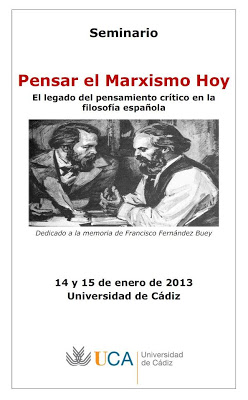 «Hacer de la pasión de los de abajo una pasión razonada,
apta para que tome cuerpo en otra sociedad, en una sociedad sin clases, sin explotación, sin alienación»
Francisco Fernández Buey
(1943-2012)
14 y 15 de enero de 2013
Aula Magna. Facultad de Filosofía y Letras
«Non-linear Processes and the dialectic»: Andy Blunden
 Most writers and researchers in the humanities speak of something like “dialectical processes” or “dialectical thinking” and use a number of metaphors to characterise the complex and nuanced processes of reality in contrast to what may be called “linear” or “mechanical” processes or thinking.
In his exposition of dialectics in the Logic, Hegel dealt with this problem in great length and detail from a conceptual point of view. Six distinct forms of the dialectic can be abstracted from Hegel’s work.
I shall briefly review the metaphors and forms of words used in popular and scientific discourse and then outline the concepts Hegel introduced for these same problems.
Popular conceptions of linear and non-linear processes
The idea of characterising processes or someone’s conception of a process as ‘linear’ has its origin in mathematical representations of processes in natural science. Here there is a dependent and an independent variable (possibly time), and this relation may be represented by a line on a graph; given appropriate measures for each variable or combination of variables, this graph may take the form of a straight line. In this case, the same change in the independent variable produces the same change in the dependent variable (add an extra kg to the pan and the spring always extends by one cm.), and the change is reversible (remove one kg from the scales and the spring retracts by one cm.)
This is the archetype of the ‘linear process’: a cause always has the same effect and is reversible. The ‘linear effect’ is thus independent of how many times it is applied, and in this specific sense is independent of previous history and context. A process can still be ‘linear’ in the strict sense while being context- and repetition-dependent, but this dependence on context and history is usually taken as one of the characteristics of ‘non-linear’ processes: a certain stimulus always produces a certain response, but suddenly one more stimulus produces a different response – the straw that broke the camel’s back. Irreversibility is also taken as a characteristic of ‘non-linear’ processes: “you can’t unscramble an egg.”
«Gramsci & Hegemony»: Peter D Thomas
 Gramsci & Hegemony | Peter D Thomas | Counterforum | London | 3 May 2010
«Credit Crunch: origins and orientation»: Paul Cockshott and Dave Zachariah
 1. Introduction
The cyclical pattern of capitalism is periodically punctuated by severe crises that lead to restructuring of the political-economic system. In this article we argue that the underlying factor of the current crisis is a real economic imbalance caused by an unprecedented growth of the nancial sector. Moreover, we argue that a return to an expansive era of capital accumulation will become impossible in the advanced countries.
Each structural crisis opens opportunities for signi cantly advancing the position of the working-class. But it requires a socialist movement with the organisational and programmatic capacity to articulate and implement progressive policies. This is not the state of the movement at present. We believe that without a political economy of the working-class it is impossible to formulate a coherent political program of the working-class.
«Spielberg’s ‘Lincoln’, Karl Marx, and the Second American Revolution»: Kevin B. Anderson
 Summary: The film “Lincoln” shows the radicalization that had taken place in Civil War America by January 1865, with the Lincoln administration allying itself with the Radical Republicans to end slavery. At the same time, this Hollywood epic ignores both the economic/class dimensions and the warm exchange of letters between Marx’s First International and the Lincoln administration during the very same weeks that are the subject of the film — Editors
Steven Spielberg’s “Lincoln” zeroes in on a single, crucial month of the U.S. Civil War, a conflict that amounted to a second American revolution. In January 1865, as the Union victory over the Confederacy is just months away, President Abraham Lincoln decides to push through the Thirteenth Amendment to the U.S Constitution, abolishing slavery unconditionally and without compensation to the slaveowners. This is a far different Lincoln than the candidate of 1860, who refused to campaign as an abolitionist, or the president who delayed issuing the Emancipation Proclamation until almost the third year of the Civil War, in 1863. It is a Lincoln who has grown with the times, whose armies now include 200,000 Black troops, and whose speeches are beginning to hint at citizenship and voting rights for the former slaves.
Leer más…
«Ernesto Che Guevara: El sujeto y el poder»: Néstor Kohan
 Nota introductoria del autor a la segunda edición
Ernesto Che Guevara: El sujeto y el poder constituye la segunda edición (aumentada) de aquella que apareció por primera vez con el título Ernesto Che Guevara: Otro mundo es posible. Hemos decidido que el volumen aparezca con este otro título, que nombra alguno de sus capítulos, porque expresa y sintetiza mejor los debates fundamentales del pensamiento político y filosófico contemporáneo que intentamos abordar. Se trata de una doble discusión.
En torno al poder, horizonte y desafío central de los movimientos sociales y políticos que se oponen al capitalismo; y en torno a la dialéctica, método de pensamiento de los sujetos sociales que continúa siendo útil para comprender críticamente el sistema capitalista mundial como una totalidad concreta. Los ensayos aquí reunidos pretenden aportar argumentos desde una posición crítica tanto frente a quienes eluden o evaden el problema fundamental de cualquier cambio social radical como frente a quienes promueven un abandono de toda perspectiva dialéctica y humanista en aras del posmodernismo y otras variantes filosóficas análogas.
«El fetichismo de la mercancía»: Reinaldo Carcanholo
 “El carácter fetichista de la mercancía y su secreto”, una sección del primer volumen del “El Capital” (Carlos Marx, 1867) presentado por el economista brasileño Reinaldo Carcanholo.
«Estranhamento e Exploração: A Ontologia de Marx nos Grundrisse»: Mario Duayer
 Mario Duayer foi um dos tradutores dos Grundrisse de Marx direto do original em alemão para o português, agora publicado pela editora Boitempo. Como parte do lançamento do livro, Duayer foi convidado a discutir esta importante obra escrita entre os anos de 1857 e 1858, mas que veio a público somente no século XX. Entre os temas discutidos, Duayer colocou especial ênfase na subordinação, no pensamento de Marx nos Grundrisse, da exploração ao estranhamento social. Exploramos uns aos outros porque em primeiro lugar nos estranhamos socialmente. É a alienação como sociabilidade que permite a existência da exploração. A ontologia de Marx, portanto, não é somente uma ode ao fim da exploração, mas propriamente ao fim do estranhamento ou da alienação, ou do outro que me é externo e indiferente. Duayer aproveita também para comentar o relativismo ontológico de Thomas Khun sobre a co-existência de diferentes paradigmas, e mostra como as ideias de Marx, Lúckacs, Roy Bhaskar e Moishe Postone oferecem uma visão que contrasta com os recentes avanços de epistemologias pós-modernas.
«Distribución y concentración en Marx –el análisis estadístico pendiente-«: Emilio José Chaves
Marx habló de “acumulación”, “desigualdad, “distribución”, “concentración” y “centralización” desde conceptos contables empresariales como el plusvalor, el salario y el capital fijo, insuficientes para el análisis social a menos que se acepten ingresos mixtos y haya datos de sus respectivas poblaciones receptoras. Dos pasajes que citó indican que ese tipo de datos ya existían en 1865; quizás no había entonces métodos para su manejo adecuado, de modo que disertó sobre el tema de forma algo intuitiva y confusa pero en general acertada. Por el lado capitalista y desde tablas similares Vilfredo Pareto en 1898 -dejó una ley pronto refutada- y Otto Lorenz en 1905 -una curva sometida a reparación en los años 1950s-. Plantea: 1) Aplicar estadística basada en curvas de Lorenz a la econometría marxista permite profundizar la crítica estructural del sistema. 2) Además del VA y del capital acumulado, los tiempos totales disponibles de empleo y ocio son objetos finitos y claves de reparto social. 3) En la lucha actual del 99% popular contra el 1 % de élites mundiales está vigente este tema inacabado donde hay grandes espacios para proponer, innovar y avanzar hacia la utopía realizable del “buen vivir mundial” con la naturaleza y entre los humanos.
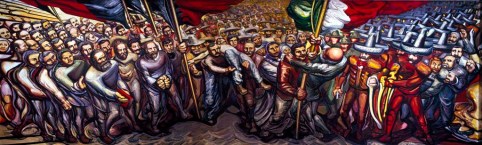
«Sociedad civil o sociedad burguesa. Ambivalencia o dialéctica de un concepto clave»: Wolfgang Fritz Haug
 1. Introducción
Pocos conceptos, sin duda, han sido utilizados en el último siglo y medio de una manera tan ilusoria por unos y equívoca por otros como el de sociedad civil. Pero, ¿qué se sigue de esto? ¿Es así pues inservible como concepto analítico? ¿Habría por tanto que prescindir de él en la elaboración de orientaciones y proyectos emancipatorios? Creo que antes de regalárselo a la ideología neoliberal a la vista de las posibilidades de uso impropio que ofrece, deberíamos detenernos un momento a examinar el catálogo de conceptos de los que más se ha abusado en nuestra época.
Porque resulta que cuando se llevan a cabo guerras de agresión contrarias al derecho internacional en nombre de los derechos humanos y de la democracia, estos mismos conceptos -derechos humanos y democracia- se sitúan justo en el encabezamiento de ese catálogo. O cuando, en nombre de la seguridad, se promueve la “globalización de la inseguridad” (Altvater/Mahnkopf), el concepto de seguridad se hace merecedor también de un lugar muy destacado en la lista, justo al lado del de libertad e incluso del de justicia, concepto este del que se ha hecho una caricatura blasfema con la llamada infinite justice. ¿Y qué pasa con las ideas de “responsabilidad, efectividad, flexibilidad e iniciativa” que adornan el catálogo de virtudes del neoliberalismo?
«Finance, crisis and the left alternatives»: Alfredo Saad-Filho
 Alfredo Saad-Filho, Dept. Head of Development studies at the University of London, England, says that we have a situation of malfunction, but there is not the political will to replace capitalism. In his recent talk in Vancouver, He says that he wants to see people claim the right to a different future. He says it is inconceivable that people will accept all the inequalities, the difficulties, the crisis and the waste that we have today. He also says that there is more than enough to satisfy everyone needs globally: Today there is no need or reason why people starve in different parts of the world (October-2010)
«The Dynamics of the Crisis»: Guglielmo Carchedi
 Download the slides from here http://www.isj.org.uk/index.php4?id=815&issue=134
«Comunismo y religión: La mística revolucionaria de José Carlos Mariátegui»: Michael Löwy
 Acerca de la religión, como acerca de otros tantos temas, Mariátegui es un heterodoxo.
Tradicionalmente, se entiende el comunismo moderno como un movimiento ateo, secular y profano, activamente opuesto a la religión, como a toda forma de “idealismo”. El pensamiento de José Carlos Mariátegui, uno des los principales fundadores del comunismo latinoamericano, tiene muy poco en común con esta imagen convencional. Acerca de la religión, como acerca de otros tantos temas, Mariátegui es un heterodoxo. En el corazón de su heterodoxia marxista, de la singularidad de su discurso filosófico y político, se encuentra un momento irreductiblemente romántico.
“La ciencia económica está absolutamente dominada por el enfoque ortodoxo”: Juan Pablo Mateo
 Juan Pablo Mateo Tomé es licenciado en Economía por la Universidad Autónoma de Madrid y doctorado en el dpto. de Economía Aplicada I de la Universidad Complutense. Ha realizado varias estancias de investigación en México, país donde llevó a cabo su tesis doctoral sobre la dinámica de acumulación y la tasa de ganancia. Actualmente se encuentra en la Universidad Federal Fluminense de Río de Janeiro, donde investiga la economía brasileña desde una perspectiva marxista, centrándose en aspectos del cambio técnico, el crecimiento y la inserción financiera.
«El papel de las ideas en la construcción de alternativas»: Perry Anderson
 Conferencia de Perry Anderson «El papel de las ideas en la construcción de alternativas», La Habana 2003.
Reading Marx’s Capital with David Harvey

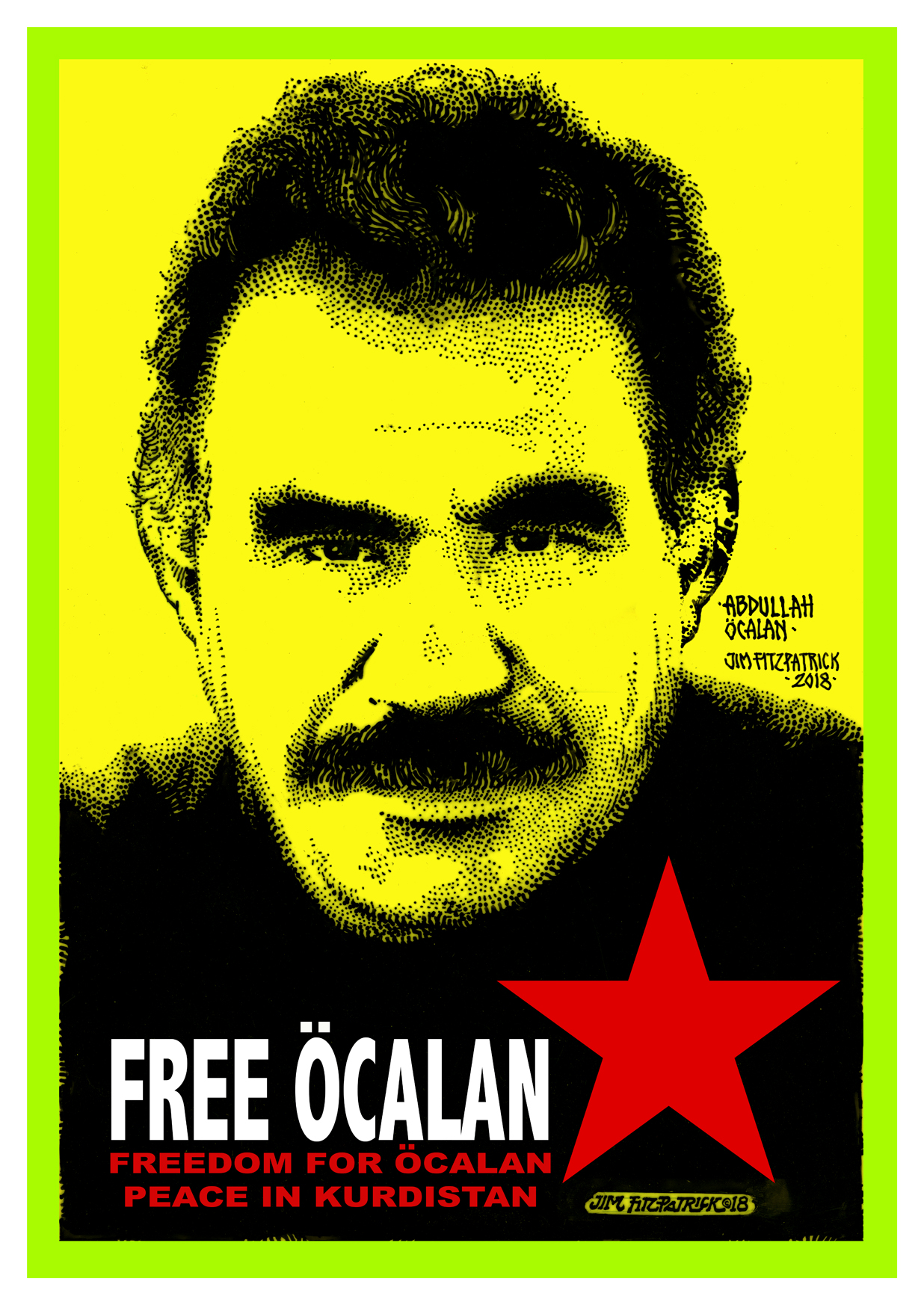
Free Öcalan
Fundación Infancia y Aprendizaje

Colección de libros Marxismo Crítico

Historical Materialism


CIPEC (Centro de Investigación en Pensamiento Crítico)

Centro para la Investigación como Crítica Práctica

Memoria Revista de Crítica Militante
Revista Laberinto





Marx desde cero




 marxismocritico.com