
Archivo
«Convergencias: Origen y declinación del capitalismo»: Jorge Beinstein
 Retorno al origen
En ciertos rituales funerarios de tiempos remotos los muertos eran colocados en posición fetal, por ejemplo se han encontrado restos de neardentales sepultados de esa manera con la cabeza apuntando hacia el Oeste y los pies hacia el Este, algunas hipótesis antropológicas sostienen que esa disposición del cadáver estaba relacionada con la creencia en el renacimiento del muerto. La civilización burguesa a medida que avanza su senilidad parece reiterar esos ritos, preparándose para el desenlace final apunta la cabeza hacia su origen occidental y va acomodando el cuerpo degradado buscando recuperar las formas prenatales intentando tal vez así conseguir una vitalidad irremediablemente perdida.
El fin y el origen aparentan converger, pero el anciano no consigue volver al pasado sino más bien reproducirlo de manera grotesca, decadente. Hacia el final de su recorrido histórico el capitalismo se vuelca prioritariamente hacia las finanzas, el comercio y el militarismo en su nivel más aventurero “copiando” sus comienzos cuando Occidente consiguió saquear recursos naturales, sobreexplotar poblaciones y realizar genocidios acumulando de ese modo riquezas desmesuradas con relación a su tamaño lo que le permitió expandir sus mercados internos, invertir en nuevas formas productivas, desarrollar instituciones, capacidad científica y técnica. En suma construir la “civilización” que llevó Voltaire a señalar: “la civilización no suprime la barbarie, la perfecciona”.
«Toda cosificación es engaño, pero no hay sociedad sin cosas y, por tanto, no hay sociedades sin engaño…»: Entrevista a Santiago Alba Rico, a propósito de “Tiempo, tecnología, capitalismo”, por Salvador López Arnal
 Escritor, traductor, activista cultural, periodista, autor teatral, colaborador en numerosos medios alternativos, arabista, guionista. Santiago Alba Rico es igualmente uno de los grandes filósofos europeos no eurocentristas que siente el compromiso con los y, sobre todo, con las personas más desfavorecidas que le es anexo como una de las características más esenciales del filosofar auténtico, del que, como diría Mario Bunge, no se ocupa de trivialidades insustantivas. Entre sus libros más esenciales La ciudad intangible y Capitalismo y nihilismo
***
Has publicado recientemente en Revista Ecologista un artículo, en mi opinión excelente, lleno de mil novecientas diecisiete ideas, titulado “Adiós a las cosas”. Me gustaría centrarme en él. Algunas veces, afirmas inicialmente, has descrito la “condición antropológica” del ser humano como una “mesopotamia de la evolución”. La expresión, la metáfora, es magnífica. ¿Nos la explicas un poco?
Es una fórmula resultona, sí, pero tampoco tan original en su contenido. Es una idea que, bajo otra formula, está ya recogida en algunos de mis libros (La ciudad intangible, Capitalismo y nihilismo y El naufragio del hombre): la tentativa, por así decirlo, de asociar la “condición humana”, como apertura “local” de posibilidades, a una “estación histórica” con un comienzo y quizás un fin determinados; a un “período” y a un “estado” fuera del cual no se podría hablar propiamente de “ser humano” sino sólo de subhumanidad o suprahumanidad, de prehumanidad o posthumanidad; el único “período” o “estado” en el que, para bien y para mal, se podría hablar de “relaciones antropológicas”. Esa “mesopotamia de la evolución” -entre la “inhumanidad” del hambre original y la del “consumo” capitalista, cierre categorial del hambre como modelo antisocial- yo la llamaba “neolítico”, menos con la intención de definir en términos paleontológicos este “período” que recordando lo que para el historiador inglés Eric Hobsbawm constituye el “gran acontecimiento del siglo XX”: el fin -precisamente- del neolítico. Ese fin es el fin de la “condición humana”, el umbral de la superación de la humanidad, el comienzo de la “obsolescencia del Hombre”, por decirlo con Günther Anders. Estamos viviendo en un mundo virtualmente post-humano como consecuencia de la combinación de capitalismo y tecnología: de la presión brutal sobre los territorios y de la desterritorialización de los cuerpos y de las relaciones entre ellos. Puede que todo vaya a ser mucho mejor -tengo mis dudas- pero no será ya “antropológico”.
«An Introduction to the History of Crisis Theories»: Anwar Shaikh
 Introduction
This paper is about the history of crisis theories. Broadly speaking, the term «crisis» as used here refers to a generalized set of failures in the economic and political relations of capitalist reproduction. In particular, the crises we seek to examine are those towards which the system is internally driven, by its own principles of operation. As we shall see, it is in the nature of capitalist production to be constantly exposed to a variety of internally and externally generated disturbances and dislocations. But only at certain times do these «shocks» set off general crises. When the system is healthy, it rapidly revives from all sorts of setbacks; when it is unhealthy, practically anything can trigger its collapse. What we seek to examine is different explanations of how and whyy the system periodically becomes unhealthy.
I Reproduction and Crisis
Consider how peculiar capitalist society is. It is a complex, interdependent social network, whose reproduction requires a precise pattern of complementarity among differen productive activities: and yet these activities are undertaken by hundreds of thousands of individual capitalists who are only concerned with their private greed for profit. Is is a class structure, in which the continued existence of the capitalist class requires the continued existence of the working class: and yet no blood lines, no tradition, no religious principle announces who is to rule and who is to be ruled. Is is a cooperative human comunity, and yet it ceaselessly pits each against the other: capitalist against worker, but also capitalist against capitalist and worker against worker.
«The profit rate in the presence of financial markets: a necessary correction»: Alan Freeman
In the past two decades the number, variety, and monetary value of marketable financial instruments, particularly securitized instruments, has grown by orders of magnitude. This is the most significant development in what many writers, for the most part Marxist, term ‘financialisation’1. It brings to light, however, an anomaly in the way they calculate the profit rate. This calculation takes no account of the capital tied up in these instruments.
This article shows that when this omission is corrected, there is a consistent long-run fall in the UK and US rate of profit which, contrary to the figures widely used by Marxists, have both fallen almost monotonically since 1968.
Why does this matter? First, the profit rate figures prominently in Marx’s own theory, as is clear from his published works. It is the explicit subject of the first 15 chapters of Capital Volume III (Marx, 1981: 117-378) and dominates the remaining analysis. Second, the results shed light on current debates about the cause of the present extended crisis. A significant group of writers (see Choonara, 2011) argue that this is recent in origin, unconnected with the serious difficulties that beset Western economies in the 1970s, and follows a recovery from that crisis, brought about by neoliberalism, in the 1980s. Thus Husson:
«After the generalized recessions of 1974-5 and 1980-82, a new phase opened in the functioning of capitalism, one which one could for convenience call neo-liberal. The beginning of the 1980s was a real turning point. A fundamental tendency towards increasing the rate of exploitation was unleashed, and that has led to a continuous rise in the rate of profit» (2008).
Leer más…
«The environmental crisis and capitalism»: Fred Magdoff and Lawrence Susskind
 The environmental damage being done to the earth has reached crisis proportions. Many causes have been proposed: too many people; industrial society; human ignorance or inability to control themselves; human nature (greed); and a «perpetual growth philosophy.» Discussion will be focused on how the inner logic and normal functioning of our economic system is contributing to this crisis.
Fred Magdoff is professor emeritus of plant and soil science at the University of Vermont. He is author of numerous articles and books on agriculture, world food problems, and the environment. He is coauthor with John Bellamy Foster of What Every Environmentalist Needs to Know About Capitalism (2011).
Lawrence Susskind, Department of Urban Studies and Planning; Director, MIT Science Impact Collaborative; Co-Director, Water Diplomacy Workshop
«La implosión del sistema europeo»: Samir Amin
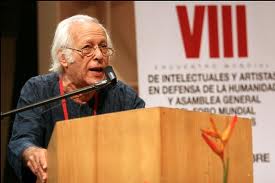 La opinión pública mayoritaria europea sostiene que Europa tiene todo lo que necesita para convertirse en una potencia económica y política comparable, y por lo tanto independiente de los Estados Unidos. La simple suma de sus poblaciones con sus respectivos PIB hace que parezca obvio. En cuanto a mí, creo que Europa sufre de tres desventajas principales que descartan esa comparación.
«Michael Heinrich, Marx’s law and crisis theory»: Michael Roberts
 Michael Heinrich is an exponent of what is known as the ‘New German Reading of Marx’, which interprets the theory of value that Marx presents in Capital as a socially specific theory of ‘impersonal social domination’. He is a collaborator on the MEGA edition of Marx and Engel’s complete works and has published several philological studies of Capital. He has also authored a work on Marx’s theory of value, The Science of Value, which is forthcoming in the Historical Materialism book series. And recently he has published An Introduction to all Three Volumes of Capital as his first full-length work to appear in English.
I am not going to do a critique of Heinrich’s views on the theory of value, as this has been done by Guglielmo Carchedi in his book, Behind the Crisis (see chapter 2). But I am moved to respond to a recent article of Heinrich’s in the American Monthly Review, entitled Crisis theory, the law of the tendency of the rate of profit to fall and Marx’s studies in the 1870s (monthlyreview.org).
In this article, Heinrich makes the following points: 1) Marx’s law is inconsistent because its categories are indeterminate; 2) it is empirically unproven and even unjustifiable on any measure of verification; 3) Engels badly edited Marx’s works to distort his view on the law in Capital Vol 3; 4) Marx himself in his later works of the 1870s began to have doubts about the law as the cause of crises and started to abandon it in favour of some theory that took into account credit, interest rates and the problem of realisation (similar to Keynesian theory); 5) Marx died before he could present these revisions of his crisis theory, so there is no coherent Marxist theory of crisis.
“Lliçons sobre el capítol sisè (inèdit) de Marx de Claudio Napoleoni»: Ivan Gordillo
 “El capital, llibre I, capítol VI (inèdit). Resultats del procés immediat de producció”1 més conegut amb el nom d’Inèdit és un text escrit per Marx als voltants de 1865 que finalment no va incloure en la versió definitiva del llibre I de El capital que va aparèixer per primera vegada el 1867. Aquest text es pot trobar individualment en edicions en format llibre que no superen les 150 pàgines. És, per tant, un text de reduïdes dimensions si ho comparem amb altres obres del pensador alemany.
Tot i el caràcter de treball previ no definitiu, l’Inèdit és d’especial interès perquè conté gran part del contingut teòric essencial del llibre I de El capital. A més, està escrit en un estil força menys farragós que d’altres obres de l’autor pel que creiem pot ser de gran utilitat als lectors novells en el pensament de Marx o aquells que volen iniciar-se en la lectura de El capital.
«De cómo la escasez de recursos y el cambio climático podrían producir una explosión global»: Michael T. Klare
 Prepárense. Puede que aún no se lo digan, pero, según los expertos de todo el mundo y la comunidad de la inteligencia estadounidense, la tierra está cambiando ya bajo sus pies. Lo sepan o no, Vds. están sobre un planeta diferente, un mundo con los recursos asediados a un nivel no experimentado nunca antes por la humanidad.
Dos escenarios de pesadilla –la escasez global de recursos vitales y el comienzo de un cambio climático extremo- están empezando ya a converger, y es muy probable que en las próximas décadas produzcan una oleada de agitación, rebelión, competitividad y conflicto. Puede que aún sea difícil discernir cómo será ese tsunami de desastres, pero los expertos advierten de “guerras del agua” sobre disputados sistemas fluviales, de disturbios alimentarios globales provocados por las crecientes subidas de los precios de los productos básicos, de migraciones masivas de refugiados climáticos (que acabarán desencadenando actos de violencia contra ellos) y de ruptura del orden social o de colapso de los Estados. Es probable que, al principio, ese caos estalle básicamente en África, Asia Central y otras zonas del Sur subdesarrollado, pero, con el tiempo, todas las regiones del planeta se verán afectadas.
Para apreciar el potencial de esta amenazante catástrofe, es necesario examinar cada una de las fuerzas que están combinándose para producir ese futuro cataclismo.
«Primitive Accumulation: From Adam Smith to Angela Merkel»: Michael Perelman
 The barbaric wave of austerity crashing across Europe and much of the rest of the world both resembles and differs from the classical period of primitive accumulation which deprived masses of people of their means of production. Although landgrabs continue in this modern version of primitive accumulation, the central thrust is the destruction of all public wealth in the interest of capital. Another difference is that classical political accumulation reflected the optimism associated with a new form of making wealth, while viciousness of modern primitive accumulation seems to be an attempt to recapture the vitality of early capitalism. However, despite the short-term benefits of such cannibalistic policies for capital, in the end the result will be detrimental to the capitalists, as well as the rest of society.
Michael Perelman is a Marxist economist and economic historian and a professor of economics at California State University, Chico. He has has written numerous books and academic articles on the topic of primitive accumulation, including The Invention of Capitalism: The Secret History of Primitive Accumulation (2000).
«Primitive Accumulation, Migrant Workers and Social Reproduction in the Age of Austerity»: David McNally
 The Age of Austerity ushered in by the global crisis of 2008-9 centrally involves cheapening the reproduction of labour-power by means of reducing both private wages and the social wage administered by the state. These policies have decided class, gender, racial and generational dimensions. To properly elucidate these dimensions, however, requires that we also grasp ongoing primitive accumulation as a crucial ‘moment’ in the austerity agenda. To accomplish this means addressing the role of the reproduction of the global reserve army of labour, and of precarious migrant workers, in the restructuring of labour-power on a world scale.
In order to develop the theory of primitive accumulation in these directions, this paper returns to tensions in Marx’s account of the social reproduction of labour-power. Here I argue that not only does Marx’s conceptualization require a gender analysis, but that it also needs to be developed with respect to the problematic of labour migration. I show where Marx points to ways in which we might do this. The analysis presented underlines the decisive importance of an anti-racist defence of migrant workers for any effective working class politics in the Age of Austerity.
David McNally is Professor of Political Science at York University and a leading member of the New Socialist Group (www.newsocialist.org). He has written extensively on the critique of political economy. His publications include Global Slump: The Economics and Politics of Crisis and Resistance and Monsters of the Market: Zombies, Vampires and Global Capitalism.
Leer más…
«Crisis capitalista, política económica y tendencias de reconfiguración del orden mundial»: Claudio Katz
 Crisis capitalista, política económica y tendencias de reconfiguración del orden mundial.
Segunda sesión temática Economía mundial, economías nacionales y crisis capitalista.
Conferencia Latinoamericana y Caribeña de Ciencias Sociales.
Miércoles 7 de noviembre de 2012 en el Aula magna de la Casa de la Primera Imprenta de América.
«Las causas de la crisis: las finanzas y la tasa de ganancia»: Alan Freeman
 En los últimos meses hemos visto un creciente debate entre los marxistas en torno a la tasa de ganancia de EE UU y su relación con la presente crisis. Resulta paradójico, ya que en su mayor parte los marxistas rechazan el propio relato de Marx sobre la relación entre la acumulación y la tasa de rentabilidad; de hecho, recientemente, Michael Heinrich ha argumentado que Marx no tenía ninguna teoría de la crisis y que no hay ninguna base para suponer que la acumulación capitalista conduzca a una caída de la tasa de ganancia. Sin embargo, existe un amplio acuerdo con Duménil y Lévy que después del descenso prolongado de posguerra, la tasa de beneficio en EEUU comenzó a aumentar en la década de 1980, recuperándose al final de los años 1990 y marcando el comienzo de una nueva fase de expansión en EEUU.
Andrew Kliman, en Una crisis de la producción capitalista/1, ha provocado una controversia considerable con la afirmación contraria, basada en un razonamiento coherente y con una amplia evidencia empírica, según la cual la tasa de ganancia en EEUU ha continuado su tendencia a la baja.
«The four laws of ecology and the four anti-ecological laws of capitalism»: John Bellamy Foster
 Climate & Capitalism is pleased to publish, with permission from John Bellamy Foster and Monthly Review Press, this excerpt from Chapter 6 of The Vulnerable Planet.
In the first part of the chapter, Foster discusses the “qualitative transformation in the level of human destructiveness” that characterized capitalist production after World War II. This transformation included massive increases in the use of synthetics that could not be readily reabsorbed by nature, accompanied by a radical expansion in the use of all forms of energy, particularly fossil fuels. These changes in the patterns of production, he writes, are “the chief reason for the rapid acceleration of the ecological crisis in the postwar period.”
In the rest of the chapter, published here, he discusses the factors that underlie capitalism’s ever-growing conflict with nature.
«From the Oil Crisis to the Great Recession: Five crises of the world economy»: J. A. Tapia Granados
 ABSTRACT — This article makes the case that the global economy has gone through five crises since the 1970s to the present. This implies not only that the world economy is a real entity, but also that the usual view that poses national economies as units of economic analysis is an approach with major limitations. The paper discusses the concept of “economic crisis” and provides data indicating that the world economy, not national economies, is the major unit to be analysed when trying to understand the economic reality of our time, and particularly the reality of crises. These crises are discrete, countable phenomena, distinctive states of an entity that can be properly called world economy, or world capitalism. Data on capital formation, on growth of the world output, of monetary aggregates, of unemployment rates and on industrial activity indicate five major “dips” of the global economy, i.e., world recessions, in (i) the mid 1970s, (ii) the early 1980s, (iii) the early 1990s, (iv) the early 2000s, and (v) the Great Recession that provisionally can be dated 2007-2009. To a large extent business cycle chronologies of national economies such as those produced by the NBER, the OECD, or other institutions are largely consistent with these five crises of the world economy which, obviously, had different manifestations in different nations and economic regions.
Reading Marx’s Capital with David Harvey

Free Öcalan



Fundación Infancia y Aprendizaje

Colección de libros Marxismo Crítico

Historical Materialism


CIPEC (Centro de Investigación en Pensamiento Crítico)

Centro para la Investigación como Crítica Práctica

Memoria Revista de Crítica Militante

Revista Laberinto






Marx desde cero





 marxismocritico.com