
«The necessary reconstitution of the historical dialectic»: István Mészáros
 AS WE know, the modern state was not formed as a result of some direct economic determination, as a mechanical super-structural outcrop, in conformity to a reductivist view of the sup-posedly one-sided material domination of society, as presented in the vulgar Marxist conception of these matters. Rather, it was dialectically constituted through its necessary reciprocal interaction with capital’s highly complex material ground. In this sense, the state was not only shaped by the economic foundations of society but it was also most actively shaping the multifaceted real-ity of capital’s reproductive manifestations throughout their his-torical transformations, both in the ascending and in the de-scending phase of development of the capital system.
In this complex dialectical process of reciprocal interchange the historical and the transhistorical determinations have been closely intertwined, even if in the course of the capital system’s descending phase of development we had to witness a growing violation of the historical dialectic, especially under the impact of the deepening structural crisis. For the defence of the estab-lished mode of societal reproduction at all cost, no matter how wasteful and destructive its impact by now even on nature, can only underline the historical anachronism and the corresponding untenability of a once all-powerful mode of productive societal reproduction, which tries to extend its power in a “globalized form” at a time when the absolute systemic limits of capital are being activated on a global scale.
Moreover, the fact that the historical phase of modern impe-rialism which used to prevail prior to and during the second world war – a form of imperialism in which a number of rival powers asserted themselves in the world, in contention with one another, as theorized by Lenin during the first world war – is now replaced by the global hegemonic imperialism of the United
States of America, attempting to impose itself everywhere as the global state of the capital system in general, does not solve any of the underlying contradictions at all. On the contrary, it can only highlight the gravity of the dangers inseparable from the struc-tural crisis of capital’s mode of controlling societal reproduction. For the imposition of global hegemonic imperialism of our time by the now dominant military power is no less untenable in the longer run than the traditional imperialist state rivalry which pro-duced two devastating world wars in the twentieth century. Far from successfully constituting the state of the capital system in general, as a vain attempt to remedy capital’s great historic fail-ure on that score, the global hegemonic imperialism of the U.S.A., with its growing military domination of the planet as an aggressive nation state, the present phase of imperialism is the potentially deadliest one.
In the course of the capital system’s historical unfolding the legal and political superstructure assumed an ever more pre-ponderant role. The present phase of global hegemonic imperial-ism is the most extreme manifestation of that, marking at the same time the end of a, for the time being practicable, but in the longer run absolutely untenable road, given the still prevailing relation of forces in which some countries with massive popula-tion and matching military potential, including China, are mar-ginalized. For nothing could be more preponderant in terms of its domination of all aspects of social life – from the elementary conditions of material reproduction and their grave impact on nature all the way to the most mediated forms of intellectual production – than the operation of a state system which directly and indirectly threatens the whole of humanity with the fate of self-destruction. Even a return to the formerly experienced vio-lent state confrontations is feasible in the not too distant future, which would certainly terminate human life on this planet, if the destructive antagonisms of the capital system are not resolved in a historically sustainable way within the time still at our dis-posal. Accordingly, only a qualitative transformation of the estab-lished legal and political superstructure in its entirety, together with the radical restructuring of its no longer viable material ground, can show a way out of this blind alley. This means an all-embracing transformation which is conceivable only in the spirit of the envisaged socialist hegemonic alternative to capi-tal’s mode of social metabolic control.
THE historically specific and necessarily transient, no matter how preponderant, legal and political superstructure of capital emerged in the course of systemic development in conjunction with some vital structural requirements of the unfolding overall societal complex.
In sharp contrast to the feudal type of material productive and political relationship which had to be replaced by the capital system, a direct political control of the countless particular pro-ductive units – the locally articulated microcosms of the newly developing material ground, with its abstract and “free” labour force1 was neither feasible nor conducive to the irresistible pro-cess of capital-expansion. It was controlled in a most contradictory way by the individual “personifications of capital”2 as mas-ters of their particular enterprises, who, however, could by no means control, as individual capitalists acting in the economic domain, the capital system as a whole.
Thus, in the course of historical development we witnessed the emergence of an inherently centrifugal material productive system in which the particular microcosms dynamically interacted with each other, and with society as a whole, by following their self-oriented and self-expansionary capital interests. This kind of productive practice was, of course, fictionalized in the form of the claimed “sovereignty” of capital’s individual personifications, and even idealized as late as the last third of the eighteenth century – by one of the greatest political economists of all times, Adam Smith – with the naïve stipulative suggestion according to which it was necessary to exclude the politicians from the repro-ductive logic of the system, since the system itself was sup-posed to function insuperably well under the beneficial guidance of the mythical “Invisible Hand”. However, no fictional postulate of “entrepreneurial sovereignty”, nor indeed the idealized pro-jection of the mysterious, yet by definition necessarily and for-ever successful “Invisible Hand”, could in actuality remedy the structural defect of the capital system’s productive microcosms: their self-oriented and self-asserting centrifugality, devoid of a systemically tenable overall/totalizing cohesion.
This is where we can clearly see the necessary reciprocal in-terrelationship between the unfolding and systemically consolidating material reproductive ground of capital and its historically specific state formation. For it was inconceivable that the new modality of reproduction, with its inherently centrifugal material productive microcosms, should be able to consolidate itself in actuality as a comprehensive system, without acquiring an appro-priate cohesive dimension. At the same time, it was no less inconceivable that the required totalizing/cohesive dimension – the answer to the objective imperative to remedy in some way, no matter how problematically, the structural defect of potentially most disruptive centrifugality – should be able to emerge from the direct materiality of the productive practices pursued by the individual personifications of capital in the particular economic microcosms.
Reading Marx’s Capital with David Harvey

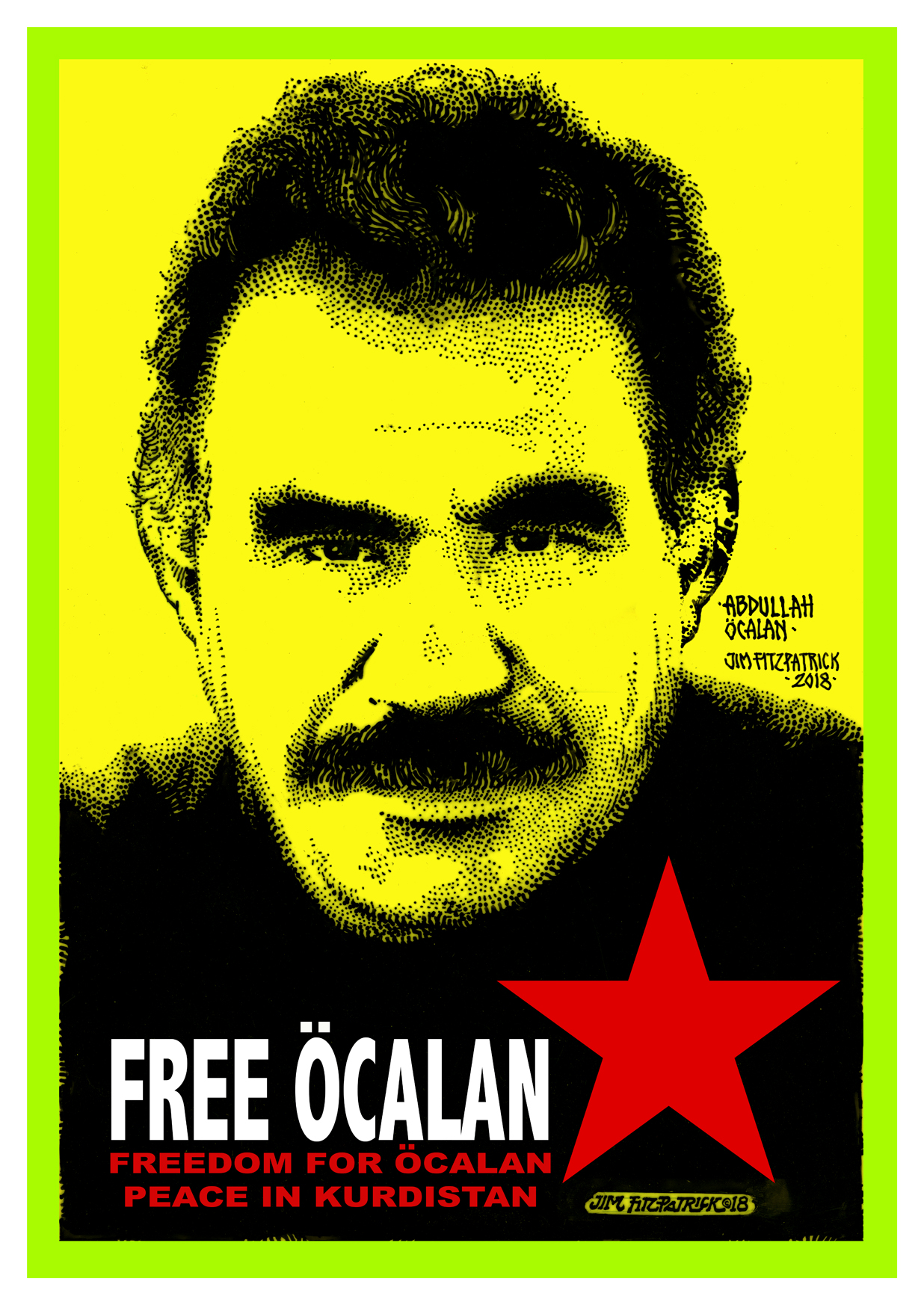
Free Öcalan

Fundación Infancia y Aprendizaje

Colección de libros Marxismo Crítico

Historical Materialism


CIPEC (Centro de Investigación en Pensamiento Crítico)

Centro para la Investigación como Crítica Práctica

Memoria Revista de Crítica Militante

Revista Laberinto






Marx desde cero




 marxismocritico.com